Showing posts with label nest. Show all posts

Friday, July 31, 2026

Greater Roadrunners

I lived in Arkansas for several years, and one bird from that region that I sometimes find myself missing is the roadrunner.  Luckily, where I am now, I can still watch some of its close relatives, the Yellow-billed Cuckoos.  The following is a brief species account of the Greater Roadrunner.

The Greater Roadrunner (Geococcyx californianus) is a large, ground-dwelling cuckoo (Order Cuculiformes) that occurs in North America, typically in deserts, shrubby habitats, and chaparral.  As a member of the Cuculiformes, the roadrunner has zygodactyl feet (i.e., two toes pointing forward, and two pointing backward), and, like many others of that group, it also has a proportionally long tail.  Its plumage is brown and streaked, and it has a crest and bluish skin around the eyes. 

Greater Roadrunners begin breeding in early spring.  Egg-laying occurs mainly during April and May, although some eggs have been found during mid-March.  Two broods may be produced per season.  Courtship includes the male singing a song composed of low, cooing notes, and drooping the wings and tail during a courtship dance.  The nest is usually placed about 3-15 feet from the ground in a low tree, thicket, or cactus clump, although nests are occasionally also built on the ground.  The nest, which is a foundation of sticks with leaves, grasses, feathers, roots, and other materials as lining, is about one foot in diameter and 6-8 inches high.  The clutch size is usually 3-6 eggs, which are ovate or elliptical, about 39.2 by 30.1 millimeters in size, and are white with a chalky, yellowish film.  Eggs are laid at long intervals, and both sexes begin incubating as soon as the first few eggs are deposited.  The incubation period lasts approximately 18 days, and the newly-hatched chicks are altricial with black skin and scattered white, hair-like plumes.  The young are cared for in the nest for about 2-3 ½ weeks, and adults may continue to provide care for young for over a month after fledging occurs. 

Roadrunners consume a variety of foods, including lizards, snakes, spiders, scorpions, insects, rodents, ground birds and their eggs and young, fruit, and seeds.  The diet is approximately 90 percent animal matter.  Roadrunners range from the southwestern United States south to central Mexico.  More specifically, the range is north to north-central California, southern Kansas, and Colorado; east to Kansas, central Oklahoma, Texas, Pueblo, and Tamaulipas; west to Jalisco and Baja California; and east to southwestern Missouri, Arkansas, and Louisiana.  They are nonmigratory, year-round residents in these areas. 

Greater Roadrunner

Sutton, G. M.  1940.  Roadrunner.  In A. C. Bent (Ed.), Life Histories of North American Cuckoos, Goatsuckers, Hummingbirds, and Their Allies: Orders Psittaciformes, Cuculiformes, Trogoniformes, Coraciiformes, Caprimulgiformes, and Micropodiiformes (pp. 36-50).  Washington: United States Government Printing Office.

Sunday, May 31, 2026

Nesting Northern Cardinals


Female Northern Cardinal in Arkansas, November 5, 2013.

Male -- also November 5, 2013, in Arkansas.

If you live in eastern or central North America and spend any time outside, chances are good that you’re familiar with the Northern Cardinal.  Cardinals are so common, in fact, that I confess I tend not to pay them much attention—especially if there are more unusual birds nearby.  But nearly a decade ago, a pair of these birds nested in the thorny elaeagnus shrub near my home, right outside the living room window.  Naturally, I had to pay attention to that!

The cardinals began nesting in the thorny elaeagnus shrub right around the time that the White-eyed Vireos that I wrote about previously were nearly fledged.  I first noticed the female cardinal carrying twigs in her bill to the nest site, which was a few feet higher in the shrub than the vireos’ nest had been.  This was typical behavior.  Female cardinals construct the nests and incubate the eggs, while males bring food to the females during incubation and assist in feeding the young after they hatch.  

As you can see, cardinals build their nests on top of limbs, unlike vireos, which suspend theirs from forks in the branches.  Whenever the female cardinal added new material to the nest, she bent it with her bill and pushed it into a cup shape with her feet.  The outside layers were constructed from twigs, bark, and leaves, while finer materials, such as grasses and pine needles, formed the lining.

June 19, 2016 -- Cardinal building the nest!

Checking early-stage nests too frequently can lead to the parent birds abandoning the site, so I was cautious about getting photos at that point.  By June 28, there were two eggs in the nest, but, since I had been avoiding the nest, I assumed that they had probably been there for two or three days.  Cardinals lay anywhere from one to five eggs, with two to three being more typical.


According to Birds of North America Online, incubation takes 11-13 days.  The eggs were definitely hatched on or before July 7, when I photographed the slightly downy nestlings for the first time.


By July 11, the young birds were much larger and more heavily feathered.  You can see how their bills are starting to turn dark, a characteristic of juvenile cardinals.  Their beak color doesn’t change to red or red-orange until late in the fall.

July 11, 2016

On July 14, the nestlings were nearly ready to fledge.  Although it’s difficult to determine exactly how heavily feathered the average dinosaur might have been, this is what I tend to imagine juvenile dinos looking like.  (On the anatomical level, though, modern birds and the dinosaurs from which they evolved differ very little—so I’d guess that quite a lot of dinosaurs may have had full plumage.)

July 14, 2016

I think that these cardinals fledged on July 15 or 16.  Fledging usually occurs after about nine or ten days, so this estimate seems reasonable.  You can just barely make out one of the nestlings in the center of the photo below.  That photo was from July 15, and the one of the empty nest was taken the next day.  This might have been the second brood of the year from these nonmigratory birds, but I can’t say for certain.

July 15, 2016 -- at least one young cardinal still on the nest

July 16, 2016

Thursday, April 30, 2026

Spring Migrants: Solitary and Spotted Sandpipers

The mention of sandpipers often brings stress to inexperienced birders.  After all, sandpipers are those dull, brownish little creatures that skitter over mud and all look alike.  In other words, it can be hard to appreciate them.  But actually, on closer study, sandpipers are unusual and highly fascinating birds.  And, no, they don’t all look alike!  I will focus on two very distinctive, common sandpipers that can be seen in migration now: the Solitary Sandpiper and the Spotted Sandpiper.

Solitary and Spotted Sandpipers

Although they are not closely related, the Solitary Sandpiper (Tringa solitaria) and the Spotted Sandpiper (Actitis macularius) are often seen together feeding in the same ponds and lakes, frequently those with woods or at least low-lying vegetation nearby.  Both can be found migrating in Mississippi from about March to June in the spring, and late July to late October in the fall.  The Spotted Sandpiper is an occasional winter resident in the state, as well, but is more common along the coast than inland.

Both sandpipers forage and migrate singly or in small groups, and both exhibit tail-bobbing behavior.  With the Spotted, the entire body is teetered; the bird is in constant, jittery motion: scampering along the water’s edge, picking up small insects, mollusks, crustaceans, and even tiny fish.  The Solitary Sandpiper has slower, more deliberate movements, and when it pauses, it often bobs its head and tail.  It has longer legs and a longer bill than the Spotted, which enables it to feed in slightly deeper water, where I assume the menu would include bigger fish and frogs!  As an additional feeding adaptation, it often shakes its foot above the water to draw small fish and insects to the surface.

If you come unexpectedly upon either of these sandpipers, they will probably fly up immediately, uttering high-pitched peet-WEET calls (the Solitary’s call is the higher pitched of the two).  Fortunately, their flight styles are very different and distinctive.  The Solitary Sandpiper has graceful, swallow-like wingbeats and displays long, pointed wings and white edges on its tail.  Spotted Sandpipers fly close to the water and give fluttery, shallow beats of their shorter, more-rounded wings, each of which shows a thin, white stripe.

Once the sandpipers land on the bank and begin feeding again, their colors and patterning are apparent.  The Solitary Sandpiper is slightly larger than the Spotted, with a longer neck and body, and it has a wide, white eye-ring that gives it an alert look.  Its head, neck, and breast are finely streaked with brown, its belly is white, and its back is dark brown and shiny, with a dusting of tiny white spots.  The thin, dark bill and dark, greenish-gray legs complete the picture.  The Spotted Sandpiper is relatively small and stocky, with orange legs and bill, brown upperparts, a white eyebrow and slight eye-ring, and in the breeding season a boldly spotted breast and belly.  At least before the birds molt in the fall and replace the spotted front with plain white, you can sometimes tell the sexes apart.  Females have larger spots that extend farther onto the belly than males.

But why would the female bird be more distinctively marked?  The answer lies in the Spotted Sandpiper’s breeding biology.  Along with phalaropes, it is unusual in that the females are polyandrous, mating with more than one male—sometimes up to five!  Each time after mating, the female lays a clutch of up to four brownish eggs, which the male is solely responsible for incubating.  However, the female does help with constructing the nest—a shallow scrape in the ground, lined with grass.  After the eggs hatch, the male alone raises the chicks, which are born precocial like all sandpipers.

While the Solitary Sandpiper is monogamous and doesn’t exhibit such unusual breeding behavior as the Spotted, it is unique among North American shorebirds in that it nests in trees.  A female Solitary Sandpiper will add a little extra nesting material to the abandoned nest of a songbird, such as a Rusty Blackbird, American Robin, or Cedar Waxwing, incubate her four well-camouflaged, brownish eggs, and care for the young with her mate.  Tree-nesting is so unusual among shorebirds (the Green Sandpiper of Eurasia is the only other species known to do it regularly) that, for decades, no one was sure where the Solitary Sandpiper nested until 1903, when the secret was finally discovered.

Spotted Sandpipers are one of the most widespread shorebirds, commonly found over much of North America, although they aren’t known to breed in Mississippi and some other southern states.  Solitary Sandpipers are more restricted in range, occurring in the breeding season mainly in Canada and Alaska.

The numbers of both of these sandpipers appear to be fairly stable, and that’s good news.  With care and protection, generations years into the future will be able to observe the fascinating behaviors of these and other birds that have been living here for eons.  A world without the little brown sandpipers that enliven our fields, woods, and wetlands would be bleak.

Tuesday, March 31, 2026

Nesting Strategies

April is about to begin, which means that, here in the southeastern U.S., most of the year-round resident species—including phoebes, cardinals, Carolina Wrens, and bluebirds—have probably started nesting.  Several of these common, resident birds spend a lot of time around human habitation, so if you live in this region of the country, you may have noticed lots of interesting behaviors over the last month or so.  

In the spring and summer, Carolina Wrens will often build their small, domed nests in garages, outdoor furniture, or potted plants.  Here's a photo of a nest from several years ago.  As you can see, the wren parents used grasses, oak blossoms, mosses, leaves, and string in the outer layer.

Carolina Wren eggs
Finer grasses and various bits of fuzz—feathers and possibly fur—lined the nest, and, as the photo shows, the female wren laid five eggs.  This is normal for Carolina Wrens, which lay anywhere from three to seven.  The female wren incubated the eggs for several days.
Incubating
Wren nests are a familiar sight for me, and, apart from peeking into the nests every now and then during the roughly month-long process from incubation to fledging, I never really do anything that could disturb them.  For one thing, it’s generally illegal to disturb or damage the eggs and young of wild birds, and for another, I figure that interfering with nature is usually unwarranted.  The main exception I will make is for species that are endangered, or just generally imperiled.  Carolina Wrens, though?  Thankfully, they seem to be doing just fine.
The empty nest
The species is doing just fine, that is.  Unfortunately, these particular individuals had their nest raided by some sort of predator before the eggs could hatch.  Maybe a snake?  Several nonvenomous species, including gray ratsnakes, black racers, and speckled kingsnakes, are common in the Southeast.  I do not endorse killing snakes, by the way; they have a right to be here, and the benefits that they provide (e.g., rodent control) far outweigh any damage that they occasionally do to the birds that people love to watch.  Below is a picture of a large gray ratsnake that had taken up residence in the garage a couple of years before.  A raccoon is another possibility; although you may not often see them, they are extremely common in wooded areas, and their opportunistic feeding habits make them remarkably persistent.
Gray ratsnake
It was bad luck for the Carolina Wrens, but there's usually a chance for a second brood, at least.  

On a lighter note, even though the wrens failed, the Eastern Phoebes that year successfully raised at least three young over the garage entrance.  Phoebes typically don’t build low to the ground, so unless you bring out a ladder, you’re probably going to have a hard time looking into their nests.  Until they hatch and the young birds are large enough to stick their heads over the edge, I usually have no idea how many eggs there are.  The brood sizes of phoebes can vary fairly widely—from two to six.  Like Carolina Wrens, phoebes easily acclimate to human activity; as long as you leave them alone, they will nest year after year in the same spot on a ledge, over a porch, or under an eave or a bridge.  
The phoebes' nest
The phoebe nestlings in the garage nest grew rapidly, and eventually the concrete below became coated with bird droppings—yuck.  I expected the birds to fledge a day or two before they finally did; they had been looking very large and mature, but they weren’t finished developing yet.  On the day that they did wind up leaving, I was standing at one side of the garage entrance and peering at them through my binoculars.  My presence apparently agitated them, because they all blasted out of the nest at once and flew strongly to the row of hardwood trees lining the driveway.  Clearly, they were ready!  For many other bird species, however, the season was just getting started.

Phoebe nestlings

Wednesday, December 31, 2025

The Red-shouldered Hawk


It wouldn’t seem quite like winter without the hawks and falcons hunting along fencerows, darting through the woods, or soaring on the breezes. I have been seeing a number of raptor species over the last few months, including the swift and agile Cooper’s Hawks, the slower but more powerful Red-tailed Hawks, and the wary and fidgety American Kestrels.  Another common species, large and vocal, but sometimes overlooked, is the Red-shouldered Hawk.

Unlike Red-tailed Hawks, Red-shouldered Hawks tend to prefer low-lying, heavily wooded environments. They are commonly found year-round in many hardwood and mixed forests throughout southeastern North America, and, in the fall and winter, this southeastern population is boosted by migrants from the northeastern United States and southeastern Canada. The difference in habitat between Red-shouldered and Red-tailed Hawks means that their dietary preferences are a bit different, as well; like Red-tails, Red-shouldereds eat lots of small mammals, but, because they inhabit denser, swampier woods, they’re also likely to catch frogs, snakes, and lizards. However, even though they’re primarily forest hawks rather than field hawks, they will often hunt from powerlines and prominent snags at the borders of woodlands and fields. Presumably, this makes it easier for them to find and catch their prey, given that they lack the maneuverability of species such as the Cooper’s and Sharp-shinned Hawks.

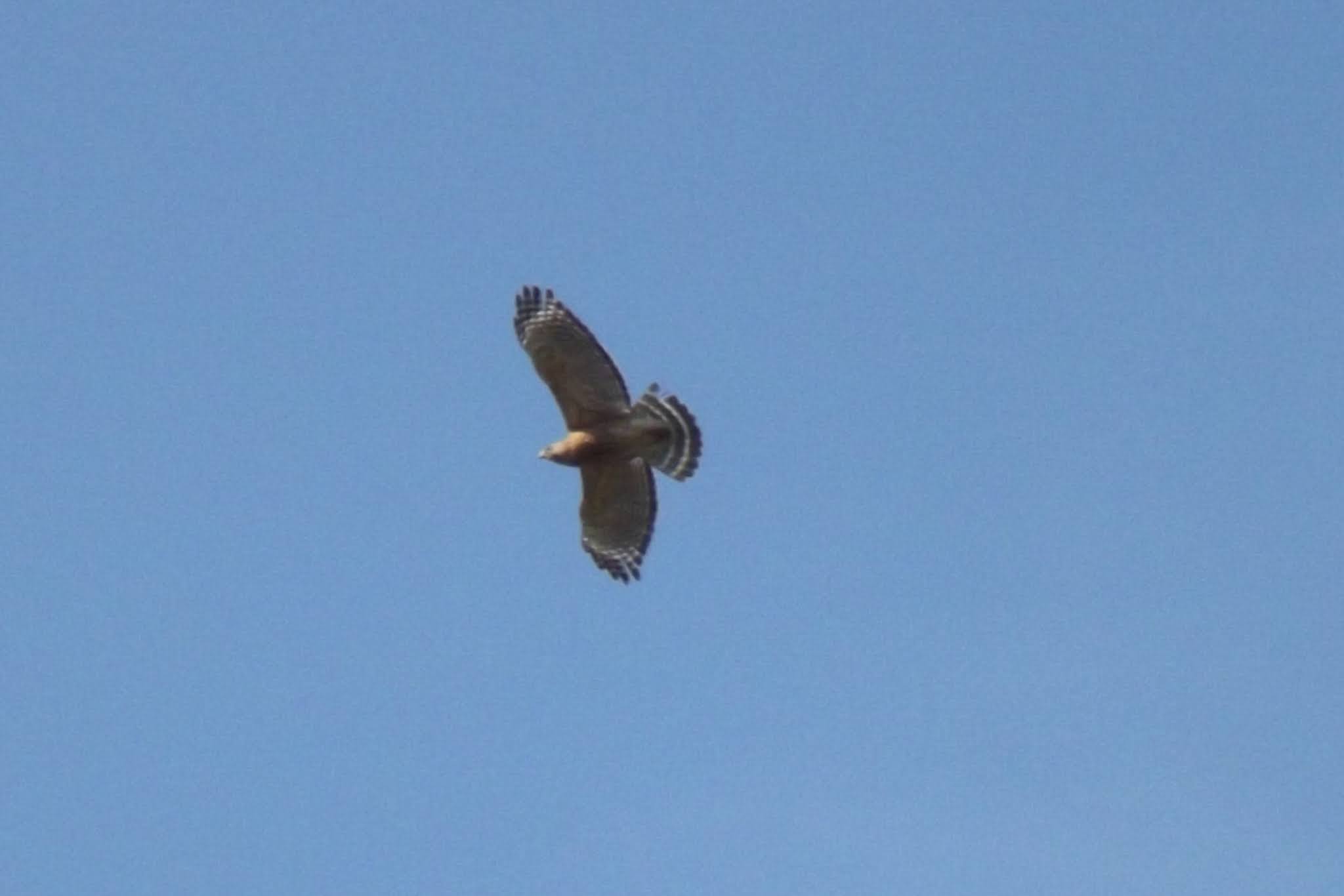
Appearance-wise, Red-shouldered Hawks are a little smaller and slimmer than Red-tailed Hawks, and, of course, they lack the brick-red tails that adult Red-tails have. They DO have reddish-brown “shoulders,” but this usually isn’t the most obvious field mark. The barred, reddish-brown breasts, black-and-white banded tails, and black-and-white wings on the adult hawks are far more noticeable features in the field. As you can see in the first of the two photos below, there are also vertical breast streaks on top of the chestnut-colored horizontal barring. Juvenile Red-shouldered Hawks look fairly similar to the adults, but have drabber, browner feathers and lack reddish barring on their breasts. In flight, both adults and juveniles show “wing windows,” which are essentially just pale crescents near the wingtips. This is a great field mark to look for if a hawk is soaring overhead. 

The rusty breast feathers on this adult hawk are a useful field mark.

Juveniles have browner plumage and streaks on their breasts.

Crescent-shaped wing markings are visible on this soaring adult hawk.

At this time of year, the immature hawks have been independent from their parents for several months, so they’re essentially competing with adult hawks for food and territory. If they survive the winter and later become breeding adults, then they will likely build their nests in large trees in the woods and lay two to five eggs per brood, with only one brood per season. Apparently, little is known about Red-shouldered Hawk nesting habits, so if you happen to spot a breeding pair next year, there is a chance that your observations could be of significant scientific value! In the meantime, enjoy watching Red-shouldered Hawks and other raptors this winter. 

Source:

Dykstra, C. R., J. L. Hays, and S. T. Crocoll (2020). Red-shouldered Hawk (Buteo lineatus), version 1.0. In Birds of the World (A. F. Poole, Editor). Cornell Lab of Ornithology, Ithaca, NY, USA. https://doi.org/10.2173/bow.reshaw.01


Tuesday, September 30, 2025

Species Account: The Northern Flicker

A shrill ki-ki-ki-ki-ki-ki breaks the silence of the forest, and a pair of fairly large brown birds with flashes of yellow in their wings and tails alight upon a decaying stump and begin picking off little flakes of bark.

With its flashy colors and raucous calls, the Northern Flicker is a difficult bird to miss.  It is a permanent resident of the Southeast and can be found in a variety of habitats where deadwood is present.  Flickers often forage on the ground in search of ants and beetle larvae.  In my own yard I can sometimes see as many as six at a time, poking their bills into the dry, dead grass in search of these insects.  Flickers also feed on small fruits and will come to feeders for suet or peanuts.

At twelve and a half inches from the tip of the bill to the tip of the tail, the Northern Flicker is the second-largest woodpecker in Mississippi.  It has black bars on its brown upper parts and spots on the under parts.  A patch of gray extends from the crown to the nape, and the male bird has a black stripe on its face.  Both sexes have bright red bars on the backs of their heads.  The white rump patch and yellow underwings are conspicuous when the birds are in flight.

Northern Flickers have a variety of calls for different situations.  A short peeough is used as a contact call between related flickers.  The ki-ki-ki-ki-ki is a territory advertisement, and the flicka-flicka-flicka-flicka for which the bird was named is used during courtship and aggressive encounters.  These two longer calls can be confused with the calls of the crow-sized Pileated Woodpecker, but, unlike the calls of this huge bird, they do not change in pitch or loudness.  Flickers drum often, sometimes choosing to do so on tin roofs at the crack of dawn, creating a great disturbance to anyone inside the house.

Nesting occurs in spring when a pair of flickers excavate a hole in a tree, a fence post, a utility pole or a nest box.  Flicker boxes should be 16 inches tall with a 7x7-inch floor and a hole two and a half inches in diameter.  The box should be at least four feet above the ground and should preferably be filled with sawdust so that the birds can partially satisfy their desire to excavate a cavity.  Even with all these rules, flickers apparently aren’t picky.  They will use almost any box large enough, including Wood Duck boxes.  The 3-10 white eggs are incubated by the female during the day and the male at night.  They hatch in about 12 days, and the hatchlings are ready to leave the nest in four weeks.

If your yard has the right habitat, put up a flicker box and study their behavior as they fledge their chicks.  If you already have a nesting box, continue to observe these noisy but beautiful birds throughout the year.


Sources:

 “Conservation Trails.”  WildBird.   March, 1994.

The Cornell Lab of Ornithology’s Guide to Birds of North America, Version 3.

Sunday, August 31, 2025

The Field Sparrow

The Field Sparrow (Spizella pusilla) is a small songbird in the family Emberizidae (Order Passeriformes) that occurs throughout most of eastern North America.  It is one of the relatively few sparrows that commonly breed in the Southeast. 

Field Sparrow in summer
Distinguishing characteristics of the Field Sparrow include a short, pink bill; white eye-rings; white outer tail feathers; and a plain, unmarked breast.  The species is found in a variety of old fields, woodland edges, fencerows, and agricultural areas.  It begins courtship and mating in early spring, with males chasing females and defending territory from other males.  Males maintain and defend their territories through physical altercations between males as well as by their song, which is a warbling trill.  In addition to this song, the Field Sparrow has several alarm and flight calls that are used in a variety of contexts. 
Field Sparrow in winter
Nest construction begins in late April and extends through mid-May.  The nest, which is placed at a height of 9-300 centimeters in vegetation, is built solely by the female, and is composed of grasses, roots, hair, and other fine materials woven into a cup shape.  The eggs have a cream or white ground color, are marked with spots in various shades of brown, and have a smooth surface.  There are usually two to five eggs laid in a brood, and the female incubates for approximately twelve days.  The mostly naked, altricial nestlings are fed in the nest by both male and female parents for a period of about seven to eight days. 

The most frequent foods offered to the nestlings include many insects in both the adult and nymph stages, and various species of spiders.  After the young birds fledge, the parents will care for them until they reach independence at about one month of age.  The adult diet consists mainly of seeds, but some insects are taken, too.  

The Field Sparrow is a widespread species, ranging from southeast and northwest Montana, central Minnesota, southern Ontario, southern Maine, and southern New Brunswick; south to northeast Colorado, western Oklahoma and Kansas, central Texas and northern Mexico, and through the Gulf Coast to central Florida.  Some populations of the Field Sparrow are migratory, although most are not.  In the northernmost regions of its range, it is present only during the breeding season, and in the southernmost regions (such as the Gulf Coast and much of Florida), it is present only as a winter resident.  Be on the lookout for Field Sparrows in grassland and forest-edge habitats as the summer wanes and the fall season approaches!


Source:

Best, L. B.  1977.  Nesting biology of the Field Sparrow.  Auk 94(2):308-319.

Thursday, July 31, 2025

The Red-cockaded Woodpecker

If you live in or near pine forest regions of the southeastern United States, you have a decent chance of encountering the Red-cockaded Woodpecker, a specialist of those habitats.  You will likely hear the raspy calls before actually seeing the woodpeckers, which tend to be relatively inconspicuous against the trunks of the pines.  When one of them comes into view, though, it can be distinguished from the far more common Downy and Hairy Woodpeckers by its white cheek patches and completely barred back.  (Downy and Hairy Woodpeckers, in contrast, have striped faces and white backs.)  Males of the species have red feathers—the “cockades”—on the sides of the crown, but, because these are tiny and seldom displayed, they are not a particularly important field mark.

Note the barred back and the white cheeks

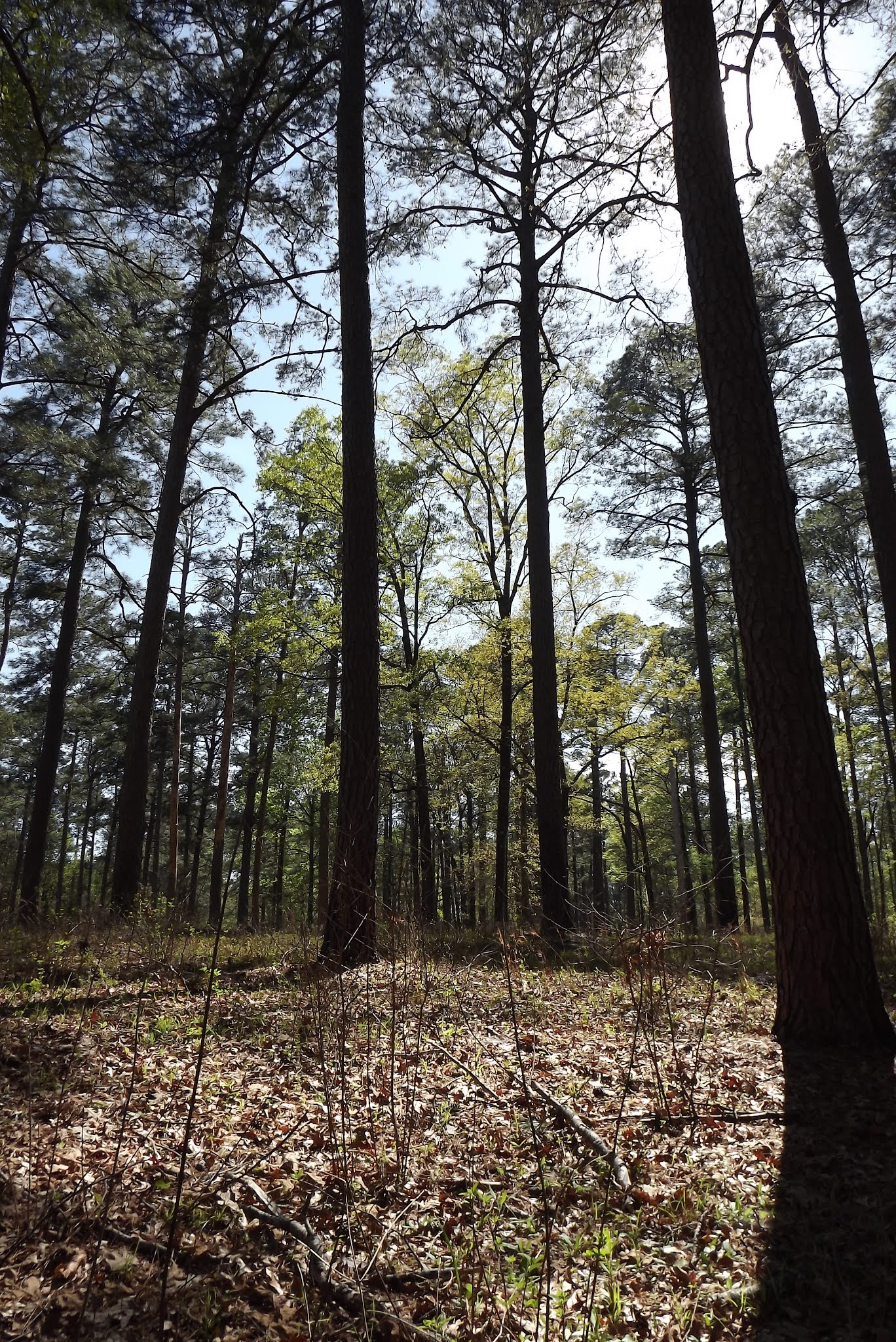
These woodpeckers are restricted to open pine forests with sparse understories of palmettos, grasses, shrubs, and other plants.  The open nature of the habitat is a consequence of natural fires, which restrict understory growth and possibly leave younger trees more susceptible to Phellinus pini, or red heart, a fungal disease that damages the heartwood of infected pines.  The softened, diseased wood can then be more easily excavated by Red-cockaded Woodpeckers, which will dig cavities 5-50 feet high in living trees infected with red heart.  Many of these infected trees are well over 40 years in age.  The birds peck into the sapwood above and below the cavities that they create, which results in a flow of sap that deters predators (such as rat snakes) and other animals from accessing the roost or nest holes.

Open pine habitat in early spring

Like most woodpeckers, Red-cockaded woodpeckers make various vocalizations at the nest and during courtship and other encounters.  Drumming on trees—usually pines—is another common means of communication, as are wing-fluttering, open-winged displays, and crest-raising.  The spread-winged display is used to reinforce the pair bond between a male and female.  Eggs are laid from late April to early June in a pre-existing cavity, rather than one that is excavated specifically for a nest.  The eggs are white in color, and become stained with pine resin over the course of the incubation period.  The female of the pair lays one egg per day, with one to six eggs comprising a clutch.  Incubation, which lasts about ten days, is performed by both parents, with the male incubating overnight.  Both parents feed and tend the altricial, pink-skinned, featherless nestlings.  Although the young birds fledge after about 26-29 days, they are at least partially dependent on their parents for up to six months afterward.  The Red-cockaded Woodpecker’s propensity for living in loose colonies or family groups benefits it during the nesting period, as unmated “helper” birds may aid breeding pairs in feeding nestlings and fledglings.  Usually, a pair has only one brood per year.

A foraging Red-cockaded Woodpecker

Interestingly, male and female Red-cockaded Woodpeckers are somewhat segregated according to the types of feeding sites that they use, with males foraging on branches and high on the trunks of pines, and females preferring to forage at lower elevations and only on the trunks.  Both sexes eat mainly insects and other arthropods, including cerambycid beetles, larvae and grubs of various species, ants, and millipedes.  On occasion, they will also consume small fruits and seeds. 

Although the Red-cockaded Woodpecker is a fairly widespread species, it is patchily distributed due to its highly specialized niche.  Habitat loss remains a serious threat to these woodpeckers, so conservation efforts generally focus on preserving tracts of large pines and subjecting them to controlled burning to clear the understory layers.  These measures seem to be working.  Just last year, the U.S. Fish and Wildlife Service downlisted the species from endangered to threatened.  Any birder or naturalist who is fortunate enough to live near one of the managed populations would do well to keep a sharp eye—and ear—out for these fascinating little woodpeckers during this summer and fall.


Sources:

Ligon, J. D.  1970.  Behavior and breeding biology of the Red-cockaded Woodpecker.  Auk        87(2):255-278.

https://www.fws.gov/press-release/2024-10/downlisting-red-cockaded-woodpecker-endangered-threatened

Monday, June 30, 2025

Observing Gallinules

My first sighting of a gallinule was over twenty years ago at Noxubee National Wildlife Refuge.  It was a Purple Gallinule, and utterly unmistakable: violet head, neck, and breast blending to green on the back and wings; long, yellow legs; red-and-yellow bill; ruffled white undertail feathers; and a chicken-like gait and stance.  I later saw Common Gallinules (then called Common Moorhens—they were split from the Old World species in 2011), as well.  I had heard them calling at a heronry in south-central Mississippi before that, but had not seen them.  As it turns out, even though gallinules may be less secretive than their cousins, the rails, they don’t always make themselves obvious.

Perfect gallinule habitat -- and a gallinule in the upper right corner.

However, this time of year—late summer—is one of the best times to look for them.  Both Common and Purple Gallinules can be found on many ponds and lakes in the southeastern United States.  They need lots of aquatic vegetation on which to build their nests and search for food.  In the summer months, they are surprisingly active and vocal, and often have chicks in tow.  

This Common Gallinule swims with its three young.

This Purple Gallinule stays with its chick.

Gallinule clutch sizes are fairly large; eight is a typical number of eggs, although, obviously, not all of the chicks will survive to adulthood.  In the video below, you can see three Common Gallinule young swimming with the adult.

Gallinules consume a variety of foods, including aquatic vegetation and invertebrates.  Their long toes enable them to walk on floating vegetation (generally lily and lotus pads) while foraging.  They sometimes pluck insects and snails from the undersides of leaves, as you can see in the following video of a Purple Gallinule chick:

Because their nesting period is generally in the spring, their young are pretty far along in development by this point.  It also helps that they are born semi-precocial, rather than altricial.  This means that, unlike songbird chicks, they are feathered and have their eyes open.  Unlike precocial Killdeer chicks, though, they still stay in the nest for a day or so and must be fed by their parents for several days.  Once out of the nest, they can climb through vegetation using the tiny claws on their wings.  This is a feature of birds in Rallidae, the rail family.

This Purple Gallinule chick is stretching its wings.

It takes several weeks for gallinule chicks to learn to fly, and it could be argued that they are never truly comfortable with that skill!  On lakes and ponds, gallinules generally fly for only short distances, but some North American populations do migrate from breeding territories to wintering grounds in southern North America or Central America.  The vast majority of Common and Purple Galinules actually occur in South America, where they are permanent residents.

An immature Purple Gallinule -- old enough to be away from its parents, but not old enough for adult plumage.  Note the white undertail coverts, though.  Adult birds have these, too.

Some of my favorite places to see gallinules are Noxubee NWR and Ross Barnett Reservoir.  Of course, there are many other areas to look, and, if you go exploring, you just might discover a new hotspot. 


Sources:

Bannor, B. K. and E. Kiviat (2020). Common Gallinule (Gallinula galeata), version 1.0. In Birds of the World (A. F. Poole and F. B. Gill, Editors). Cornell Lab of Ornithology, Ithaca, NY, USA. https://doi.org/10.2173/bow.comgal1.01.

West, R. L. and G. K. Hess (2020). Purple Gallinule (Porphyrio martinica), version 1.0. In Birds of the World (A. F. Poole and F. B. Gill, Editors). Cornell Lab of Ornithology, Ithaca, NY, USA. https://doi.org/10.2173/bow.purgal2.01.