Thursday, May 30, 2019

Tricky Birds, Part I

I would guess that most birders start out separating birds in the field primarily by plumage colors and patterns.  I know that it was like that for me; the first field guide that I used contained photos that showed birds engaged in a variety of behaviors in their natural habitats, and even went so far as to categorize so-called “perching birds” by color.  Any given page spread would show six related (or, in the case of the “perching birds” section, not closely related) species, often in completely different poses and with no real sense of scale.

I want to emphasize that photographic guides aren’t necessarily bad—the problem I experienced was only that I came to subconsciously expect what I saw in the field to match the pictures in the book, and when that didn’t happen, I was sometimes a tad frustrated.  I simply lacked the experience at that stage to quickly and accurately discern the differences in shape, size, and usual posture between various species of birds.  That skill had to come with time.

Not to discount plumage, of course, but shape, size, posture, and behavior are usually far more diagnostic than intricate feather details, at least for some species.  Comparing several related or somewhat similar birds at once also helps immensely, although it’s not always easy to find an opportunity to do so.  That’s why I was pleased to be able to compare multiple species of gulls, terns, and shorebirds—of various ages—this year at Dauphin Island, Alabama.  This occurred on the 14th and 15th of March, which meant that some of the gulls and terns (and other species) were in alternate (or breeding) plumage, while others were still in basic (or winter) plumage, or in the middle of molting.  The first part of my photo essay will focus on gulls and terns, although shorebirds do show up in some of the pictures!

Let’s start by analyzing this small assortment of birds:
All of these are pretty easy to identify.  Breeding adult Laughing Gulls, like the one on the left, have black hoods, dark-red bills, slate-gray backs and wings, and mostly black wingtips.  The bird in back, an adult Ring-billed Gull, has the conspicuous black ring on a yellow bill, yellow legs, a somewhat lighter gray back, and a little more white on the primary feathers.  You can probably tell that the Ring-billed Gull is larger than the Laughing Gull, as well.  The two birds in front, shorebirds, are also drastically different from each other: the large, lanky one is a Willet, and the tiny one is a Sanderling.

Lone birds can be slightly trickier, especially if they’re not in full adult plumage.  For instance, look at this younger Ring-billed Gull:
The bill lacks an obvious dark ring, being pink with a black tip.  The legs are a dull pink, as well, and the plumage looks scruffier and more mottled on this “teenager” bird than on the adult in the first photo.  The body shape is basically the same, though.

Now, compare that bird to the Herring Gull in this photo:
Although both the Herring Gull and the Ring-billed Gull have black-tipped pink bills, pink legs, mostly grayish backs, and whitish heads, they’re subtly different in shape.  The Herring Gull has a bulkier build and a thicker bill.  Also notice that the Ring-billed Gull’s primary feathers extend pretty far past the tail.  The Herring Gull’s primaries look much shorter.  And, of course, the Herring Gull has a lot more brown feathers in its plumage.  (An adult bird would show more white, but this one is a subadult.)

Of course, if the Herring Gull had been standing next to the Ring-billed Gull, another difference would have been obvious: Herring Gulls are giants in comparison to Ring-bills.  In the photo below, the Herring Gull is on the left, dwarfing the Laughing Gull (without a black hood) and the Royal Tern (the bird with the orange bill).
Herring Gull, Royal Tern, and Laughing Gull
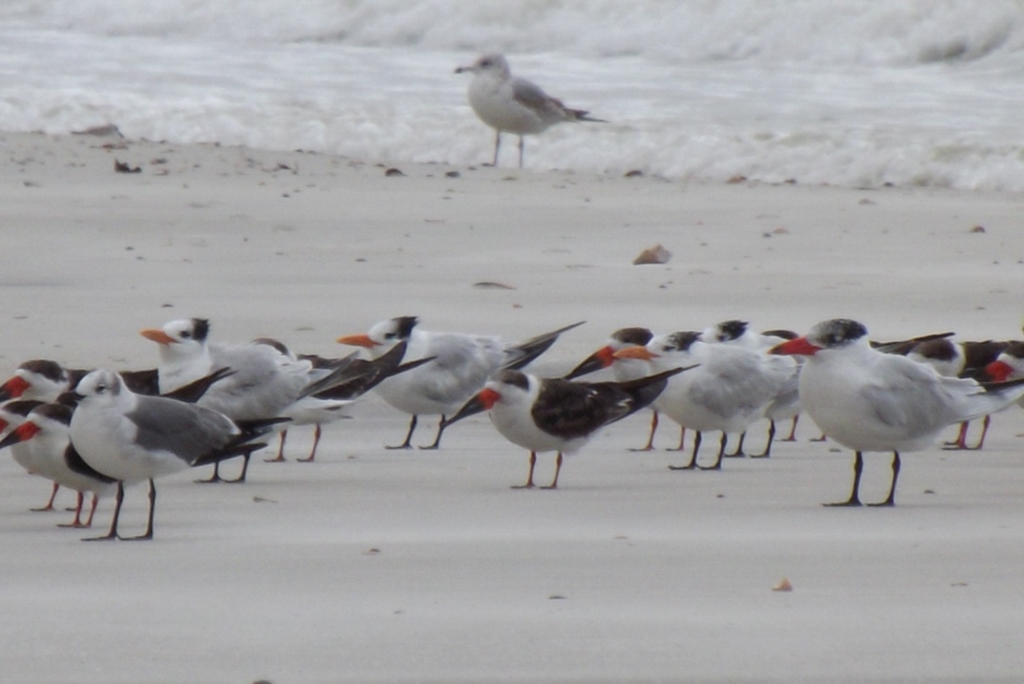
Speaking of Royal Terns, there were dozens of them on the beach, along with over a hundred Black Skimmers.  Skimmers are mostly crepuscular (i.e., active at dawn and dusk), so these birds were just roosting together in the late morning on the shore.  Their distinctive looks didn’t present any identification challenges, but they did provide a nice basis for comparison with other birds.

In the photo below, you can see how some of the skimmers have their heads resting on their backs, while a few of the birds are alert, with their cartoonishly large, red-and-black beaks visible.  Skimmers forage by flying low over the water, their long mandibles slicing through the surface.  If they touch fish, they snap them up quickly.  Terns, like the Royal Terns in the photo, are more specialized than gulls in their feeding habits, and usually dive for aquatic invertebrates and fish.  Their bills are longer and more dagger-like than those of gulls, but much smaller than those of skimmers.  Some of the Royal Terns had already completed the molt into breeding plumage, while others still retained the characteristic white foreheads of winter plumage. 
There is also a Ring-billed Gull in the picture.  Can you spot it?
A few Caspian Terns were mixed in with the group.  In the next picture, you can see a Caspian Tern on the right.  It has a fairly stocky, red bill with a smudge of black at the tip, and its head has a more rounded crest, unlike the long and spiky one of the Royal Tern.  The orange-billed Royal Terns in the photo are congregating with Black Skimmers, and do you see the winter-plumaged Laughing Gull on the left, and the Ring-billed Gull in the background?
Here’s another type of tern: the Forster’s Tern.  These are considerably smaller than the other two species I mentioned.  They have red legs, and, in winter plumage, black bills.  Distinguishing them from the similarly small, closely-related Common Terns can be tricky, but they don’t pose an identification challenge when seen with Royal and Caspian Terns.
Forster's Tern (with Royal Terns and Black Skimmers)
You might have noticed that the tern at the upper left has a much redder bill than any of the others in that photo.  If you were simply relying on bill color for identification, you might be tempted to call this individual a Caspian Tern.  However, the bill is relatively slim, like that of a Royal Tern, and lacks the black smudge that you would expect to see on a Caspian Tern.  The bird’s crest clinches the ID: it is long and shaggy in the classic Royal Tern shape, rather than short and rounded.  Noticeable variation can and does occur within species of birds!

That’s the end of Part I.  Stay tuned for Part II, which will focus on the shorebirds.

Tuesday, April 30, 2019

Solitary and Spotted Sandpipers


At the mention of sandpipers, many birders mentally groan.  After all, sandpipers are those dull, brownish little creatures that skitter over mud and all look alike.  In other words, it can be really hard to appreciate them.  But actually, on closer study, sandpipers are unusual and highly fascinating birds.  And, no, they don’t all look alike!  I will focus on two very distinctive, common sandpipers that can be seen in migration now: the Solitary Sandpiper and the Spotted Sandpiper.

Although they are not closely related, the Solitary Sandpiper (Tringa solitaria) and the Spotted Sandpiper (Actitis macularius) are often seen together feeding in the same ponds and lakes, frequently those with woods or at least low-lying vegetation nearby.  Both can be found migrating in Mississippi from about March to June in the spring, and late July to late October in the fall.  The Spotted Sandpiper is an occasional winter resident in the state, as well, but is more common along the coast than inland.

Both sandpipers forage and migrate singly or in small groups, and both exhibit tail-bobbing behavior.  With the Spotted, the entire body is teetered; the bird is in constant, jittery motion: scampering along the water’s edge, picking up small insects, mollusks, crustaceans, and even tiny fish.  The Solitary Sandpiper has slower, more deliberate movements, and when it pauses, it often bobs its head and tail.  It has longer legs and a longer bill than the Spotted, which enables it to feed in slightly deeper water, where I assume the menu would include bigger fish and frogs!  As an additional feeding adaptation, it often shakes its foot above the water to draw small fish and insects to the surface.

If you come unexpectedly upon either of these sandpipers, they will probably fly up immediately, uttering high-pitched peet-WEET calls (the Solitary’s call is the higher pitched of the two).  Fortunately, their flight styles are very different and distinctive.  The Solitary Sandpiper has graceful, swallow-like wingbeats and displays long, pointed wings and white edges on its tail.  Spotted Sandpipers fly close to the water and give fluttery, shallow beats of their shorter, more-rounded wings, each of which shows a thin, white stripe.

Once the sandpipers land on the bank and begin feeding again, their colors and patterning are apparent.  The Solitary Sandpiper is slightly larger than the Spotted, with a longer neck and body, and it has a wide, white eye-ring that gives it an alert look.  Its head, neck, and breast are finely streaked with brown, its belly is white, and its back is dark brown and shiny, with a dusting of tiny white spots.  The thin, dark bill and dark, greenish-gray legs complete the picture.  The Spotted Sandpiper is relatively small and stocky, with orange legs and bill, brown upperparts, a white eyebrow and slight eye-ring, and in the breeding season a boldly spotted breast and belly.  At least before the birds molt in the fall and replace the spotted front with plain white, you can sometimes tell the sexes apart.  Females have larger spots that extend farther onto the belly than males.

But why would the female bird be more distinctively marked?  The answer lies in the Spotted Sandpiper’s breeding biology.  Along with phalaropes, it is unusual in that the females are polyandrous, mating with more than one male—sometimes up to five!  Each time after mating, the female lays a clutch of up to four brownish eggs, which the male is solely responsible for incubating.  However, the female does help with constructing the nest—a shallow scrape in the ground, lined with grass.  After the eggs hatch, the male alone raises the chicks, which are born precocial like all sandpipers.

While the Solitary Sandpiper is monogamous and doesn’t exhibit such unusual breeding behavior as the Spotted, it is unique among North American shorebirds in that it nests in trees.  A female Solitary Sandpiper will add a little extra nesting material to the abandoned nest of a songbird, such as a Rusty Blackbird, American Robin, or Cedar Waxwing, incubate her four well-camouflaged, brownish eggs, and care for the young with her mate.  Tree-nesting is so unusual among shorebirds (the Green Sandpiper of Eurasia is the only other species known to do it regularly) that, for decades, no one was sure where the Solitary Sandpiper nested until 1903, when the secret was finally discovered.

Spotted Sandpipers are one of the most widespread shorebirds, commonly found over much of North America, although they aren’t known to breed in Mississippi and some other southern states.  Solitary Sandpipers are more restricted in range, occurring in the breeding season mainly in Canada and Alaska.

The numbers of both of these sandpipers appear to be fairly stable, and that’s good news.  With care and protection, generations years into the future will be able to observe the fascinating behaviors of these and other birds that have been living here for eons.  A world without the little brown sandpipers that enliven our fields, woods, and wetlands would be bleak.

Saturday, March 30, 2019

Too Much of a Not-So-Good Thing


On a sunny afternoon in February, my sister was about to let the dog outside when she noticed that there was a small bird squatting, dazed and sluggish, on the back patio.  She handled the bird with gloves, and, as is usual, I was called to investigate the situation.  It turned out that the bird was a Purple Finch—either an adult female or an immature, judging from its lack of “purple” (or, more accurately, pinkish) coloration.  Given the predatory propensities of dogs, and the fact that the finch did not seem to be in any condition to fly, it was probably fortunate that my sister had checked before simply allowing the dog to run outside.

The finch being handled
The seed feeder that I maintain for wild birds in the backyard is situated far enough from the house that I doubted that the finch had fled from it—because of a hawk, let’s say—and slammed into the windows.  Of course it was a possibility, but I thought that the likelier explanation was that the finch was intoxicated.  Drunkenness in birds occurs more often than some people might suspect.  In the winter and early spring months, warm days may cause fermentation in the sugary berries that grow on shrubs and vines.  If birds then consume these potent ethanol capsules in large enough quantities, they may exhibit symptoms of inebriation: flying erratically or weakly, dropping to the ground, lurching lethargically, etc.  In rare cases, birds may die from alcohol poisoning.  

While I didn’t entertain any real fears that the finch would die, I was pretty convinced that it was suffering from a mild case of intoxication, probably from eating too many overripe privet berries.  Over the previous few weeks, I had regularly observed the wintering flock of Purple Finches munching on these blue fruits, usually in the company of Cedar Waxwings—which, incidentally, seem to be found in a drunken state more often than most North American birds, if online reports and articles are any indication.  It’s also possible, although less likely, I think, that the toxin syringin, found in privet, had poisoned this bird.

Purple Finch feeding on privet berries

More finches at the feast
Since it wasn't practical for us to simply leave the finch on the patio, my sister and I decided to set it on a large stump near the feeder and wait for it to recover.  The feeder itself hangs under some very large oak trees and near an expanse of fairly dense shrubbery—plenty of cover to make the bird feel more secure.  We went about our business for a while, and, apparently, the bird eventually sobered up.  Several of its Purple Finch flockmates were also hanging around the backyard feeder, so, after a while, I completely lost track of which bird had been ailing.  They all seemed alert and healthy.  Success!

Recovering
On a not-unrelated note, in Googling a few things for this blog post, I found yet another item to add to my growing list of concerns about Chinese privet, the shrub on which the Purple Finches had been feeding.  Perhaps unsurprisingly, there has been research indicating that fruit from invasive plants may not be healthy for birds.  Specifically, many species invasive to North America contain more carbohydrates than their native counterparts, which tend to contain more fats.  Unfortunately, this means that birds often go for the “quick energy,” so to speak, even if it hurts them farther down the line.  Another problem that I hadn’t considered before is that feeding on invasive plants might interfere with mate selection in some species of birds.  For example, male Northern Cardinals that feed heavily on the nonnative Amur honeysuckle will have more vibrant plumage and may therefore be more attractive to female cardinals than males that feed on native plants, simply because the honeysuckle contains extremely high levels of carotenoids—i.e., pigments found in plants and certain other groups of organisms.  Male cardinals that don’t feed on Amur honeysuckle may well be healthier than their counterparts, but their plumage won’t reflect that.  Finally, I have to wonder if the higher levels of carbohydrates in many invasive species increase the likelihood that their fruits will ferment and lead to inebriated birds.  

Yes, I realize that I’m probably a bit hypocritical on this subject: I keep a feeder in the backyard.  It encourages birds to be lazy and to congregate in an area that normally wouldn’t interest them.  On the other hand, I would guess that the seed mixes they eat from it are healthier than the berries from privet and Japanese honeysuckle, to name only a couple of common invasives in this region, and at least the feeder isn’t strangling trees and shading out native vegetation.  Chinese privet is a tough weed to eradicate.  The best that most of us amateur naturalists can do on an individual level to combat its effects is to plant native shrubs and cut or uproot the privet wherever possible.  And, of course, keep alert for birds that might have had a little too much of this not-so-good thing.

Links: