Sunday, June 30, 2019

Tricky Birds, Part II

Last month, I discussed how to identify gulls, terns, and related species by analyzing their structural characteristics and behavior.  This time, I’m examining the shorebirds that I saw at Dauphin Island during March of this year.

Shorebirds are a challenging group; most of them are fairly drab in color, and several species are so similar that, at certain times of year, it may be impossible to reliably distinguish them.  That being said, if you know which species are common for the particular area, habitat, and season that you’re birding, then you’re probably already halfway to making an identification.  For example, at Dauphin Island, I was birding on the beach, so I knew that I was unlikely to see any shorebirds that prefer freshwater habitats.  Furthermore, I knew that Sanderlings and Willets are two of the most abundant shorebird species in coastal Alabama, so I could use those as a basis for comparison with other, less familiar species. 

Here’s a photo from the last post.  The larger, brown shorebird is a Willet.  As you’ll see, Willets are much larger and taller than most of the other shorebirds that you are likely to find on the beach.  The small, pale sandpiper is a Sanderling.  It’s considerably smaller than a Willet, but far from the tiniest shorebird seen on the beach, as we’ll see.
Sanderling, Willet, Laughing Gull, and Ring-billed Gull
On the shoreline, there were a few plovers—small, stocky shorebirds.  The one in the photo is a Semipalmated Plover, a name that refers to the partial webbing between its toes.  As you can see, its bill is much shorter than that of the Sanderling (in the lower photo), and its body is stockier and more front-heavy, on the whole.  Semipalmated plovers are smaller than Sanderlings, though, and they tend to forage farther up the beach than Sanderlings, which will skitter around closer to the waves.  The plover family includes the abundant and widespread Killdeer, which usually occurs on inland fields, pastures, and meadows.  Like the Killdeer, the Semipalmated Plover will walk several feet and then pull up sharply, apparently scanning its environment.
Semipalmated Plover
Sanderling
There was another plover species on the beach, the much paler Piping Plover, but I didn’t manage to photograph it.  However, I did get a picture of a Snowy Plover that was wandering on the dunes.  The Snowy Plover is smaller and slimmer than the Semipalmated Plover, and lacks a complete neck-ring.  It has pale, grayish upperparts; a proportionally long, narrow bill; and black legs.  Snowy Plovers are a vulnerable species, and the bird in the photo had been color-banded for population research purposes.
Snowy Plover
In the photo below, you can see a Semipalmated Plover and a Sanderling foraging near the same pool.  The differences between the species are pretty obvious.  What species are the birds in the background?
Sanderling and Semipalmated Plover.  (Ring-billed Gull and Willet in background.)
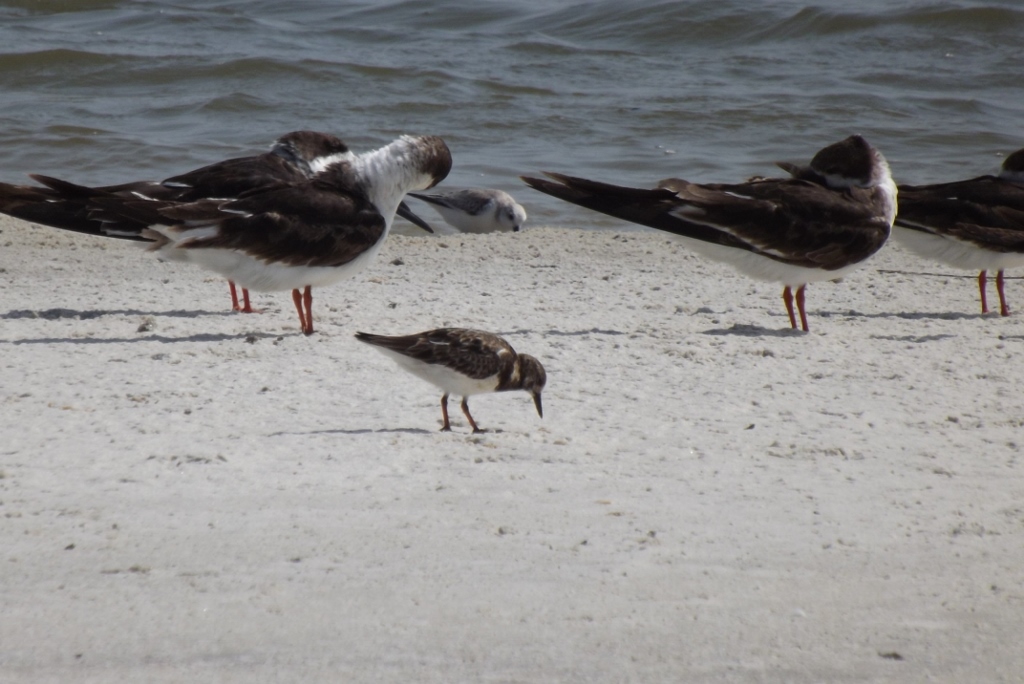
This next photo shows a species that is a bit larger than the Sanderling and the Semipalmated and Snowy Plovers, but much smaller than the Willet.  True to its name, the Ruddy Turnstone actually does turn over rocks and other material to find food underneath, so its foraging behavior can be an important clue to its identity.  It also has bright orange legs and a dark, swirling pattern on the breast.  The white patches on its back, wings, and tail are concealed unless it is in flight.
Ruddy Turnstone with Black Skimmers and Sanderling
Okay, what are the birds in the photo below?  They have small, stocky bodies; short, black legs; drab brown upperparts; and white underparts.  These are Dunlins, which have longer bills than Sanderlings but are otherwise about the same size.  Their longer bills provide a clue to their behavior, as they often feed in deeper water than Sanderlings do. 
Dunlin
In the next photo, a Sanderling forages to the left of two Dunlins.  Notice the difference in color: the warmer brown of the Dunlin versus the pale gray of the Sanderling.
Sanderling and Dunlin
The next pictures show the bill differences a bit more clearly:
Sanderling
Dunlin
Willets are so much larger than any of the shorebirds I’ve previously discussed that they usually don’t provide any identification challenges.  As you can see in the photo below, they’re nearly as large as Laughing Gulls.
Calm Willets, angry Willet, and a Laughing Gull
Here is a Willet by itself.  You can see the long, grayish legs, grayish bill, and overall grayish-brown plumage.  I should mention, though, that Willets are grayer and drabber in the winter and early spring than they are during the summer.  The bird’s face has white feathers in front of the eye and a thin eye-ring, but is otherwise very plain.
Willet
In the next pictures, the two larger birds are Willets, but the smaller bird on the left is a Short-billed Dowitcher.  Notice the warmer tone of the brown plumage, the speckling on the underparts, the pale “eyebrow,” the yellowish-gray legs, and the white rump feathers.  (The very similar Long-billed Dowitchers also occur on the coast in March, but they are less common in saltwater habitats, and their identification is a bit beyond the scope of this piece.)
Short-billed Dowitcher and Willets
Same Short-billed Dowitcher and Willets
In the photo below, dowitchers mingle with Willets and Laughing Gulls.  Size and body structure, plumage characteristics, and posture/behavior can all help you to sort out these birds!
Obviously, identifying tricky-to-ID species is far more difficult when they are alone than when other birds are nearby, and I still struggle with a number of species groups.  However, breaking away from a fixation on minute plumage details and taking a more holistic approach to identification can save you plenty of frustration in the field and teach you more about bird ecology.  Try it out!

Thursday, May 30, 2019

Tricky Birds, Part I

I would guess that most birders start out separating birds in the field primarily by plumage colors and patterns.  I know that it was like that for me; the first field guide that I used contained photos that showed birds engaged in a variety of behaviors in their natural habitats, and even went so far as to categorize so-called “perching birds” by color.  Any given page spread would show six related (or, in the case of the “perching birds” section, not closely related) species, often in completely different poses and with no real sense of scale.

I want to emphasize that photographic guides aren’t necessarily bad—the problem I experienced was only that I came to subconsciously expect what I saw in the field to match the pictures in the book, and when that didn’t happen, I was sometimes a tad frustrated.  I simply lacked the experience at that stage to quickly and accurately discern the differences in shape, size, and usual posture between various species of birds.  That skill had to come with time.

Not to discount plumage, of course, but shape, size, posture, and behavior are usually far more diagnostic than intricate feather details, at least for some species.  Comparing several related or somewhat similar birds at once also helps immensely, although it’s not always easy to find an opportunity to do so.  That’s why I was pleased to be able to compare multiple species of gulls, terns, and shorebirds—of various ages—this year at Dauphin Island, Alabama.  This occurred on the 14th and 15th of March, which meant that some of the gulls and terns (and other species) were in alternate (or breeding) plumage, while others were still in basic (or winter) plumage, or in the middle of molting.  The first part of my photo essay will focus on gulls and terns, although shorebirds do show up in some of the pictures!

Let’s start by analyzing this small assortment of birds:
All of these are pretty easy to identify.  Breeding adult Laughing Gulls, like the one on the left, have black hoods, dark-red bills, slate-gray backs and wings, and mostly black wingtips.  The bird in back, an adult Ring-billed Gull, has the conspicuous black ring on a yellow bill, yellow legs, a somewhat lighter gray back, and a little more white on the primary feathers.  You can probably tell that the Ring-billed Gull is larger than the Laughing Gull, as well.  The two birds in front, shorebirds, are also drastically different from each other: the large, lanky one is a Willet, and the tiny one is a Sanderling.

Lone birds can be slightly trickier, especially if they’re not in full adult plumage.  For instance, look at this younger Ring-billed Gull:
The bill lacks an obvious dark ring, being pink with a black tip.  The legs are a dull pink, as well, and the plumage looks scruffier and more mottled on this “teenager” bird than on the adult in the first photo.  The body shape is basically the same, though.

Now, compare that bird to the Herring Gull in this photo:
Although both the Herring Gull and the Ring-billed Gull have black-tipped pink bills, pink legs, mostly grayish backs, and whitish heads, they’re subtly different in shape.  The Herring Gull has a bulkier build and a thicker bill.  Also notice that the Ring-billed Gull’s primary feathers extend pretty far past the tail.  The Herring Gull’s primaries look much shorter.  And, of course, the Herring Gull has a lot more brown feathers in its plumage.  (An adult bird would show more white, but this one is a subadult.)

Of course, if the Herring Gull had been standing next to the Ring-billed Gull, another difference would have been obvious: Herring Gulls are giants in comparison to Ring-bills.  In the photo below, the Herring Gull is on the left, dwarfing the Laughing Gull (without a black hood) and the Royal Tern (the bird with the orange bill).
Herring Gull, Royal Tern, and Laughing Gull
Speaking of Royal Terns, there were dozens of them on the beach, along with over a hundred Black Skimmers.  Skimmers are mostly crepuscular (i.e., active at dawn and dusk), so these birds were just roosting together in the late morning on the shore.  Their distinctive looks didn’t present any identification challenges, but they did provide a nice basis for comparison with other birds.

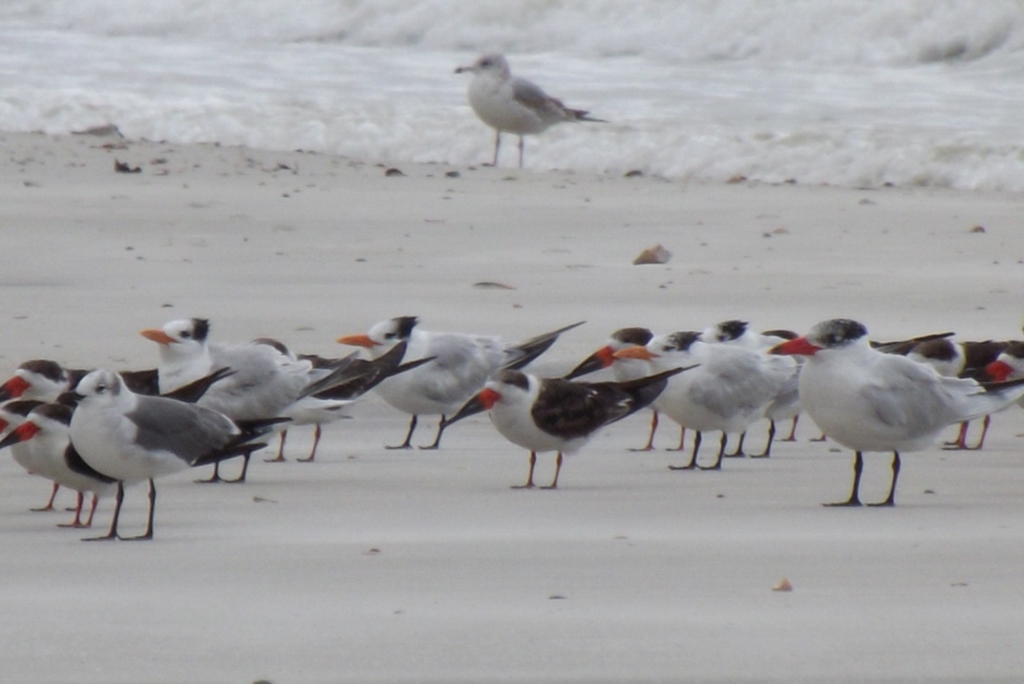
In the photo below, you can see how some of the skimmers have their heads resting on their backs, while a few of the birds are alert, with their cartoonishly large, red-and-black beaks visible.  Skimmers forage by flying low over the water, their long mandibles slicing through the surface.  If they touch fish, they snap them up quickly.  Terns, like the Royal Terns in the photo, are more specialized than gulls in their feeding habits, and usually dive for aquatic invertebrates and fish.  Their bills are longer and more dagger-like than those of gulls, but much smaller than those of skimmers.  Some of the Royal Terns had already completed the molt into breeding plumage, while others still retained the characteristic white foreheads of winter plumage. 
There is also a Ring-billed Gull in the picture.  Can you spot it?
A few Caspian Terns were mixed in with the group.  In the next picture, you can see a Caspian Tern on the right.  It has a fairly stocky, red bill with a smudge of black at the tip, and its head has a more rounded crest, unlike the long and spiky one of the Royal Tern.  The orange-billed Royal Terns in the photo are congregating with Black Skimmers, and do you see the winter-plumaged Laughing Gull on the left, and the Ring-billed Gull in the background?
Here’s another type of tern: the Forster’s Tern.  These are considerably smaller than the other two species I mentioned.  They have red legs, and, in winter plumage, black bills.  Distinguishing them from the similarly small, closely-related Common Terns can be tricky, but they don’t pose an identification challenge when seen with Royal and Caspian Terns.
Forster's Tern (with Royal Terns and Black Skimmers)
You might have noticed that the tern at the upper left has a much redder bill than any of the others in that photo.  If you were simply relying on bill color for identification, you might be tempted to call this individual a Caspian Tern.  However, the bill is relatively slim, like that of a Royal Tern, and lacks the black smudge that you would expect to see on a Caspian Tern.  The bird’s crest clinches the ID: it is long and shaggy in the classic Royal Tern shape, rather than short and rounded.  Noticeable variation can and does occur within species of birds!

That’s the end of Part I.  Stay tuned for Part II, which will focus on the shorebirds.

Tuesday, April 30, 2019

Solitary and Spotted Sandpipers


At the mention of sandpipers, many birders mentally groan.  After all, sandpipers are those dull, brownish little creatures that skitter over mud and all look alike.  In other words, it can be really hard to appreciate them.  But actually, on closer study, sandpipers are unusual and highly fascinating birds.  And, no, they don’t all look alike!  I will focus on two very distinctive, common sandpipers that can be seen in migration now: the Solitary Sandpiper and the Spotted Sandpiper.

Although they are not closely related, the Solitary Sandpiper (Tringa solitaria) and the Spotted Sandpiper (Actitis macularius) are often seen together feeding in the same ponds and lakes, frequently those with woods or at least low-lying vegetation nearby.  Both can be found migrating in Mississippi from about March to June in the spring, and late July to late October in the fall.  The Spotted Sandpiper is an occasional winter resident in the state, as well, but is more common along the coast than inland.

Both sandpipers forage and migrate singly or in small groups, and both exhibit tail-bobbing behavior.  With the Spotted, the entire body is teetered; the bird is in constant, jittery motion: scampering along the water’s edge, picking up small insects, mollusks, crustaceans, and even tiny fish.  The Solitary Sandpiper has slower, more deliberate movements, and when it pauses, it often bobs its head and tail.  It has longer legs and a longer bill than the Spotted, which enables it to feed in slightly deeper water, where I assume the menu would include bigger fish and frogs!  As an additional feeding adaptation, it often shakes its foot above the water to draw small fish and insects to the surface.

If you come unexpectedly upon either of these sandpipers, they will probably fly up immediately, uttering high-pitched peet-WEET calls (the Solitary’s call is the higher pitched of the two).  Fortunately, their flight styles are very different and distinctive.  The Solitary Sandpiper has graceful, swallow-like wingbeats and displays long, pointed wings and white edges on its tail.  Spotted Sandpipers fly close to the water and give fluttery, shallow beats of their shorter, more-rounded wings, each of which shows a thin, white stripe.

Once the sandpipers land on the bank and begin feeding again, their colors and patterning are apparent.  The Solitary Sandpiper is slightly larger than the Spotted, with a longer neck and body, and it has a wide, white eye-ring that gives it an alert look.  Its head, neck, and breast are finely streaked with brown, its belly is white, and its back is dark brown and shiny, with a dusting of tiny white spots.  The thin, dark bill and dark, greenish-gray legs complete the picture.  The Spotted Sandpiper is relatively small and stocky, with orange legs and bill, brown upperparts, a white eyebrow and slight eye-ring, and in the breeding season a boldly spotted breast and belly.  At least before the birds molt in the fall and replace the spotted front with plain white, you can sometimes tell the sexes apart.  Females have larger spots that extend farther onto the belly than males.

But why would the female bird be more distinctively marked?  The answer lies in the Spotted Sandpiper’s breeding biology.  Along with phalaropes, it is unusual in that the females are polyandrous, mating with more than one male—sometimes up to five!  Each time after mating, the female lays a clutch of up to four brownish eggs, which the male is solely responsible for incubating.  However, the female does help with constructing the nest—a shallow scrape in the ground, lined with grass.  After the eggs hatch, the male alone raises the chicks, which are born precocial like all sandpipers.

While the Solitary Sandpiper is monogamous and doesn’t exhibit such unusual breeding behavior as the Spotted, it is unique among North American shorebirds in that it nests in trees.  A female Solitary Sandpiper will add a little extra nesting material to the abandoned nest of a songbird, such as a Rusty Blackbird, American Robin, or Cedar Waxwing, incubate her four well-camouflaged, brownish eggs, and care for the young with her mate.  Tree-nesting is so unusual among shorebirds (the Green Sandpiper of Eurasia is the only other species known to do it regularly) that, for decades, no one was sure where the Solitary Sandpiper nested until 1903, when the secret was finally discovered.

Spotted Sandpipers are one of the most widespread shorebirds, commonly found over much of North America, although they aren’t known to breed in Mississippi and some other southern states.  Solitary Sandpipers are more restricted in range, occurring in the breeding season mainly in Canada and Alaska.

The numbers of both of these sandpipers appear to be fairly stable, and that’s good news.  With care and protection, generations years into the future will be able to observe the fascinating behaviors of these and other birds that have been living here for eons.  A world without the little brown sandpipers that enliven our fields, woods, and wetlands would be bleak.