Thursday, April 30, 2020

The Perks and Perils of Nesting

April is drawing to a close, which means that, here in the southeastern U.S., most of the summer-resident birds have arrived on their breeding territories.  They join the year-round resident species—including phoebes, cardinals, Carolina Wrens, and bluebirds—that have possibly already nested this season, and could be starting on second broods.  Several of these common, resident birds spend a lot of time around human habitation, so if you live in this region of the country, you may have noticed nesting behavior from some of them during the last couple of months.  The ones that typically build around my home are Carolina Wrens and Eastern Phoebes, which I see in the yard almost every day.  In the spring and summer, the Carolina Wrens will often build their small, domed nests in the garage or in the chairs or potted plants on the patio.  This April, they built a nest on top of some random stuff in the garage.  As you can see, they used grasses, oak blossoms, mosses, leaves, and string in the outer layer.  There are several enormous post oak and red oak trees in the yard, so oak blossoms were all over the place earlier this season, and I have to say that I was getting sick of tracking them into the house.  Good thing that the wrens were able to repurpose them.
Carolina Wren eggs
Finer grasses and various bits of fuzz—feathers and possibly fur—lined the nest, and, as the photo shows, the female wren laid five eggs.  This is normal for Carolina Wrens, which lay anywhere from three to seven.  The female wren incubated the eggs for several days.
Incubating
Wrens build nests around the house every year, and, apart from peeking into the nests every now and then during the roughly month-long process from incubation to fledging, I never really do anything that could disturb them.  For one thing, it’s technically illegal to disturb or damage the eggs and young of wild birds, and for another, I figure that interfering with nature is usually unwarranted.  The main exception I will make is for species that are endangered, or just generally imperiled.  Carolina Wrens, though?  Thankfully, they seem to be doing just fine.
The empty nest
The species is doing just fine, that is.  Unfortunately, these particular individuals had their nest raided by some sort of predator before the eggs could hatch.  Maybe a snake?  Several nonvenomous species, including gray ratsnakes, black racers, and speckled kingsnakes, are pretty common in this area.  I do not endorse killing snakes, by the way; they have a right to be here, and the benefits that they provide (e.g., rodent control) far outweigh any damage that they occasionally do to the birds that people love to watch.  Below is a picture I took a couple of years ago of a large gray ratsnake that had taken up residence in the garage.  A raccoon is another possibility; although I haven’t yet seen raccoons near the house itself, I know that they hang out in the woods at the creek.
Gray ratsnake
The Carolina Wrens have not re-nested in the garage, but, given the fact that a pair of wrens can have up to three broods a year, I suspect that they do have another nest somewhere close.  Hopefully, the second brood will fare better.  

On a lighter note, even though the wrens had a failed nest this spring, the Eastern Phoebes successfully raised at least three young over the garage entrance.  Phoebes typically don’t build low to the ground, so unless you bring out a ladder, you’re probably going to have a hard time looking into their nests.  Until they hatch and the young birds are large enough to stick their heads over the edge, I usually have no idea how many eggs there were.  The brood sizes of phoebes can vary fairly widely—from two to six.  Like Carolina Wrens, phoebes easily acclimate to human activity; as long as you leave them alone, they will nest year after year in the same spot on a ledge, over a porch, or under an eave or a bridge.  
The phoebes' nest
The phoebe nestlings in the garage nest grew rapidly, and eventually the concrete below became coated with bird droppings—yuck.  I expected the birds to fledge a day or two before they finally did; they had been looking very large and mature, but I guess that they weren’t finished developing yet.  On the day that they did wind up leaving, I was standing at one side of the garage entrance and peering at them through my binoculars.  My presence apparently agitated them, because they all blasted out of the nest at once and flew strongly to the row of hardwood trees lining the driveway.  Clearly, they were ready!  Maybe the adult phoebes will start another brood, or maybe not.  They can have up to two per year.  For many of the other bird species on this property, however, the season is just getting started.

Phoebe nestlings

Monday, March 30, 2020

Beach Birds

Earlier this month, my family and I spent a few days on Dauphin Island, AL.  Given the current pandemic situation, this is likely to be our last coastal trip in quite a while, so I thought it would be interesting to discuss yet more “tricky birds” that I observed (for more of that series, see here and here) and show some of the other avian life that can be found on the Gulf Coast.

This year’s visit was slightly earlier in the season than the one that we made last year—but only slightly.  Even so, the assortment of gulls, terns, and shorebirds on the public beach was fairly different from last time.  I saw only one Black Skimmer, and no Forster’s Terns at all.  But plovers, particularly Semipalmated and Piping, were abundant.  Small, brown sandpipers were also everywhere.  In the photo below, three species are depicted.  What are they?
The ten or so birds in the foreground (plus the one farthest to the left in the back) are chunky with drab, brownish upperparts, white bellies, grayish legs, and semi-long bills that droop at the tips.  If you remember the previous identification post, you may recall that these are Dunlins.  They spend the winter on the coast before migrating to Alaska and northern Canada for the breeding season.
Resting Dunlin
The remaining seven birds are all plovers, but you’ve probably noticed that two of them have very pale plumage compared to the rest.  The five darker plovers are Semipalmated Plovers, and the two paler ones are Piping Plovers.  You can tell that the Semipalmated Plovers have dark bands of feathers that completely encircle their breasts, while the Piping Plovers have incomplete breast-bands.  Both species have orange legs, unlike the Snowy Plover, which has grayish legs.  Like the Dunlin (but unlike the Snowy Plover), the Semipalmated and Piping Plovers do not remain on the Gulf Coast to breed.
Piping Plover
Even more species of shorebirds were to be found at the tide pools.  While I was walking beside one of these pools, I noticed this group of tiny sandpipers.  The two birds in front were obviously not Dunlins or Sanderlings, since they were much smaller in size and had brighter and more mottled plumage.  
The next photo, showing the beak and legs, makes everything perfectly clear: these birds are Least Sandpipers.  Their moderately short, slightly decurved bills; short, yellow legs; and warm-brown upperparts help to distinguish them from other shorebirds.  As you might guess, they migrate northward at this time of year, as well.
Least Sandpiper
As I’ve mentioned before, even though it can be overwhelming to stumble upon large groups of similar-looking bird species, being patient with yourself and going through a mental checklist of field marks for each bird will enable you to identify most or all of them without too much difficulty.  Don’t give up!

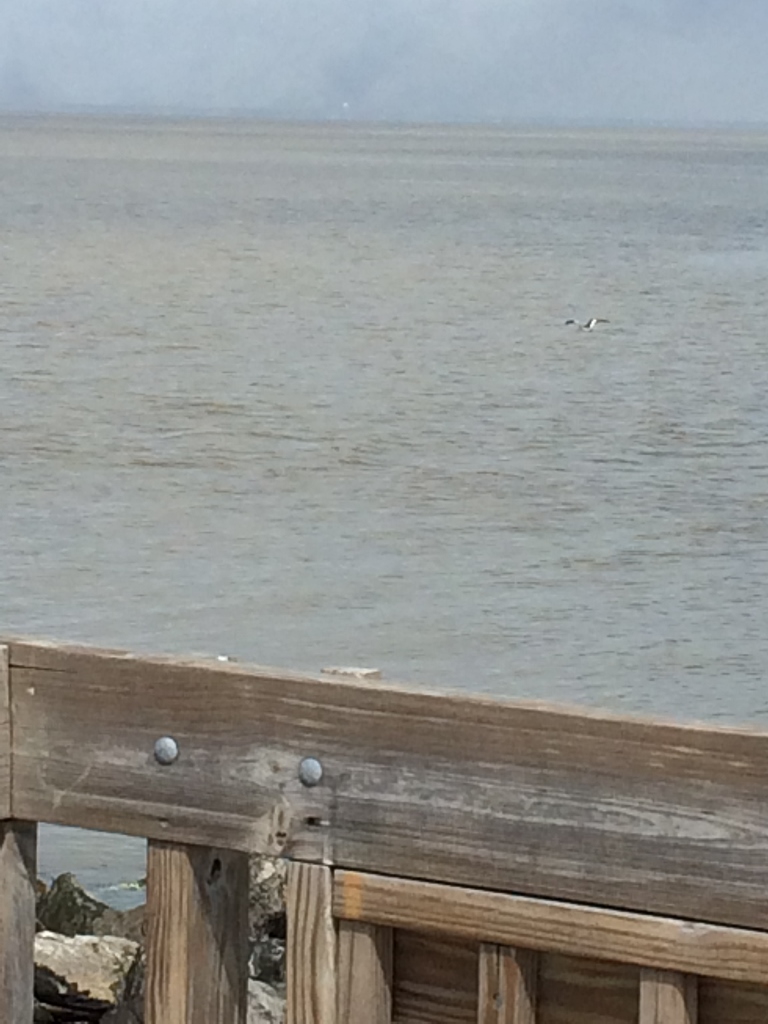
Of course, many of the birds that I saw on this vacation were the farthest thing from “tricky,” at least where identification was concerned.  This American Oystercatcher that I glimpsed through the railing at the Dauphin Island Sea Lab is a shorebird, but its bold black-and-white-and-brown plumage and almost clownish-looking red bill make it unlikely to be confused with any other species!  This particular individual, though, was “tricky” and wary in its behavior, making it difficult for me to get photographs.  Oystercatchers are year-round residents of the Gulf Coast, and they do indeed eat oysters.
American Oystercatcher watching from rock perch...
...and flying over the waves!  Notice its striking wing pattern.

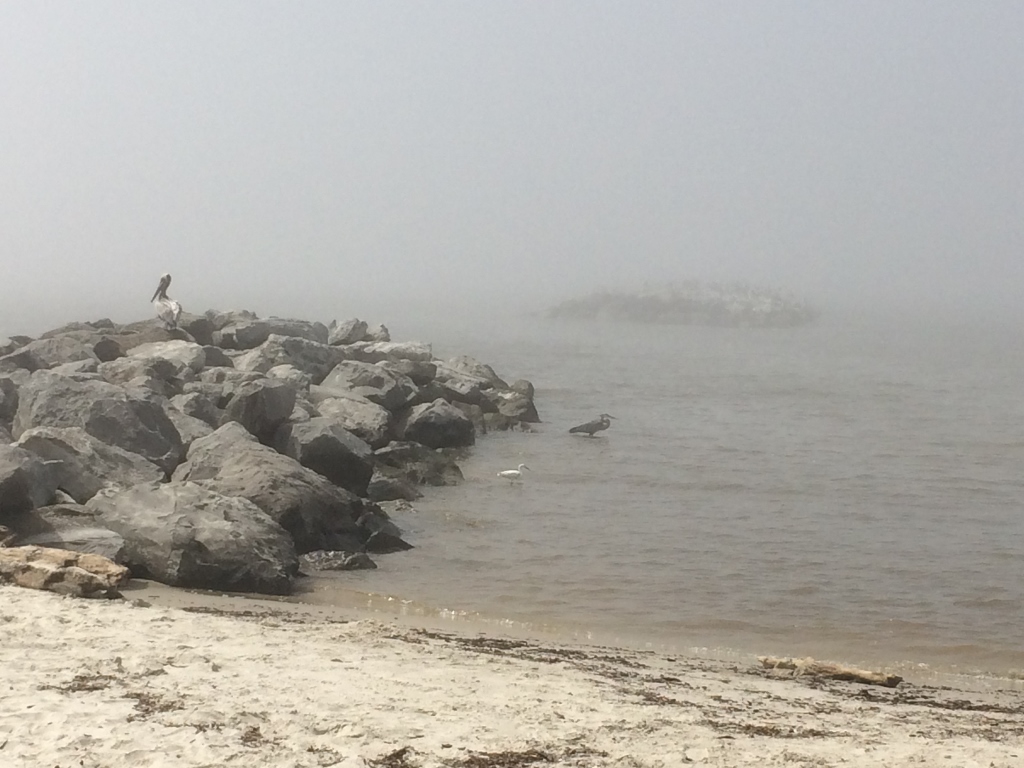
Here are some other interesting but easy-to-ID birds: a Brown Pelican (standing on the rocks on the left), a Snowy Egret, and a Great Blue Heron.  The fog on this day, the 11th, obscured almost everything past the shoreline.  There are probably many cormorants, gulls, terns, and pelicans on the rocks farther out, but it’s almost impossible to tell.  Despite the visibility issues, there was something intriguing about seeing the beach shrouded in mist like this.
I can’t resist ending on this picture of a slightly miffed-looking Laughing Gull.  If you can, keep watching your local wildlife, and please continue to check for updates to the blog as we all move forward in this weird and stressful time. 

Saturday, February 29, 2020

Leap Year


Excuse the terrible pun in the title.  Lately, I have been thinking about Anurans—frogs and toads.  There are a little under 100 species in the U.S., but that’s not so many that enthusiastic amateur naturalists can’t become familiar with the most common ones in their locales in a short time.  For comparison, there are several hundred species of birds in the U.S., many of which have different plumages for different ages, sexes, and seasons, as well as multiple calls and songs for different purposes.  That’s not to say that frogs and toads show no intraspecies variation.  However, the degree of variation is less overwhelming, and, again, it’s easier to learn to identify 10-30 or so species—about the number that you could reasonably expect to find in any given region of the country, I think—than it is to learn upwards of 200 species of birds that occur regularly in the state where you live.  
 
How do you begin learning about frogs and toads?  Well, these days, there are several useful online resources that can help you.  I happen to like the U.S. Geological Survey page (https://www.pwrc.usgs.gov/frogquiz/index.cfm?fuseaction=main.lookup), which allows you to see the species lists for all of the eastern states (unfortunately, western states haven’t been added yet) and listen to recordings.  The Association of Zoos and Aquariums looks like another great source, as it has a FrogWatch USA page that breaks species lists down by state (https://www.aza.org/frogwatch-usa-mississippi) and contains links to both the Macaulay Library (https://search.macaulaylibrary.org/catalog?searchField=animals) and AmphibiaWeb (https://amphibiaweb.org/index.html).  There are also plenty of good field guides that help with visual and/or aural identification.  When I was a child, I enjoyed listening to the cassette tape that, along with a short booklet, comprised A Field Guide to Mississippi Frog Songs.  This explains why I knew several frog sounds long before I became interested in birds.  

No matter what sources you use, though, keep in mind that there is no substitute for hearing frogs and toads in their natural habitats.  If you’re frogwatching in a particularly good location, you will probably hear several frog species calling at once, so you will need to pay close attention to the differences.  Loud, overlapping choruses of frogs and toads can sometimes make it difficult to concentrate!  During the breeding seasons, singing male frogs are working hard to attract females, so they need to be as loud and persistent as possible.  Right now, in late February and early March, the main species calling in the southeastern U.S. is the spring peeper.  In January and February, I was hearing a lot of upland chorus frogs, which, as I’ve mentioned before, have a metallic sound to their song.  In a few weeks, I will expect to hear Fowler’s toads, and, by late March, gray treefrogs, green treefrogs, squirrel treefrogs, and others will have entered their breeding period.

To help get you started learning about frogs and toads during this leap year, here are some of the short articles I’ve written about Anurans in Mississippi:


Happy frogwatching!