Saturday, October 31, 2020

Oak Mast

Do you see many oak trees in your area?  Did you know that there are two main types (or sections, in botanical terminology) of oaks in eastern North America?  While oaks are extremely variable, hybridize often, and can be quite difficult to identify to species, figuring out which section they belong to is relatively easy.  If they are white oaks, then they will have smooth margins on the lobes of their leaves, rounded lobes, and acorns near the ends of their branches.  Red oaks, on the other hand, will usually have a bristle at the end of each leaf lobe (which will probably be pointed instead of rounded, but there are several exceptions), and their mature acorns will be farther down on the twigs.  The reason for the difference in acorn position is that white oak acorns mature in a single season, while red oak acorns take two full seasons to mature.  Therefore, red oak branches will display additional growth past the acorns.  This feature is very noticeable once you start looking for it.

Acorns are at the tips of branches in white oaks (left) and at the earlier growth level in red oaks (right).

Oaks are perhaps the most familiar trees that produce large crops of seeds on a synchronous, highly variable basis, although they’re far from the only ones.  The mass production of seeds across an entire population of plants is referred to as masting.  Most oak species have these masting events every two to six years, and these mast production years can have significant long-term impacts on forest ecosystems.  In general, high acorn production has a positive effect on rodent and deer populations and a neutral to negative effect on nesting songbirds. 

One of the most famous studies to demonstrate the link between oak masting and rodent populations was conducted by Jerry Wolff in the Allegheny Mountains of southwestern Virginia.  Wolff (1996) surveyed populations of mice and eastern chipmunks by live-trapping and ear-tagging the animals, and recording data on their sex, age, mass, and reproductive condition.  Wolff’s data showed that populations of these rodent species peaked in the summers of 1981, 1986, 1989, and 1990, while an index of oak mast data for the area showed that the highest production occurred during 1980, 1985, 1988, and 1989.  What this indicates is that, while the rodents were enjoying an abundant food source during the high mast years, they were increasing both their chances of survival during the winter and their rate of reproduction during the following summer.  High mast years weren’t bad for the oaks, either: because there were more acorns than could be consumed by the rodents, more seeds than usual were able to germinate.

Mice, chipmunks, and squirrels will sometimes prey on eggs and young in birds’ nests, so, as might be expected, larger rodent populations can negatively affect bird species that nest either in low shrubs or on the ground.  One study in a forest near Front Royal, Virginia, showed that nest predation by rodents increased significantly following high mast years, and that Breeding Bird Survey indices for both Hooded and Worm-eating Warblers correlated negatively with high mast production years (McShea 2000).  However, it’s important to note that not all ground-nesting bird species will necessarily be affected.  For example, Ovenbird populations in Hudson Valley, New York, remained the same after increases in rodent numbers (Schmidt and Ostfeld 2003).  Schmidt and Ostfeld also found that Sharp-shinned and Cooper’s Hawks, which can feed on small mammals as well as on birds, became more abundant after high mast years—not surprising when you consider the rodent population boom that often follows a mast event! 

The links between deer populations, oak mast, and bird nest predation are a little more complicated.  Deer are more likely to produce twins after a high mast crop in the fall (Ostfeld et al. 1996), so it seems clear that acorn mast has a positive effect on deer populations.  Deer are heavy browsers of forest plants, though, and the previously mentioned study by McShea (2000) found that deer significantly reduced the understory vegetation within the forest community when their numbers were high, and that populations of white-footed mice and eastern chipmunks increased when deer populations were excluded from study plots.  McShea did not observe significant impacts on bird nesting success due to the presence of deer, but he did note that research by Leimgruber et al. (1994) discovered that, when vegetation density was high, nest predation rates tended to be low.  Therefore, even though numbers of nest-raiding rodents tend to increase when there are fewer deer in a forest, ground-nesting birds still benefit from the higher density of vegetation.

If deer populations increase after mast years, how does that affect the spread of Lyme disease?  Lyme disease is caused by a bacterium, Borrelia burgdorferi, which is mainly transmitted by the black-legged tick (Ixodes scapularis), a common parasite of deer and mice.  Ostfeld et al. (1996) noted that larval tick populations were around 10 times higher in oak forests than in other habitats after a mast year.  Additionally, deer avoided oak-dominated habitats during poor mast years, preferring instead to use forests dominated by maples and other tree species.  When the deer did this, larval tick populations also increased in those habitats. 

Yet another study (Ostfeld et al. 2001) monitored black-legged ticks, white-footed mice, and acorn production during the growing season in southeastern New York, and found that the number of B. burgdorferi-infected ticks was higher in the two years following a high mast year.  Not surprisingly, this population increase was also correlated with increases in mouse populations.  In case you’re wondering, ticks can be collected for research by dragging white cloths through study plots.  As anyone who has walked through forest undergrowth during the summer months knows, it really doesn’t take much effort to find and collect ticks!

As we’ve seen, oak mast directly and indirectly affects populations of other organisms.  But these relationships are far from one-sided; it’s important to understand that animal behavior in turn influences oak evolution.  For example, research by Steele et al. (2001) demonstrated that small mammals can strongly influence the growth and dispersal of oaks.  In that study, gray squirrels were found to prefer the acorns of white oaks to those of red oaks, because white oak acorns lasted longer in winter caches.  Also, squirrels performed embryo excision—that is, the killing of an acorn embryo by notching a seed at its apex—on their cached white oak seeds far more frequently than on red oak seeds.  This is probably because white oak acorns germinate earlier and more rapidly than those of red oaks, and squirrels can’t risk losing their cached food supply.  Of course, white oaks’ rapid germination also ensures that reproduction takes place despite some loss to squirrel caching.  It’s basically an evolutionary tug-of-war. 

Identification tip: white oak acorns (left) tend to have much deeper caps than red oak acorns (right).
On an even broader ecological scale, Blue Jays play an important role in the dispersal of oak species across eastern North America, and have helped to determine the present-day distribution of oak species across the continent.  Paleontological evidence suggests that, between around 126,000 and 11,700 years ago, Blue Jays dispersed oaks northward beyond what had been their usual range at the time (Johnson and Webb 1989).  Blue Jays can transport acorns hundreds of meters away from the source tree, and, for every acorn that they consume, they disperse about three.  Because climate change could potentially impart major changes to oak distributions in North America, dispersal of oaks by Blue Jays ultimately may help to compensate for areas that are unsuitable for oaks’ continued survival.  Hopefully, though, we won’t have to find out if that’s the case.

To sum up: Oak mast production and the presence of oaks in forest communities have many significant relationships with other species within the community, and are an essential part of the community food web.  Take a look around your area and see what sorts of oak-related ecological interactions are occurring!

References

Johnson W. C., & Webb, T. III. 1989. The role of blue jays (Cyanocitta cristata L.) in the postglacial dispersal of fagaceous trees in eastern North America. J. Biogeogr. 16:561-571.

McShea W. J. 2000. The influence of acorn crops on annual variation in rodent and bird populations. Ecology 81(1):228-238.

Ostfeld R. S., Jones C. G., Wolff J. O. 1996. Of mice and mast: ecological connections in eastern deciduous forests. BioScience 6(5):323-330.

Ostfeld R. S., Schauber E. M., Canham C. D., Keesing F., Jones C. G., Wolff J. O. 2001. Effects of acorn production and mouse abundance on abundance and Borrelia burgdorferi infection prevalence of nymphal Ixodes scapularis ticks. Vector Borne. Zoonotic. Dis.       1(1):55-63.

Schmidt K. A., & Ostfeld R. S. 2003. Songbird populations in fluctuating environments: predator responses to pulsed resources. Ecology 84(2):406-415.

Steele M. A., Turner G., Smallwood P. D., Wolff J. O., Radillo J. 2001. Cache management by small mammals: experimental evidence for the significance of acorn-embryo excision.    J. Mammal. 82(1):35-42.

Wolff J. O. 1996. Population fluctuations of mast-eating rodents are correlated with production of acorns. J. Mammal. 77(3):850-856.

Wednesday, September 30, 2020

Red-shouldered Hawks

It wouldn’t seem quite like autumn without the hawks and falcons hunting along fencerows, darting through the woods, or soaring on the breezes. I have been seeing a number of raptor species lately, including the swift and agile Cooper’s Hawks, the slower but more powerful Red-tailed Hawks, the wary and fidgety American Kestrels, and the high-soaring (at this time of year, as they migrate) Broad-winged Hawks. But the species that I see most frequently in my neck of the woods is actually none of these: it’s the Red-shouldered Hawk, a member of the genus Buteo and a close relative of the Red-tailed and Broad-winged Hawks. Red-tailed Hawks might be more common and widespread, but the types of habitats near my home are simply better for Red-shouldereds, and that’s fine with me. 

Unlike Red-tailed Hawks, Red-shouldered Hawks tend to prefer low-lying, heavily wooded environments. They are commonly found year-round in many hardwood and mixed forests throughout southeastern North America, and, in the fall and winter, this southeastern population is boosted by migrants from the northeastern United States and southeastern Canada. The difference in habitat between Red-shouldered and Red-tailed Hawks means that their dietary preferences are a bit different, as well; like Red-tails, Red-shouldereds eat lots of small mammals, but, because they inhabit denser, swampier woods, they’re also likely to catch frogs, snakes, and lizards. However, even though they’re primarily forest hawks rather than field hawks, they will often hunt from powerlines and prominent snags at the borders of woodlands and fields. Presumably, this makes it easier for them to find and catch their prey, given that they lack the maneuverability of species such as the Cooper’s and Sharp-shinned Hawks.

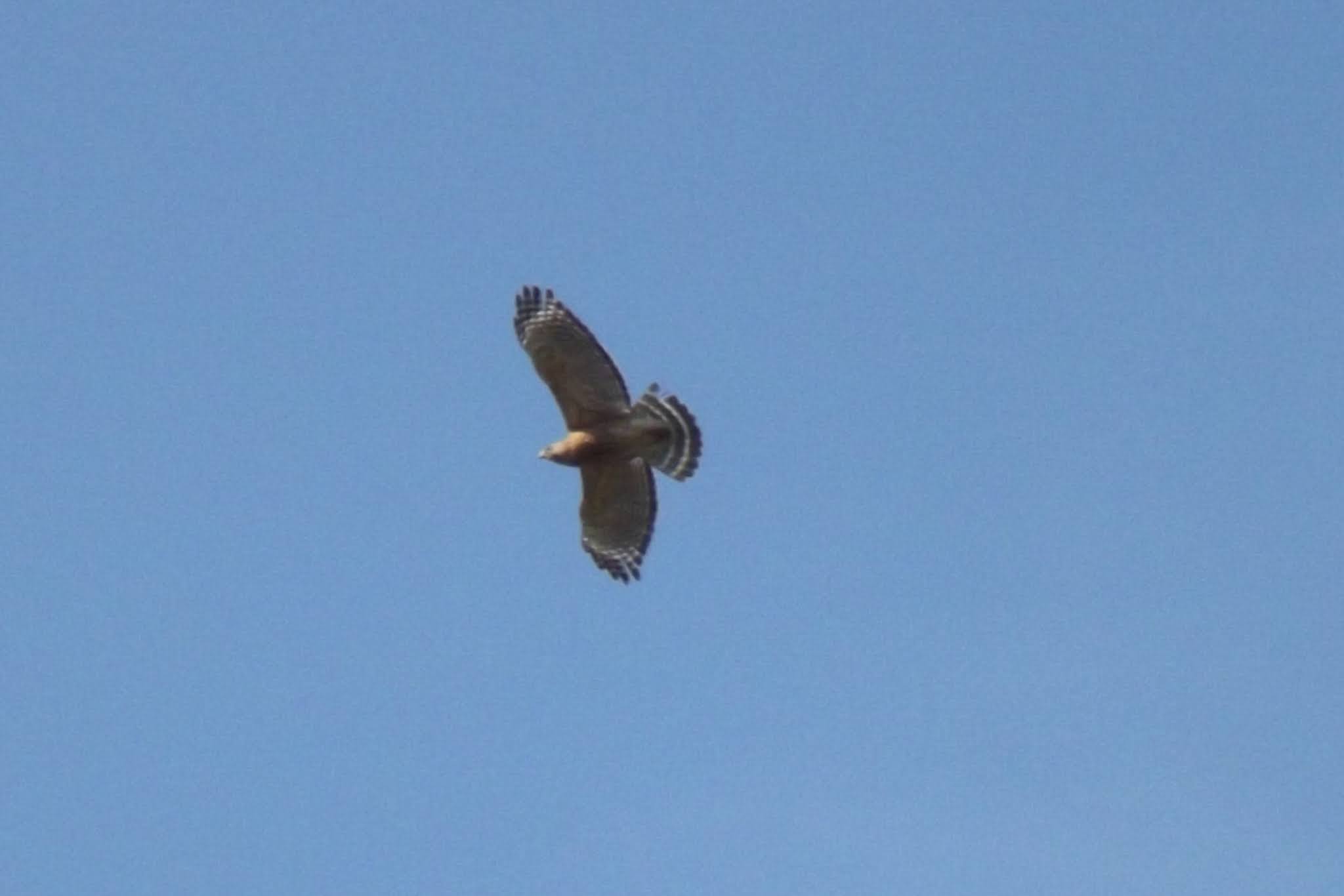
Appearance-wise, Red-shouldered Hawks are a little smaller and slimmer than Red-tailed Hawks, and, of course, they lack the brick-red tails that adult Red-tails have. They DO have reddish-brown “shoulders,” but this usually isn’t the most obvious field mark. The barred, reddish-brown breasts, black-and-white banded tails, and black-and-white wings on the adult hawks are far more noticeable features in the field. As you can see in the first of the two photos below, there are also vertical breast streaks on top of the chestnut-colored horizontal barring. Juvenile Red-shouldered Hawks look fairly similar to the adults, but have drabber, browner feathers and lack reddish barring on their breasts. In flight, both adults and juveniles show “wing windows,” which are essentially just pale crescents near the wingtips. This is a great field mark to look for if a hawk is soaring overhead. 

The rusty breast feathers on this adult hawk are a useful field mark.

Juveniles have browner plumage and streaks on their breasts.

Crescent-shaped wing markings are visible on this soaring adult hawk.
At this time of year, the immature hawks have probably been independent from their parents for several months, so they’re essentially competing with adult hawks for food and territory. If they survive the winter and later become breeding adults, then they will likely build their nests in large trees in the woods and lay two to five eggs per brood, with only one brood per season. Apparently, little is known about Red-shouldered Hawk nesting habits, so if you happen to spot a breeding pair next year, there is a chance that your observations could be of significant scientific value! In the meantime, enjoy watching Red-shouldered Hawks and other raptors as this year wanes. 

Source:

Dykstra, C. R., J. L. Hays, and S. T. Crocoll (2020). Red-shouldered Hawk (Buteo lineatus), version 1.0. In Birds of the World (A. F. Poole, Editor). Cornell Lab of Ornithology, Ithaca, NY, USA. https://doi.org/10.2173/bow.reshaw.01


Monday, August 31, 2020

Summer Redbirds

While the Northern Cardinal is the most familiar “redbird” in southeastern North America, the region hosts another rosy-plumaged songbird species that is also quite common, if somewhat more secretive: the Summer Tanager.  Catching a glimpse of one of these migratory birds may be difficult at times, but, if you learn to recognize their vocalizations, you may find them in a lot of places that you might not have expected.  The main call of this species is a dry pik-i-tuk-tuk, while the song is a slurred, throaty warble—smoother than the more separated phrases of the American Robin.  Because Summer Tanagers—and most tanager species, in general—tend to forage in the middle and upper branches of trees, seldom venturing close to the ground, the sounds that they make really are the most obvious signs of their presence in a given area.  Mixed forests, particularly pine-oak woods, are the preferred habitats for this species.

If you do manage to spot a Summer Tanager after hearing its song or call, it’s generally pretty easy to tell whether the bird is male or female.  Fully adult males have rose-red feathers all over.  Adult females are more variable, and can be anywhere from a slightly greenish yellow to an orange-yellow with hints of red.  

Adult male Summer Tanager

Female Summer Tanager

Notice that I said it’s generally pretty easy to tell the sexes apart.  Identification becomes slightly more complicated in the fall, when first-year males can have smatterings of red in their plumage or even an overall orangey appearance, just like female tanagers.  However, the young males usually have more red on the undertail coverts than the adult females do, so it’s sometimes possible to tell them apart.  Additionally, although some first-year female Summer Tanagers may look almost identical to some adult females, it’s more typical for them to be a bit drabber in color.  At any rate, studying the variety of tanager plumages during the autumn season can be an interesting project!  And, when spring rolls around and the tanagers return from their wintering grounds in Mexico, Central America, and the northern portion of South America, most of the young males will have plumage in a patchwork of red and yellow, as in the photos below.  It takes another year for their yellow feathers to be completely replaced with red. 

Preening immature male Summer Tanager
 

Immature male Summer Tanager

Summer Tanagers feed mainly on insects and fruit, and this is evident from the shape of their bills, which are stouter than those of exclusively insectivorous species, but slimmer than those of seed-eaters.  Actually, most people should probably be thrilled to have tanagers around, since the birds’ favorite insects to consume are bees, wasps, and hornets!  One of my earliest Summer Tanager sightings was of an adult male casually catching paper wasps high in a sweet gum tree in my backyard, and I’ve witnessed countless other tanager and hymenopteran interactions since then.  If there isn’t too much ambient noise, then you can sometimes even hear the *SNAP* of a tanager’s bill as it closes on the bee or wasp.  The tanager will then sometimes vigorously rub its prey against a tree branch before swallowing it whole and, later, regurgitating the tough, indigestible bits of insect exoskeleton.  Yep, hawks and owls aren’t the only birds to produce pellets; most species do.

I have never seen an active Summer Tanager nest—perhaps surprisingly, considering how interested I am in birds’ nesting habits.  However, monitoring a nest if I found one would probably not be too difficult, since tanagers prefer building on branches over open spaces and gaps in the woods.  There would be minimal vegetation in the way!  The usual number of eggs for the species is three to four, which are laid in a cup-shaped nest of grasses and leaves.  Females do the incubating, but both parents feed the young throughout the nestling stage and for at least a few weeks after the fledging.  Because Summer Tanagers are Neotropical migratory birds, developing survival skills during their first summer and autumn is crucial; after all, they don’t get any do-overs during that first grueling and hazardous journey to the wintering grounds.  If they make it back to the breeding grounds in the spring, then they can start to claim nesting territories for themselves, continuing the cycle.

Although summer is nearly over, there are still plenty of opportunities to see Summer Tanagers in their breeding range before they depart around mid-October.  Listen for the calls, watch for the wasp-catching behavior, observe the varied plumage patterns, and just enjoy the presence of our other “redbird.”

Source:

Robinson, W. D. (2020). Summer Tanager (Piranga rubra), version 1.0. In Birds of the World (A. F. Poole, Editor). Cornell Lab of Ornithology, Ithaca, NY, USA. https://doi.org/10.2173/bow.sumtan.01