Showing posts with label American Goldfinch. Show all posts

Sunday, February 28, 2021

Ice Storms

The ice storm that hit during the third week of February threw everything off-kilter for a while.  The ground was crunchy (and, later, slick) with a layer of ice, the roads were impassable, tree limbs sagged, and being outdoors was tolerable for only a few minutes at a time.  I had taken down the bird feeders in the backyard, mainly because I was concerned about freezing rain coating them and clogging up their openings.  If the ice rendered them unusable for the birds, then there would be no point in keeping them up.  However, my mom and I did put birdseed inside the rotting stump (mainly for the benefit of the tree-dwelling birds) and on the frozen ground (for the shrub- and ground-dwellers).  This turned out to be a reasonable solution, and it meant that I didn’t have to worry about continually scraping ice off the tube feeders.

Obviously, the storm system was highly unusual for this region, so it’s probably fair to say that it caused most of the birds and other wildlife to struggle.  Most of the time, birds don’t actually need the food that we put out for them; we feed birds because of the enjoyment we get from watching their activity.  During extreme weather events, however, feeding can sometimes help.  Seed-eating birds, such as sparrows and finches, may have a hard time finding food after a storm buries ground vegetation under a sheet of ice.  

Insectivorous birds may have it even worse.  Freezing weather kills most of their prey, making it difficult for them to find anything to eat.  I was reminded of this fact just a few days into the freezing weather event, when an Eastern Phoebe turned up dead on our front porch.  The bird seemed to be extremely thin, with its keel—the part of the sternum to which the flight muscles attach—very bony and prominent, which makes me suspect that it starved to death.  An American Robin was found on the driveway a couple of days later, dead for the same reason, I would guess.  I stored these birds in the freezer until I could give them to the Department of Wildlife, Fisheries and Aquaculture at Mississippi State University.  They’re going to be part of the ornithology collection.

The deceased Eastern Phoebe
 
The American Robin specimen -- after I'd bagged it for the freezer
Although some omnivorous and insectivorous birds will come to feeders for mealworms, I didn't have any of those available, and phoebes tend to feed more on flying insects than on crawling ones, anyway.  I doubt that anything I could have done would have prevented the deaths of the phoebe and the robin.  Other birds, however, seemed to benefit from the easy pickings in the backyard.  The cold weather drew out many small groups of birds, including some species that I don't see very frequently in this area.  For example, the makeshift feeding station attracted at least fifteen Fox Sparrows.  On normal days, I'm lucky if I see one or two of these large, rust-colored sparrows in the neighborhood.  Some of the sparrows even serenaded us with snippets of their songs.

Fox Sparrows foraging with White-throated Sparrows

Like this Fox Sparrow, most of the songbirds fluffed their feathers out in order to stay warm!
A couple of Rusty Blackbirds also showed up.  Although I occasionally see larger flocks of this species, it isn't an especially common bird around here, either.

Rusty Blackbirds -- with a Fox Sparrow in the background
In the fields between the creek and the end of the driveway, a few Killdeer scavenged for whatever dead insects they could find in the icy grass.  I see Killdeer flying over the neighborhood on a semi-regular basis, but it's less typical of them to forage in these fields.  I think that the grass is usually too high for them.

Killdeer in the field
 
The other species were more common birds for this area, but they were still enjoyable to watch.  Here are some photos of the avian activity in our yard:
Perhaps surprisingly, Brown Thrashers came to eat the seed.
 
American Goldfinches fed on the ground.

A female Eastern Towhee showed up at one point.

White-throated Sparrows (front) were fairly numerous, but I saw only one Song Sparrow (back).
 
Northern Cardinals always put in appearances, even during foul weather.

"Snowbird" is actually a nickname for the Dark-eyed Junco.

Cardinals and juncos used the stump feeder.
 
And Purple Finches did, too.

Although this event is definitely not one that I was eager to experience, I think it provided some interesting perspectiveenabling me to think about ecosystems and bird communities in ways that I hadn't considered before.  I'm sure that the birds appreciate the much warmer temperatures that have followed this historic event, though!

Fox Sparrow seemingly enjoying the sun!

Monday, September 30, 2019

The Value of Snags


One of the benefits of leaving large, dead trees standing is that they often become magnets for wildlife.  Their decaying bark and wood attract countless species of insects, which in turn become food for wild animals; they provide space for nesting and roosting; and hawks, owls, and flycatchers, among other species, use them as hunting perches.  I realize that sometimes these snags have to be removed, as they pose a danger to humans or to property, but if a dead tree stands in a place that isn’t inconvenient for people, I would argue that it’s better to leave it alone.  
Half-dead sugarberry tree
My observations of birds in and around snags in the neighborhood where I live bear this out.  Like most residential areas, my neighborhood has severely fragmented forest habitats, which aren’t ideal.  However, within those tiny woodlands, the ages of the trees vary widely, and there are some trees that have died.  Ecologically, this is a good thing!  If you have snags near your home, watch closely to see the variety of birds and other animals that use them.  For example, I often see a Mourning Dove perched atop one particularly large and prominent snag.  I don’t know whether this is always the same Mourning Dove, or whether several different individuals like to use this perch.  Woodpeckers, including the species Red-headed and Red-bellied, hammer on this tree, as well (juvenile Red-headed Woodpecker in the bottom photo).  
Mourning Dove
Red-headed Woodpecker

One rather exciting find for me this fall was a migrating Olive-sided Flycatcher foraging from this snag.  Although it isn’t exactly a rare bird, it is becoming scarcer, probably as a result of global climate change combined with habitat destruction on its wintering grounds in Central and South America.  Disturbingly, surveys show that populations have declined 79% since 1970.  
Olive-sided Flycatcher
The bird’s distinctive feeding style usually involves sitting at the top of a prominent perch and darting out to catch flying insects that pass by.  This neighborhood snag is tall enough to provide an excellent vantage point for flycatchers to survey a wide area, so while I was pleased to see an Olive-sided in it, I wasn’t really surprised.  The Olive-sided’s smaller and paler cousins, Eastern Wood-Pewees, also hunt from the snag—although less habitually.
Olive-sided Flycatcher (left) and Eastern Wood-Pewee (right)

The apex predators of the bird world, hawks and owls, use snags, as well.  Red-shouldered Hawks are the ones that I most commonly see around here, probably because of the creek that harbors the frogs, crayfish, and snakes that these lowland-loving hawks like to eat.  
Red-shouldered Hawk
Mississippi Kites left the neighborhood for their wintering territories in South America well over a month ago, but while they were here, they could be seen on occasion in the tops of the snags bordering the fields.  I sometimes see Red-tailed Hawks here, as well, and I am sure that Barred Owls and Great Horned Owls use these trees at night.
Mississippi Kite
Another of the dead or dying trees around here that I enjoy monitoring for wildlife is a moribund sugarberry.  It happens to be a prop for berry-producing vines, so wildlife can binge on those in addition to the sugarberries that grow on the living side of the tree.  I’ve seen many species of birds feeding on the fruit, including tanagers, orioles, bluebirds, mockingbirds, thrashers, vireos, and woodpeckers.  As you might guess, the tree also attracts lots of insects, so even non-frugivorous bird species—e.g., warblers and gnatcatchers—can find a buffet there.  And woodpeckers really seem to like its dead top branches for drumming and feeding.  Here’s a sampling of some of these birds:
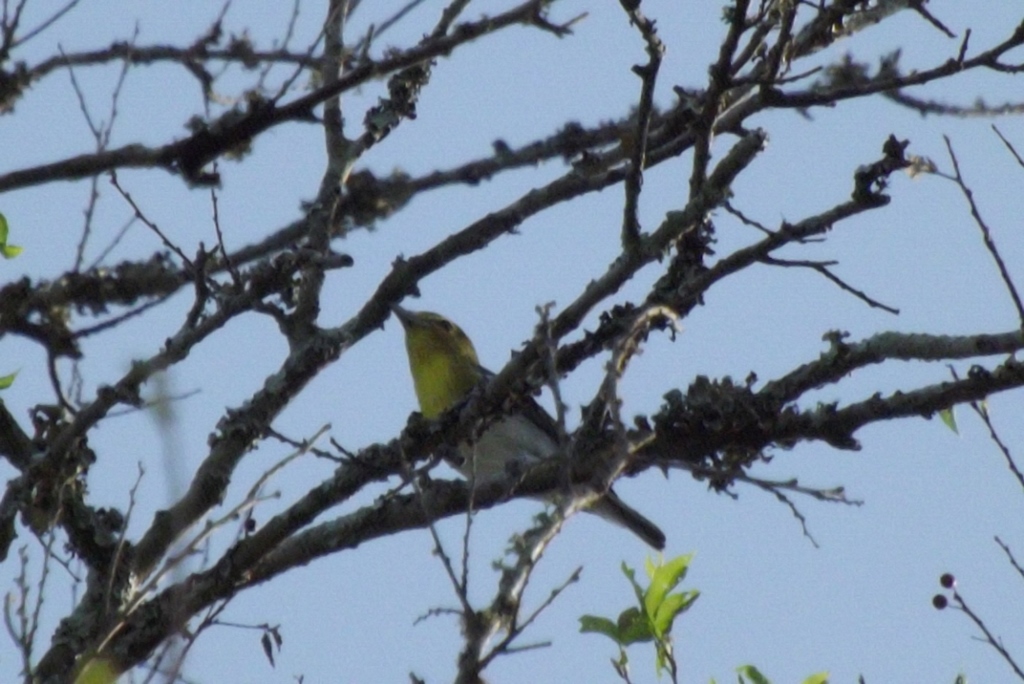
Yellow-throated Vireo inspecting dead branches
American Goldfinch
Baltimore Oriole
Since we're in the thick of bird migration right now, taking another look at snags is well worth the effort!