Showing posts with label Killdeer. Show all posts

Friday, April 30, 2021

Spring Shorebirds

Heavy rains in the springtime often lead to flooding in fields and meadows, which, in turn, attracts migrating shorebirds.  Although I’ve discussed shorebird identification in previous posts, my focus has been primarily coastal species.  However, many other shorebirds pass through inland regions on their way to their nesting grounds (which are also often inland), so you definitely don’t have to be a coastal resident or tourist to see them.  I’ve observed many in northeast-central Mississippi, including in the fields at the Mississippi State University research farms.  In late April, 2020, one of those fields became a stopover for these migrating groups of shorebirds.

To an untrained eye, the field wouldn’t have looked particularly special.  There were ridges of mud and multiple tussocks of grass above the water, and the small, brown birds seemed well camouflaged—at least until they moved!  In this photo, you might be able to make out some of the many shorebirds feeding in the mud.  There were even a few Killdeer—common, familiar birds of pastures and grasslands—at the edges of the puddles.

Killdeer in background, to the right
 One of the easiest species to pick out from the rest was the Long-billed Dowitcher, a rust-colored, comparatively chunky bird with a bill over twice the length of its head.  I described Short-billed Dowitchers in an earlier post, and most of what I said about their appearance applies to the Long-billed species, as well.  The Long-billed Dowitcher’s habits and vocalizations differ drastically from that of its cousin, though: Long-billed Dowitchers are far more likely to be found in freshwater habitats, and their call is high-pitched and sharp. 

Long-billed Dowitcher

Long-billed Dowitcher

 
Another species that stood out from the rest was the Wilson’s Phalarope.  As you can see in the photo below, the strongly contrasting head markings of this species are very distinctive.  Surprisingly, the more colorful of the two phalaropes (the one on the left) was actually a female, while the drabber bird was a male.  Phalaropes exhibit polyandry, which simply means that a female bird will mate with multiple males and lay several clutches of eggs.  The males are responsible for incubating the eggs and, later, raising the young.
 
Wilson's Phalaropes

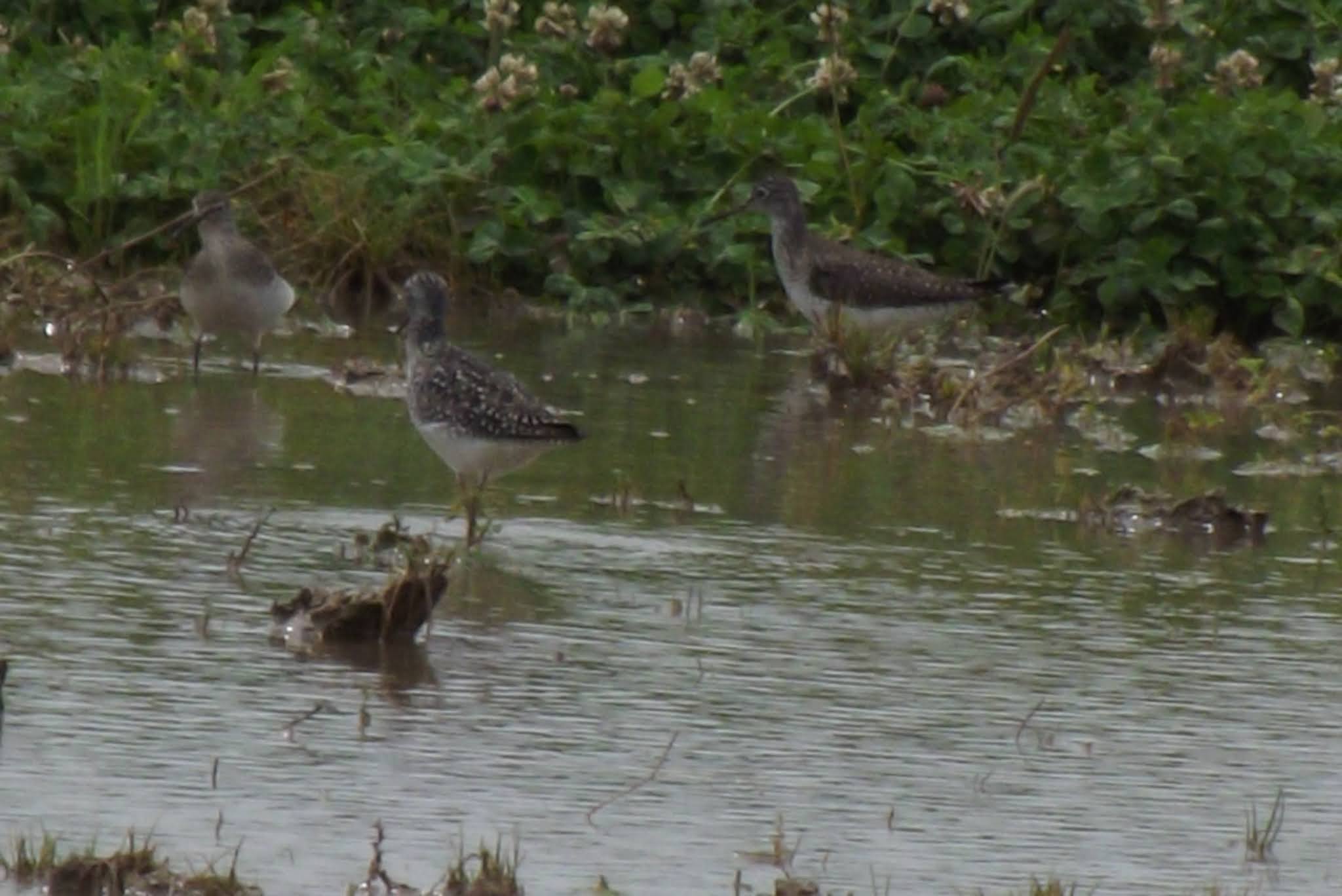
Solitary Sandpipers lurked at the edges of the field, feeding mainly in the weedier areas.  Although these birds aren’t truly “solitary” much of the time, they do tend to avoid mingling with larger flocks.  Some of their distinctive field marks are white bellies, dark brown backs, finely stippled necks, white eye-rings, greenish legs, and black bills. 
 
Solitary Sandpipers
 
In the next photo, the bird in the middle is a different species from the Solitary Sandpipers standing behind it.  It has far heavier white spotting on its back, and its legs are yellow instead of grayish-green.  The color of the legs actually provides an important clue to the bird’s identification: this was a Lesser Yellowlegs.
 
Lesser Yellowlegs and Solitary Sandpipers
 
As it turned out, there were many Lesser Yellowlegs in the flooded field.  They made long strides while foraging, frequently passing though the groups of Long-billed Dowitchers. 
 
Long-billed Dowitchers and Lesser Yellowlegs
 
Smaller numbers of the Greater Yellowlegs prowled the field, as well.  In addition to the size difference, the heavier barring on the underparts and the proportionally longer bill helped to distinguish the Greater Yellowlegs from the Lesser.
 
Greater Yellowlegs
 
 I enjoyed seeing how the Greater Yellowlegs dwarfed their relatives. 
 
Lesser and Greater Yellowlegs
 
Last but not least, there were a couple of Dunlin in the flooded field.  Yes, I often see these on the coast, but I’ve also found them inland on several occasions.  As I’ve mentioned before, their stocky build, relatively short legs, and drooped-tip bills make them distinctive.  They typically occur on the coast in the winter, but, when spring rolls around, they begin to make their way up to the arctic to breed, passing over and through large expanses of inland territory.  Marshes, wetlands, shallow ponds, and flooded fields provide important stopover sites for these migratory birds.
 
Dunlin
 
The last photo shows three species.  Can you identify them? 


Answer:

Long-billed Dowitcher (left), Wilson’s Phalarope (two birds at center), and Lesser Yellowlegs (right).

Sunday, February 28, 2021

Ice Storms

The ice storm that hit during the third week of February threw everything off-kilter for a while.  The ground was crunchy (and, later, slick) with a layer of ice, the roads were impassable, tree limbs sagged, and being outdoors was tolerable for only a few minutes at a time.  I had taken down the bird feeders in the backyard, mainly because I was concerned about freezing rain coating them and clogging up their openings.  If the ice rendered them unusable for the birds, then there would be no point in keeping them up.  However, my mom and I did put birdseed inside the rotting stump (mainly for the benefit of the tree-dwelling birds) and on the frozen ground (for the shrub- and ground-dwellers).  This turned out to be a reasonable solution, and it meant that I didn’t have to worry about continually scraping ice off the tube feeders.

Obviously, the storm system was highly unusual for this region, so it’s probably fair to say that it caused most of the birds and other wildlife to struggle.  Most of the time, birds don’t actually need the food that we put out for them; we feed birds because of the enjoyment we get from watching their activity.  During extreme weather events, however, feeding can sometimes help.  Seed-eating birds, such as sparrows and finches, may have a hard time finding food after a storm buries ground vegetation under a sheet of ice.  

Insectivorous birds may have it even worse.  Freezing weather kills most of their prey, making it difficult for them to find anything to eat.  I was reminded of this fact just a few days into the freezing weather event, when an Eastern Phoebe turned up dead on our front porch.  The bird seemed to be extremely thin, with its keel—the part of the sternum to which the flight muscles attach—very bony and prominent, which makes me suspect that it starved to death.  An American Robin was found on the driveway a couple of days later, dead for the same reason, I would guess.  I stored these birds in the freezer until I could give them to the Department of Wildlife, Fisheries and Aquaculture at Mississippi State University.  They’re going to be part of the ornithology collection.

The deceased Eastern Phoebe
 
The American Robin specimen -- after I'd bagged it for the freezer
Although some omnivorous and insectivorous birds will come to feeders for mealworms, I didn't have any of those available, and phoebes tend to feed more on flying insects than on crawling ones, anyway.  I doubt that anything I could have done would have prevented the deaths of the phoebe and the robin.  Other birds, however, seemed to benefit from the easy pickings in the backyard.  The cold weather drew out many small groups of birds, including some species that I don't see very frequently in this area.  For example, the makeshift feeding station attracted at least fifteen Fox Sparrows.  On normal days, I'm lucky if I see one or two of these large, rust-colored sparrows in the neighborhood.  Some of the sparrows even serenaded us with snippets of their songs.

Fox Sparrows foraging with White-throated Sparrows

Like this Fox Sparrow, most of the songbirds fluffed their feathers out in order to stay warm!
A couple of Rusty Blackbirds also showed up.  Although I occasionally see larger flocks of this species, it isn't an especially common bird around here, either.

Rusty Blackbirds -- with a Fox Sparrow in the background
In the fields between the creek and the end of the driveway, a few Killdeer scavenged for whatever dead insects they could find in the icy grass.  I see Killdeer flying over the neighborhood on a semi-regular basis, but it's less typical of them to forage in these fields.  I think that the grass is usually too high for them.

Killdeer in the field
 
The other species were more common birds for this area, but they were still enjoyable to watch.  Here are some photos of the avian activity in our yard:
Perhaps surprisingly, Brown Thrashers came to eat the seed.
 
American Goldfinches fed on the ground.

A female Eastern Towhee showed up at one point.

White-throated Sparrows (front) were fairly numerous, but I saw only one Song Sparrow (back).
 
Northern Cardinals always put in appearances, even during foul weather.

"Snowbird" is actually a nickname for the Dark-eyed Junco.

Cardinals and juncos used the stump feeder.
 
And Purple Finches did, too.

Although this event is definitely not one that I was eager to experience, I think it provided some interesting perspective—enabling me to think about ecosystems and bird communities in ways that I hadn't considered before.  I'm sure that the birds appreciate the much warmer temperatures that have followed this historic event, though!

Fox Sparrow seemingly enjoying the sun!