Showing posts with label Sam D. Hamilton Noxubee NWR. Show all posts

Thursday, July 31, 2025

The Red-cockaded Woodpecker

If you live in or near pine forest regions of the southeastern United States, you have a decent chance of encountering the Red-cockaded Woodpecker, a specialist of those habitats.  You will likely hear the raspy calls before actually seeing the woodpeckers, which tend to be relatively inconspicuous against the trunks of the pines.  When one of them comes into view, though, it can be distinguished from the far more common Downy and Hairy Woodpeckers by its white cheek patches and completely barred back.  (Downy and Hairy Woodpeckers, in contrast, have striped faces and white backs.)  Males of the species have red feathers—the “cockades”—on the sides of the crown, but, because these are tiny and seldom displayed, they are not a particularly important field mark.

Note the barred back and the white cheeks

These woodpeckers are restricted to open pine forests with sparse understories of palmettos, grasses, shrubs, and other plants.  The open nature of the habitat is a consequence of natural fires, which restrict understory growth and possibly leave younger trees more susceptible to Phellinus pini, or red heart, a fungal disease that damages the heartwood of infected pines.  The softened, diseased wood can then be more easily excavated by Red-cockaded Woodpeckers, which will dig cavities 5-50 feet high in living trees infected with red heart.  Many of these infected trees are well over 40 years in age.  The birds peck into the sapwood above and below the cavities that they create, which results in a flow of sap that deters predators (such as rat snakes) and other animals from accessing the roost or nest holes.
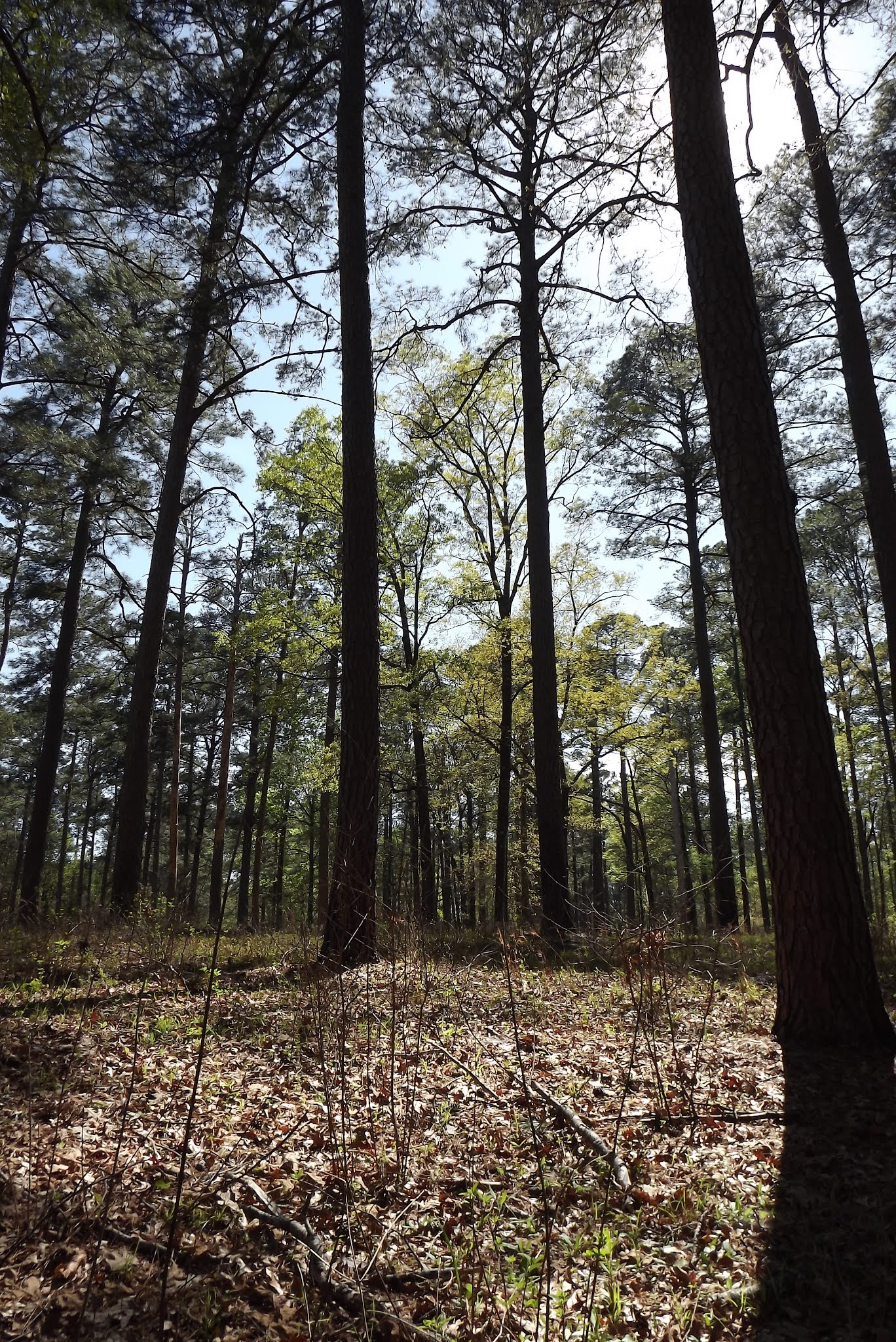
Open pine habitat in early spring

Like most woodpeckers, Red-cockaded woodpeckers make various vocalizations at the nest and during courtship and other encounters.  Drumming on trees—usually pines—is another common means of communication, as are wing-fluttering, open-winged displays, and crest-raising.  The spread-winged display is used to reinforce the pair bond between a male and female.  Eggs are laid from late April to early June in a pre-existing cavity, rather than one that is excavated specifically for a nest.  The eggs are white in color, and become stained with pine resin over the course of the incubation period.  The female of the pair lays one egg per day, with one to six eggs comprising a clutch.  Incubation, which lasts about ten days, is performed by both parents, with the male incubating overnight.  Both parents feed and tend the altricial, pink-skinned, featherless nestlings.  Although the young birds fledge after about 26-29 days, they are at least partially dependent on their parents for up to six months afterward.  The Red-cockaded Woodpecker’s propensity for living in loose colonies or family groups benefits it during the nesting period, as unmated “helper” birds may aid breeding pairs in feeding nestlings and fledglings.  Usually, a pair has only one brood per year.

A foraging Red-cockaded Woodpecker

Interestingly, male and female Red-cockaded Woodpeckers are somewhat segregated according to the types of feeding sites that they use, with males foraging on branches and high on the trunks of pines, and females preferring to forage at lower elevations and only on the trunks.  Both sexes eat mainly insects and other arthropods, including cerambycid beetles, larvae and grubs of various species, ants, and millipedes.  On occasion, they will also consume small fruits and seeds. 

Although the Red-cockaded Woodpecker is a fairly widespread species, it is patchily distributed due to its highly specialized niche.  Habitat loss remains a serious threat to these woodpeckers, so conservation efforts generally focus on preserving tracts of large pines and subjecting them to controlled burning to clear the understory layers.  These measures seem to be working.  Just last year, the U.S. Fish and Wildlife Service downlisted the species from endangered to threatened.  Any birder or naturalist who is fortunate enough to live near one of the managed populations would do well to keep a sharp eye—and ear—out for these fascinating little woodpeckers during this summer and fall.


Sources:

Ligon, J. D.  1970.  Behavior and breeding biology of the Red-cockaded Woodpecker.  Auk        87(2):255-278.

https://www.fws.gov/press-release/2024-10/downlisting-red-cockaded-woodpecker-endangered-threatened

Monday, June 30, 2025

Observing Gallinules

My first sighting of a gallinule was over twenty years ago at Noxubee National Wildlife Refuge.  It was a Purple Gallinule, and utterly unmistakable: violet head, neck, and breast blending to green on the back and wings; long, yellow legs; red-and-yellow bill; ruffled white undertail feathers; and a chicken-like gait and stance.  I later saw Common Gallinules (then called Common Moorhens—they were split from the Old World species in 2011), as well.  I had heard them calling at a heronry in south-central Mississippi before that, but had not seen them.  As it turns out, even though gallinules may be less secretive than their cousins, the rails, they don’t always make themselves obvious.

Perfect gallinule habitat -- and a gallinule in the upper right corner.

However, this time of year—late summer—is one of the best times to look for them.  Both Common and Purple Gallinules can be found on many ponds and lakes in the southeastern United States.  They need lots of aquatic vegetation on which to build their nests and search for food.  In the summer months, they are surprisingly active and vocal, and often have chicks in tow.  

This Common Gallinule swims with its three young.

This Purple Gallinule stays with its chick.

Gallinule clutch sizes are fairly large; eight is a typical number of eggs, although, obviously, not all of the chicks will survive to adulthood.  In the video below, you can see three Common Gallinule young swimming with the adult.

Gallinules consume a variety of foods, including aquatic vegetation and invertebrates.  Their long toes enable them to walk on floating vegetation (generally lily and lotus pads) while foraging.  They sometimes pluck insects and snails from the undersides of leaves, as you can see in the following video of a Purple Gallinule chick:

Because their nesting period is generally in the spring, their young are pretty far along in development by this point.  It also helps that they are born semi-precocial, rather than altricial.  This means that, unlike songbird chicks, they are feathered and have their eyes open.  Unlike precocial Killdeer chicks, though, they still stay in the nest for a day or so and must be fed by their parents for several days.  Once out of the nest, they can climb through vegetation using the tiny claws on their wings.  This is a feature of birds in Rallidae, the rail family.

This Purple Gallinule chick is stretching its wings.

It takes several weeks for gallinule chicks to learn to fly, and it could be argued that they are never truly comfortable with that skill!  On lakes and ponds, gallinules generally fly for only short distances, but some North American populations do migrate from breeding territories to wintering grounds in southern North America or Central America.  The vast majority of Common and Purple Galinules actually occur in South America, where they are permanent residents.

An immature Purple Gallinule -- old enough to be away from its parents, but not old enough for adult plumage.  Note the white undertail coverts, though.  Adult birds have these, too.

Some of my favorite places to see gallinules are Noxubee NWR and Ross Barnett Reservoir.  Of course, there are many other areas to look, and, if you go exploring, you just might discover a new hotspot. 


Sources:

Bannor, B. K. and E. Kiviat (2020). Common Gallinule (Gallinula galeata), version 1.0. In Birds of the World (A. F. Poole and F. B. Gill, Editors). Cornell Lab of Ornithology, Ithaca, NY, USA. https://doi.org/10.2173/bow.comgal1.01.

West, R. L. and G. K. Hess (2020). Purple Gallinule (Porphyrio martinica), version 1.0. In Birds of the World (A. F. Poole and F. B. Gill, Editors). Cornell Lab of Ornithology, Ithaca, NY, USA. https://doi.org/10.2173/bow.purgal2.01.


Tuesday, January 31, 2023

Common Gallinules at the Refuge

Over the last few years, Common Gallinules have become more common at Sam D. Hamilton Noxubee National Wildlife Refuge during the winter.  While they have long been regular summer residents in the area, the overwintering is apparently a fairly recent development.  Is it a bad sign?  A good one?  Neutral?  I'm not entirely sure.  I suspect that it may be related to climate change (in this case, increasingly warm winters in north Mississippi), so it's certainly a potentially concerning development, and worth monitoring.

During the winter, these Noxubee NWR gallinules spend most of their time around the edges of the lakes, and occasionally mingle with American Coots.  Here are some photos:

The Gallinule is to the right of the American Coot

Gallinule -- note the white lines on the sides of the body.
.
Lots of foraging in the shallows!

The lake.  What you can't see is the biting wind!


Sunday, July 31, 2022

Gallinules

My first sighting of a gallinule was around twenty years ago at Noxubee National Wildlife Refuge.  It was a Purple Gallinule, and utterly unmistakable: violet head, neck, and breast blending to green on the back and wings; long, yellow legs; red-and-yellow bill; ruffled white undertail feathers; and a chicken-like gait and stance.  I later saw Common Gallinules (then called Common Moorhens—they were split from the Old World species in 2011), as well.  I had heard them calling at a heronry in south-central Mississippi before that, but had not seen them.  As it turns out, even though gallinules may be less secretive than their cousins, the rails, they don’t always make themselves obvious.

Perfect gallinule habitat -- and a gallinule in the upper right corner.

However, this time of year—late summer—is one of the best times to look for them.  Both Common and Purple Gallinules can be found on many ponds and lakes in the southeastern United States.  They need lots of aquatic vegetation on which to build their nests and search for food.  In the summer months, they are surprisingly active and vocal, and often have chicks in tow.  

This Common Gallinule swims with its three young.

This Purple Gallinule stays with its chick.

Gallinule clutch sizes are fairly large; eight is a typical number of eggs, although, obviously, not all of the chicks will survive to adulthood.  In the video below, you can see three Common Gallinule young swimming with the adult.

Gallinules consume a variety of foods, including aquatic vegetation and invertebrates.  Their long toes enable them to walk on floating vegetation (generally lily and lotus pads) while foraging.  They sometimes pluck insects and snails from the undersides of leaves, as you can see in the following video of a Purple Gallinule chick:

Because their nesting period is generally in the spring, their young are pretty far along in development by this point.  It also helps that they are born semi-precocial, rather than altricial.  This means that, unlike songbird chicks, they are feathered and have their eyes open.  Unlike precocial Killdeer chicks, though, they still stay in the nest for a day or so and must be fed by their parents for several days.  Once out of the nest, they can climb through vegetation using the tiny claws on their wings.  This is a feature of birds in Rallidae, the rail family.

This Purple Gallinule chick is stretching its wings.

It takes several weeks for gallinule chicks to learn to fly, and it could be argued that they are never truly comfortable with that skill!  On lakes and ponds, gallinules generally fly for only short distances, but some North American populations do migrate from breeding territories to wintering grounds in southern North America or Central America.  The vast majority of Common and Purple Galinules actually occur in South America, where they are permanent residents.

An immature Purple Gallinule -- old enough to be away from its parents, but not old enough for adult plumage.  Note the white undertail coverts, though.  Adult birds have these, too.

Some of my favorite places to see gallinules are Noxubee NWR and Ross Barnett Reservoir.  Of course, there are many other areas to look, and, if you go exploring, you just might discover a new hotspot. 


Sources:

Bannor, B. K. and E. Kiviat (2020). Common Gallinule (Gallinula galeata), version 1.0. In Birds of the World (A. F. Poole and F. B. Gill, Editors). Cornell Lab of Ornithology, Ithaca, NY, USA. https://doi.org/10.2173/bow.comgal1.01.

West, R. L. and G. K. Hess (2020). Purple Gallinule (Porphyrio martinica), version 1.0. In Birds of the World (A. F. Poole and F. B. Gill, Editors). Cornell Lab of Ornithology, Ithaca, NY, USA. https://doi.org/10.2173/bow.purgal2.01.


Sunday, October 31, 2021

Nature Viewing

The fall bird migration is starting to wind down in most places, but that doesn’t mean that there aren’t many birds to observe.  If you know where to look, you may find a wider variety of species than you would have guessed would be present.  Come along and see!

Cattle Egrets, ubiquitous in fields and pastures across the southeastern U.S. during the summer months, have mostly made their way south to the Gulf Coast, Florida, Mexico, and Central America.  However, you can still find some stragglers here and there, mainly around large bodies of water.  In the photo below, a small flock of Cattle Egrets congregate in a shrubby cypress tree at Bluff Lake.  In a month or so, they will most likely have departed for warmer territories where insects are abundant.

Cattle Egrets roosting at Noxubee National Wildife Refuge

Anhingas, the long-necked “snakebirds” of southern swamps, seem to be increasingly common on inland bodies of water during the winter months.  This may be due to climate change, but, regardless of the cause, checking for these birds in the field right now is well worth the effort.  Watch for their long, snake-like necks that they hold above the water as they swim, or scan the trees for perched birds that are busy airing out their wet wings.  These seemingly odd habits stem from the fact that Anhingas lack the oily plumage that provides ducks and geese with waterproofing and improved buoyancy.  Instead of bobbing on the surface, they dive for fish under the water.

Anhinga at Noxubee NWR

Another species that you can still find in some numbers on lakes and ponds is the Common Gallinule, a close relative of the abundant American Coot.  Gallinules tend to be slightly more secretive and retiring than coots, generally staying close to the shorelines or swimming among floating vegetation.  Their vividly-colored bills and the white streaks of feathers across their flanks make them easy to identify.  You can also listen for their loud, squawking calls carrying across the marsh.

Common Gallinules swimming at Noxubee NWR

Some birds that are usually common year-round, such as Eastern Phoebes, may still come as pleasant surprises in the field.  The ice storm of February 2021 killed many of the flying insects that phoebes, warblers, and certain other insectivorous bird species rely on for food, so some of these birds starved to death.  Phoebe numbers, in particular, seemed remarkably low this spring and summer.  Recently, though, I’ve noticed phoebes returning to areas from which they had apparently disappeared—an encouraging example of nature’s resilience.

Eastern Phoebe perched in cypress tree

These are all just my observations, though.  If you’re a birder, the most rewarding thing to do is to make your own discoveries in the field.  You never know what you might find!

Wednesday, September 29, 2021

"Fall" in Love with the Refuge

On a warm day in late October, well over a decade ago, my mom and I drove to the Noxubee Refuge to spend some time birding and just winding down from a busy week.  It was a beautiful day, although humid.  Of course, the humidity might have had an effect on us, but it seemed to have very little effect on the wildlife at the Noxubee National Wildlife Refuge--birds, mammals, butterflies.  

Butterflies were everywhere at Morgan Hill, our first stop.  The bright sunlight was drawing them out along the trail leading through the Black Belt prairie.  Most of the butterflies of the fall season are rusty-tinted, and these were no exception.  Gulf Fritillaries, bright orange with nearly three-inch wingspans, were very abundant.  Orange Sulphurs, less intense in color, were also common.  Angle-winged Question Marks and Commas showed up, also, along with a few Painted Ladys, Monarchs and one Red Admiral, dark brown with red-orange bars on its wings.  Cloudless Sulphurs brought touches of yellow to the scene.  They were not confined to the prairie, though; they had flitted in front of our vehicle as we had made our way down the road earlier.

Grasshoppers scattered as we walked, some of them unfurling delicate wings as colorful as some of the butterflies.  On the gravel-covered path, Buckeyes, little butterflies sporting peacock-like eyespots and red and white “paint” on their brown wings, were surprisingly numerous, and I saw one Variegated Fritillary.  Smaller than the Gulf Fritillary, this species has paler but more intricately patterned wings.  By looking closely at a small passionflower (also known as maypop) plant growing on the trail, I spotted two tiny Gulf Fritillary caterpillars.


Of course, there were birds to be seen in addition to the insects.  The sparrows had arrived in flocks, and Savannah, Swamp, Song, and White-throated Sparrows and Dark-eyed Juncos flew out of the grasses at every step we took.  Eastern Bluebirds eyed us from their perches atop the few small trees dotting the hill.  Zhip!  With a sharp call and a flick of its tail, an Eastern Phoebe joined them. 

When my mom and I arrived back at the parking area, a big Woolly Bear caterpillar lurched its way across the gravel and over to some leaf litter in the nearby thicket where it would be safe.  As we left the prairie, a female American Kestrel gave us a great show as it hovered over the field and then landed in a huge oak tree.  A group of eleven Wild Turkeys was foraging in the same area.

Next we headed to Goose Overlook for more watching.  The water was nice and clear at Bluff Lake, where the observation point is located.  It was a little early for ducks, but there were plenty of Canada Geese wading in the shallows.  Chickadees, titmice, woodpeckers and wrens chattered in the surrounding woods.  A flock of Yellow-rumped Warblers landed in a cypress tree, flicking their wings and scrambling over the branches for insects.  We were amused by these antics but soon decided to walk down Woodpecker Trail, a path cutting through areas of both pine and mixed woods.  There were lots of small birds and several small dusty-brown Carolina Satyr butterflies.  Our shoes and socks soon became spotted with clinging Beggar’s Lice from the many plants growing on the edges of the trail. 

After spending time at Goose Overlook, we headed back to Morgan Hill Prairie.  It didn’t take long for me to spot some species I hadn’t seen on the prairie earlier.  A small butterfly alighted on a twig, and from the orange, brown and white wings and long, beak-like extension of the head, it was evident that this was a Snout Butterfly.  Several birds suddenly flew up in front of us and landed in the small trees and shrubs—bluebirds, Savannah Sparrow, juncos—but there was something else:  a Palm Warbler.  This brown-streaked little bird with the yellow undertail was only a few feet away from us.  A small bright-green caterpillar was clasped in its bill, and at first it seemed that the bird would soon eat it.  But the caterpillar was still very much alive; and as we watched, it reached down and grabbed the branch that the warbler was perched on.  The bird jerked its head up, pulling the caterpillar off the branch, but the insect was not ready to give up.  Suspended from the warbler’s bill, it suddenly curled into a tight ball, and the bird dropped it.  Oops!  The bird was probably pretty upset about losing this meal, and it dived down into the shrub to search for it.  We didn’t hang around long enough to see what finally happened, but I can imagine the caterpillar crawling off with a great battle story to retell all of its short life.

It was time to head out of the refuge, so we left, reflecting that the relaxing yet entertaining day there had definitely been worth the bother of going.

Saturday, July 31, 2021

The Red-cockaded Woodpecker: A Life History

It occurs to me from time to time that I am privileged to live in an area where I can regularly see a federally Endangered bird species—the Red-cockaded Woodpecker—if I choose.  These woodpeckers have small colonies at several locations in and around Noxubee National Wildlife Refuge, and they are relatively easy to detect—all a birder has to do is listen carefully for the raspy, nasal calls in the refuge’s pine woods.  If one of these medium-sized, black-and-white woodpeckers comes into view, it can be distinguished from the far more common Downy and Hairy Woodpeckers by its white cheek patches and completely barred back.  (Downy and Hairy Woodpeckers, in contrast, have striped faces and white backs.)  Males of the species have red feathers—the “cockades”—on the sides of the crown, but, because these are tiny and seldom displayed, they are not a particularly important field mark.

Note the barred back and the white cheeks

This endangered woodpecker is restricted to open pine forests with sparse understories of palmettos, grasses, shrubs, and other plants.  The open nature of the habitat is a consequence of natural fires, which restrict understory growth and possibly leave younger trees more susceptible to Phellinus pini, or red heart, a fungal disease that damages the heartwood of infected pines.  The softened, diseased wood can then be more easily excavated by Red-cockaded Woodpeckers, which will dig cavities 5-50 feet high in living trees infected with red heart.  Many of these infected trees are well over 40 years in age.  The birds peck into the sapwood above and below the cavities that they create, which results in a flow of sap that deters predators (such as rat snakes) and other animals from accessing the roost or nest holes.

Open pine habitat in early spring

Like most woodpeckers, Red-cockaded woodpeckers make various vocalizations at the nest and during courtship and other encounters.  Drumming on trees—usually pines—is another common means of communication, as are wing-fluttering, open-winged displays, and crest-raising.  The spread-winged display is used to reinforce the pair bond between a male and female.  Eggs are laid from late April to early June in a pre-existing cavity, rather than one that is excavated specifically for a nest.  The eggs are white in color, and become stained with pine resin over the course of the incubation period.  The female of the pair lays one egg per day, with one to six eggs comprising a clutch.  Incubation, which lasts about ten days, is performed by both parents, with the male incubating overnight.  Both parents feed and tend the altricial, pink-skinned, featherless nestlings.  Although the young birds fledge after about 26-29 days, they are at least partially dependent on their parents for up to six months afterward.  The Red-cockaded Woodpecker’s propensity for living in loose colonies or family groups benefits it during the nesting period, as unmated “helper” birds may aid breeding pairs in feeding nestlings and fledglings.  Usually, a pair has only one brood per year.

A foraging Red-cockaded Woodpecker

Interestingly, male and female Red-cockaded Woodpeckers are somewhat segregated according to the types of feeding sites that they use, with males foraging on branches and high on the trunks of pines, and females preferring to forage at lower elevations and only on the trunks.  For this reason, I suspect that most of the Red-cockaded Woodpeckers that I have seen near the refuge’s Visitor Center have been females.  Both sexes eat mainly insects and other arthropods, including cerambycid beetles, larvae and grubs of various species, ants, and millipedes.  On occasion, they will also consume small fruits and seeds. 

Although the Red-cockaded Woodpecker is a fairly widespread species, it is patchily distributed due to its highly specialized niche.  It is considered an endangered species across its range, which extends from the southeastern Atlantic Coast to Oklahoma and Texas.  Habitat loss remains the most serious threat to these woodpeckers, so conservation efforts generally focus on preserving tracts of large pines and subjecting them to controlled burning to clear the understory layers.  Any birder or naturalist who is fortunate enough to live near one of the managed populations would do well to keep a sharp eye—and ear—out for these fascinating little woodpeckers during this summer and fall.


Source:

Ligon, J. D.  1970.  Behavior and breeding biology of the Red-cockaded Woodpecker.  Auk        87(2):255-278.

Wednesday, March 31, 2021

Seasonal Changes at Noxubee National Wildlife Refuge

Although it seemed at first that it might take a while for the Southeast to recover from the ice storms of last February, spring weather has pushed its way into most of these previously frozen areas.  As many readers are already well aware, I frequently visit Sam D. Hamilton Noxubee National Wildlife Refuge to enjoy the natural sights.  I did just that a few days ago.  The woods at Noxubee are beautiful right now, with plenty of blooming trees, such as flowering dogwood.  The cypresses that grow all around the two main lakes have just started unfurling their leaves, and the oaks and redbuds have nearly completed their leafing-out.

Flowering dogwood
The birdlife at Noxubee is in the process of a changeover, with winter residents—such as ducks and most of the sparrow species—leaving the area, and the summer residents—including Purple Martins, Northern Parulas, some types of wading birds, and warblers—settling in.  That is exactly what’s happening right now at Bluff Lake.  In this photo from earlier in the month, you can see an enormous raft of American Coots: 

However, near the end of the month, the coots are nearly all gone from the refuge:

Instead, what can be seen from Bluff Lake right now are the Great Egrets beginning their breeding period.  They roost and nest in the cypress trees over the water.  Cattle Egrets, Little Blue Herons, White Ibises, and several other species also use these trees, but the population of Great Egrets at this location has really exploded in recent years, likely as a result of the trees growing taller.  The smaller Cattle Egrets still nest at the lake, but their numbers are a bit lower than they were a decade or two ago.

Great Egrets at heronry
Little Blue Herons are very common at the refuge, as well, even though they never appear in numbers as high as those of Cattle and Great Egrets.  These Little Blues can be seen foraging in one of the marshy shorelines of Bluff Lake.  Their slate blue coloration is distinctive, and they are unlikely to be confused with other herons in this part of the country.  Unlike the adults, though, juvenile Little Blue Herons are almost entirely white, with touches of gray on their wingtips.  They acquire a patchwork white-and-blue appearance as they gradually molt into adult plumage.

Little Blue Herons foraging in the grass

 
Little Blue Herons

Other spring water birds of note are Blue-winged Teal.  Although these small ducks generally do not overwinter in northern Mississippi in large numbers, flocks of them do pass through regularly during spring and fall migration.  The photo below shows two teal swimming in the shallows of Loakfoma Lake.  The male duck has a prominent white crescent-shaped marking on the face, while the female has buff-colored scallop markings on the wings and flanks. 
Blue-winged Teal
If you spend some time scanning the cypress and pine snags over the water or near the shore, you may spot a Bald Eagle or two.  These huge raptors nest at the refuge every year, and can often be detected by their startlingly chirpy, piping calls.  In the middle part of the 20th century, Bald Eagle populations experienced sharp declines as a result of DDT poisoning, but they have since rebounded, and it now seems that nearly every large body of water in the Southeast may have a pair of eagles nearby.  But Bald Eagles’ commonness doesn’t take anything away from their amazing charisma, in my opinion.  No matter where I am, I love seeing them.
Yes, spring is here.  The temperatures are still fluctuating quite a bit, which is normal, but the heavy rains and strong storms, blossoming and leafing-out plants, and breeding and migrating birds signify the change in seasons. Be sure not to miss it!