Showing posts with label Snowy Egret. Show all posts

Saturday, January 31, 2026

Sunset

I love walking on the beach near sunset, especially when the weather isn’t too warm.  The sand feels delightfully soft and cool, the clouds stretch across the sky in gorgeous pastel shades, and waves provide a relaxing soundtrack as they steadily lap the shoreline.

The seashore birds’ calls—some raucous, some guttural, and some piping—punctuate the sounds of the water and wind.  Black-bellied Plovers may look fairly drab in their winter plumage, but their plaintive, whistling notes are anything but dull.  These close relatives of the familiar, pasture-loving Killdeer remain on the Gulf Coast through the winter, but migrate north in the spring.  It amuses me that this bird doesn’t have a black belly at all during this time of year.

Black-bellied Plover at the shoreline

Like most egrets and herons, the Snowy Egret has a very unmelodious—even grating—call.  But few people would deny its elegance as it gracefully strides through the tide pools, hunting for small fish and invertebrates.  Although the water is a bit too cold for me, the Snowy Egret appears to pay it no mind.  Black legs ending in bright yellow feet are one of its identifying features.

Snowy Egret striding

While the egret moves off, the small, browinish Dunlin comes forward to prod the mud near the edge of the pool with its pointed beak.  The Dunlin is a common winter visitor and migrant on the Gulf Coast, and, on most beaches, only the grayish but equally small Sanderling outnumbers it.  These species may mingle with each other, but the Dunlin tends to feed in somewhat deeper water, as the slightly greater length of its bill would suggest.

Snowy Egret and Dunlin foraging

As I look up and slightly to the right, I see several more species of shorebirds, including Marbled Godwit, Willet, and Semipalmated Plover.  The larger individuals, such as the godwits and the willets, forage in the deeper water, while the smaller plovers and dunlins stay in the shallower sections.  The names godwit and willet may seem strange, but they were intended as transcriptions of the birds’ calls.  I hear neither of these species calling at the time, but the persistent chirps and whistles of the others more than make up for that.

Shorebirds foraging in the tide pools

The sun starts to drop below the horizon, signaling that it’s time for me to leave.  I will miss the sights, sounds, and sensations of the beach, and I hope that I can re-experience them soon.


Wednesday, May 31, 2023

Reporting from the Coast

How about a nice, long walk?  I find that strolling up and down a stretch of seashore helps me to decompress.  Any time of the year can be good, but springtime is surely one of the most interesting seasons for avian life—especially on the Mississippi coast.

It is late afternoon.  A lone Reddish Egret stalks fish in the cobalt waters.  Its blue-gray body—with touches of white—and rust-colored head and neck echo the tints of the waves.  Found almost exclusively in coastal regions, this species occurs in a white form as well as the more familiar “reddish” morph.  This individual appears almost stately—perhaps it is wary of beach walkers—but Reddish Egrets are frequently very lively foragers, darting back and forth and flicking their wings outward to startle their prey. 

Reddish Egret
The egret isn’t the only wading bird braving the waves: a trio of Marbled Godwits—migratory transients on the Gulf Coast—also feeds in the surf.  They’ll likely have moved on, northward, in a month or two.

Marbled Godwits
The same cannot be said for the ubiquitous Laughing Gulls.  These coastal residents remain here all year long, and are as opportunistic as they are common.  Many people view Laughing Gulls as nothing more than nuisances, but I think this is an unfair assessment of these long-lived and clever birds.  Like crows, raccoons, and black bears, they have figured out how to exploit human resources, and we hate them for it!  I don’t think the gulls are too concerned about this, however.
Laughing Gulls
The Reddish Egret from earlier paces in front of the group of gulls.  Are the pickings better over this way?  Maybe, maybe not.

Reddish Egret and Laughing Gulls
A Snowy Egret shows up to survey the surf for small fish.  As you can probably tell from the photo, this species is considerably smaller than the Reddish Egret.  Like its larger relative, it often displays a particularly active foraging style, with lots of “dancing” in and out of the waves.  The larger wading birds, such as Great Blue Herons and Great Egrets, tend to be more sedate in their hunting behavior.  This Snowy, however, mostly stands still and makes itself compact, probably as protection from the wind.
Snowy Egret and Laughing Gulls
Farther up the beach, a Ruddy Turnstone turns over … not a stone, but a leaf.  What is it finding in the sand?  Tiny insects?  Possibly so—this is a fairly opportunistic hunter.  Like the Marbled Godwit, it’s a species that breeds farther north.  It will probably migrate soon, but, in the meantime, it frequents the beaches with other migratory shorebirds, flashing its stunning black-and-white wing patterns whenever it flies up the shoreline in search of prey.
Ruddy Turnstone
Tire tracks show where someone has driven an ATV up the beach.  Laughing Gulls, Black Skimmers, and a few Sanderlings congregate just past these markings, while Dunlin rest closer to the dunes.  They remind me of cattle, with their (tucked-in) heads all turned in the same direction. 
Beach birds

Laughing Gulls and Sanderling

Dunlin
A close-up of snoozing Dunlin reveals subtle markings, which would help to camouflage these birds in the sand and mud.

Dunlin markings
Other migratory shorebird species on the beach sands are Black-bellied Plovers and Willets.  The plovers are still mostly in drab winter plumage, but they’re showing signs of molting into breeding plumage, in which they will have black bellies.  The Willets are similarly dull and gray, since they haven’t finished molting into their barred-and-mottled breeding plumage.  Willets are common all over the beaches at this time of year.
Black-bellied Plovers and Sanderlings

Black-bellied Plover and Dunlin

Willets and Laughing Gull
Rounding out the beach bird community are Black Skimmers.  It’s still early enough in the day that these crepuscular birds probably haven't made too many trips away from the shore.  They will head out in larger numbers closer to evening, when they fly low over the water and drag their ultra-long, red-and-black bills along the surface to find fish to snap up.  Right now, resting along the beach, they look a bit odd and awkward, propped up on their stumpy legs and with their colossal bills slanting downward.  At evening, however, their unusual adaptations will serve them well, making them highly efficient hunters.
Black Skimmers, Laughing Gulls, and Dunlin
For a diurnal mammal like me, though, it’s about time to turn in for the night.  Since this is spring, coming back to the beach later will likely mean reporting on a slightly different group of birds—a unique mixture of resident species and transients—as migration continues.

Tuesday, November 30, 2021

Beach Sunset

I love walking on the beach near sunset, especially when the weather isn’t too warm.  The sand feels delightfully soft and cool, the clouds stretch across the sky in gorgeous pastel shades, and waves provide a relaxing soundtrack as they steadily lap the shoreline.

The seashore birds’ calls—some raucous, some guttural, and some piping—punctuate the sounds of the water and wind.  Black-bellied Plovers may look fairly drab in their winter plumage, but their plaintive, whistling notes are anything but dull.  These close relatives of the familiar, pasture-loving Killdeer remain on the Gulf Coast through the winter, but migrate north in the spring.  It amuses me that this bird doesn’t have a black belly at all during this time of year.

Black-bellied Plover at the shoreline

Like most egrets and herons, the Snowy Egret has a very unmelodious—even grating—call.  But few people would deny its elegance as it gracefully strides through the tide pools, hunting for small fish and invertebrates.  Although the water is a bit too cold for me, the Snowy Egret appears to pay it no mind.  Black legs ending in bright yellow feet are one of its identifying features.

Snowy Egret striding

While the egret moves off, the small, browinish Dunlin comes forward to prod the mud near the edge of the pool with its pointed beak.  The Dunlin is a common winter visitor and migrant on the Gulf Coast, and, on most beaches, only the grayish but equally small Sanderling outnumbers it.  These species may mingle with each other, but the Dunlin tends to feed in somewhat deeper water, as the slightly greater length of its bill would suggest.

Snowy Egret and Dunlin foraging

As I look up and slightly to the right, I see several more species of shorebirds, including Marbled Godwit, Willet, and Semipalmated Plover.  The larger individuals, such as the godwits and the willets, forage in the deeper water, while the smaller plovers and dunlins stay in the shallower sections.  The names godwit and willet may seem strange, but they were intended as transcriptions of the birds’ calls.  I hear neither of these species calling at the time, but the persistent chirps and whistles of the others more than make up for that.

Shorebirds foraging in the tide pools

The sun starts to drop below the horizon, signaling that it’s time for me to leave.  I will miss the sights, sounds, and sensations of the beach, and I hope that I can re-experience them soon.


Monday, May 31, 2021

An Afternoon at the Beach

As regular readers probably already know, I love spending time on the Gulf Coast.  This spring, I was able to spend a few days enjoying the natural sights in parts of coastal Mississippi and Alabama.  Let’s take a look at some of the avian life that I observed in an afternoon on the Mississippi coast!

It was a pleasant day at the Ocean Springs public beach, and the area was teeming with birds.  Snowy Egrets waded near the shore, darting back and forth in the shallows as they searched for fish and aquatic invertebrates.  They occasionally stopped and flew farther up the beach to find better pickings.

Snowy Egrets
Gulls, terns, cormorants, and pelicans perched on old pilings.  The size difference between the species Laughing Gull and Herring Gull is apparent in the next couple of photos.  Most of the Herring Gulls that I saw had not yet attained adult plumage—probably because it takes the birds four years to reach maturity.  Herring Gulls’ slow maturation goes hand-in-hand with their longevity, though; individuals have been known to live for several decades in the wild.  I imagine that the older ones are the wiliest of beach marauders. 

Herring Gulls, Laughing Gull (foreground), and Double-crested Cormorant (at right)

Herring Gull in middle, Laughing Gulls above and below
In addition to the Herring Gulls, there were dozens of Laughing Gulls milling around on the beach and foraging over the water.  Their raucous calls rang out in the salty air.

Laughing Gull flock
Black Skimmers, which, as their name suggests, hunt for fish by gliding low over the water and skimming the surface with their long bills, formed their own sizeable flocks on the sandbars.  They also sometimes mingled with the Laughing Gulls, but they did not fly out to hunt.  Unlike the more diurnal gulls and terns, skimmers tend to be crepuscular, foraging mainly during dawn and dusk.  I can relate; I don’t always feel so energetic during the heat of midday, either.  Skimmers actually have more rods than cones in their eyes than most birds do, which makes it easier for them to hunt in dim light. 

Gulls and Black Skimmers
A few Ring-billed and Bonaparte’s Gulls were mixed in with the enormous flocks of Laughing Gulls.  Ring-billed Gulls bear distinctive black markings on their bills, and Bonaparte’s Gulls—during winter and spring, at least—have smudgy dark spots on their heads.  Both species are common on the Gulf Coast from fall to spring, although they’re far less numerous than Laughing Gulls.

Ring-billed Gull strolling along

Bonaparte's Gull swimming

At one point, most of the roosting and foraging birds were stirred up by … something.  The flocks of gulls and skimmers simply exploded upward in a flurry of wingbeats.  What was going on? 

Stirred up!
Looking around, I deduced that the source of the consternation was an adult Bald Eagle that was perched in a giant live oak tree.  Wow!  Bald Eagles will certainly catch gulls and other shorebirds if they get the opportunity, but, given that this one had been detected already by its potential prey, I think that its chances of obtaining a poultry meal at this site were slim.

The Bald Eagle

Apparently, even a predator as fierce as a Bald Eagle is a bit less frightening to smaller birds if they can let it know that they can see it.  This is probably why a bunch of the Laughing Gulls dive-bombed the eagle—taunting it prevented it from launching a surprise attack on the flock. 

Gull flying over eagle's head
Overall, it was a great afternoon for birding on the Gulf Coast.  Stay tuned for more in later posts!

Monday, March 30, 2020

Beach Birds

Earlier this month, my family and I spent a few days on Dauphin Island, AL.  Given the current pandemic situation, this is likely to be our last coastal trip in quite a while, so I thought it would be interesting to discuss yet more “tricky birds” that I observed (for more of that series, see here and here) and show some of the other avian life that can be found on the Gulf Coast.

This year’s visit was slightly earlier in the season than the one that we made last year—but only slightly.  Even so, the assortment of gulls, terns, and shorebirds on the public beach was fairly different from last time.  I saw only one Black Skimmer, and no Forster’s Terns at all.  But plovers, particularly Semipalmated and Piping, were abundant.  Small, brown sandpipers were also everywhere.  In the photo below, three species are depicted.  What are they?
The ten or so birds in the foreground (plus the one farthest to the left in the back) are chunky with drab, brownish upperparts, white bellies, grayish legs, and semi-long bills that droop at the tips.  If you remember the previous identification post, you may recall that these are Dunlins.  They spend the winter on the coast before migrating to Alaska and northern Canada for the breeding season.
Resting Dunlin
The remaining seven birds are all plovers, but you’ve probably noticed that two of them have very pale plumage compared to the rest.  The five darker plovers are Semipalmated Plovers, and the two paler ones are Piping Plovers.  You can tell that the Semipalmated Plovers have dark bands of feathers that completely encircle their breasts, while the Piping Plovers have incomplete breast-bands.  Both species have orange legs, unlike the Snowy Plover, which has grayish legs.  Like the Dunlin (but unlike the Snowy Plover), the Semipalmated and Piping Plovers do not remain on the Gulf Coast to breed.
Piping Plover
Even more species of shorebirds were to be found at the tide pools.  While I was walking beside one of these pools, I noticed this group of tiny sandpipers.  The two birds in front were obviously not Dunlins or Sanderlings, since they were much smaller in size and had brighter and more mottled plumage.  
The next photo, showing the beak and legs, makes everything perfectly clear: these birds are Least Sandpipers.  Their moderately short, slightly decurved bills; short, yellow legs; and warm-brown upperparts help to distinguish them from other shorebirds.  As you might guess, they migrate northward at this time of year, as well.
Least Sandpiper
As I’ve mentioned before, even though it can be overwhelming to stumble upon large groups of similar-looking bird species, being patient with yourself and going through a mental checklist of field marks for each bird will enable you to identify most or all of them without too much difficulty.  Don’t give up!

Of course, many of the birds that I saw on this vacation were the farthest thing from “tricky,” at least where identification was concerned.  This American Oystercatcher that I glimpsed through the railing at the Dauphin Island Sea Lab is a shorebird, but its bold black-and-white-and-brown plumage and almost clownish-looking red bill make it unlikely to be confused with any other species!  This particular individual, though, was “tricky” and wary in its behavior, making it difficult for me to get photographs.  Oystercatchers are year-round residents of the Gulf Coast, and they do indeed eat oysters.
American Oystercatcher watching from rock perch...
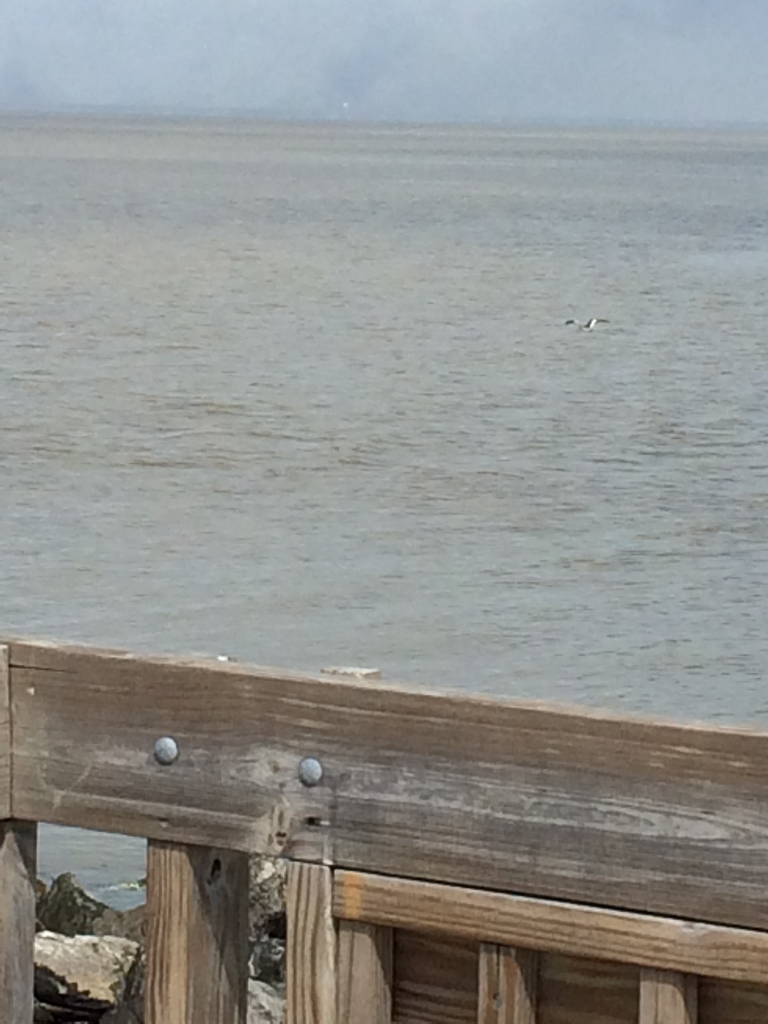
...and flying over the waves!  Notice its striking wing pattern.

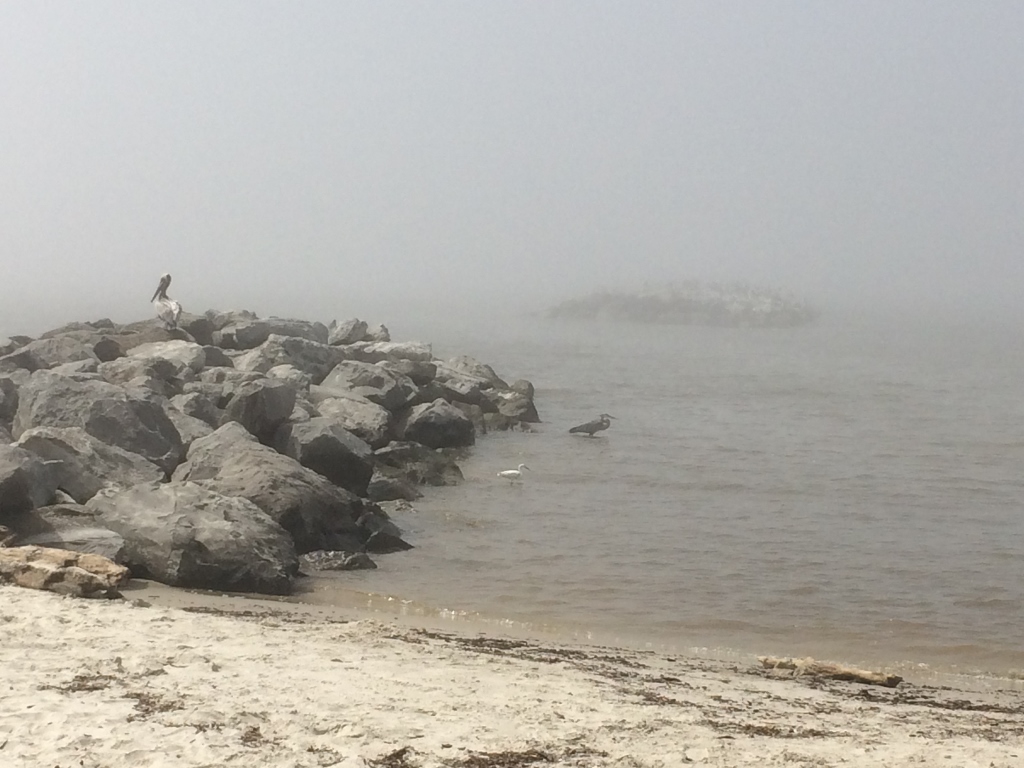
Here are some other interesting but easy-to-ID birds: a Brown Pelican (standing on the rocks on the left), a Snowy Egret, and a Great Blue Heron.  The fog on this day, the 11th, obscured almost everything past the shoreline.  There are probably many cormorants, gulls, terns, and pelicans on the rocks farther out, but it’s almost impossible to tell.  Despite the visibility issues, there was something intriguing about seeing the beach shrouded in mist like this.
I can’t resist ending on this picture of a slightly miffed-looking Laughing Gull.  If you can, keep watching your local wildlife, and please continue to check for updates to the blog as we all move forward in this weird and stressful time.