Showing posts with label Red-shouldered Hawk. Show all posts

Wednesday, December 31, 2025

The Red-shouldered Hawk


It wouldn’t seem quite like winter without the hawks and falcons hunting along fencerows, darting through the woods, or soaring on the breezes. I have been seeing a number of raptor species over the last few months, including the swift and agile Cooper’s Hawks, the slower but more powerful Red-tailed Hawks, and the wary and fidgety American Kestrels.  Another common species, large and vocal, but sometimes overlooked, is the Red-shouldered Hawk.

Unlike Red-tailed Hawks, Red-shouldered Hawks tend to prefer low-lying, heavily wooded environments. They are commonly found year-round in many hardwood and mixed forests throughout southeastern North America, and, in the fall and winter, this southeastern population is boosted by migrants from the northeastern United States and southeastern Canada. The difference in habitat between Red-shouldered and Red-tailed Hawks means that their dietary preferences are a bit different, as well; like Red-tails, Red-shouldereds eat lots of small mammals, but, because they inhabit denser, swampier woods, they’re also likely to catch frogs, snakes, and lizards. However, even though they’re primarily forest hawks rather than field hawks, they will often hunt from powerlines and prominent snags at the borders of woodlands and fields. Presumably, this makes it easier for them to find and catch their prey, given that they lack the maneuverability of species such as the Cooper’s and Sharp-shinned Hawks.

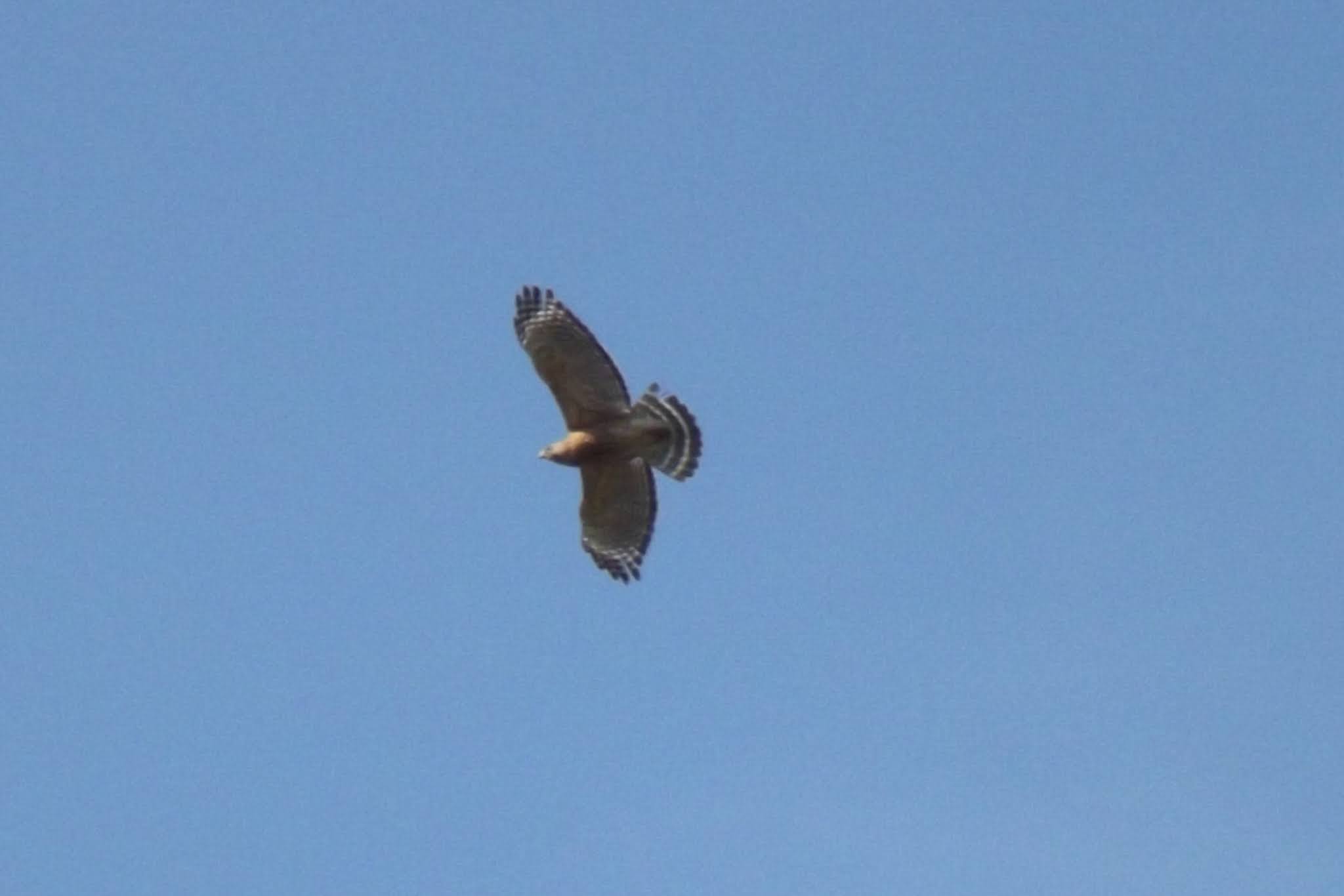
Appearance-wise, Red-shouldered Hawks are a little smaller and slimmer than Red-tailed Hawks, and, of course, they lack the brick-red tails that adult Red-tails have. They DO have reddish-brown “shoulders,” but this usually isn’t the most obvious field mark. The barred, reddish-brown breasts, black-and-white banded tails, and black-and-white wings on the adult hawks are far more noticeable features in the field. As you can see in the first of the two photos below, there are also vertical breast streaks on top of the chestnut-colored horizontal barring. Juvenile Red-shouldered Hawks look fairly similar to the adults, but have drabber, browner feathers and lack reddish barring on their breasts. In flight, both adults and juveniles show “wing windows,” which are essentially just pale crescents near the wingtips. This is a great field mark to look for if a hawk is soaring overhead. 

The rusty breast feathers on this adult hawk are a useful field mark.

Juveniles have browner plumage and streaks on their breasts.

Crescent-shaped wing markings are visible on this soaring adult hawk.

At this time of year, the immature hawks have been independent from their parents for several months, so they’re essentially competing with adult hawks for food and territory. If they survive the winter and later become breeding adults, then they will likely build their nests in large trees in the woods and lay two to five eggs per brood, with only one brood per season. Apparently, little is known about Red-shouldered Hawk nesting habits, so if you happen to spot a breeding pair next year, there is a chance that your observations could be of significant scientific value! In the meantime, enjoy watching Red-shouldered Hawks and other raptors this winter. 

Source:

Dykstra, C. R., J. L. Hays, and S. T. Crocoll (2020). Red-shouldered Hawk (Buteo lineatus), version 1.0. In Birds of the World (A. F. Poole, Editor). Cornell Lab of Ornithology, Ithaca, NY, USA. https://doi.org/10.2173/bow.reshaw.01


Wednesday, September 30, 2020

Red-shouldered Hawks

It wouldn’t seem quite like autumn without the hawks and falcons hunting along fencerows, darting through the woods, or soaring on the breezes. I have been seeing a number of raptor species lately, including the swift and agile Cooper’s Hawks, the slower but more powerful Red-tailed Hawks, the wary and fidgety American Kestrels, and the high-soaring (at this time of year, as they migrate) Broad-winged Hawks. But the species that I see most frequently in my neck of the woods is actually none of these: it’s the Red-shouldered Hawk, a member of the genus Buteo and a close relative of the Red-tailed and Broad-winged Hawks. Red-tailed Hawks might be more common and widespread, but the types of habitats near my home are simply better for Red-shouldereds, and that’s fine with me. 

Unlike Red-tailed Hawks, Red-shouldered Hawks tend to prefer low-lying, heavily wooded environments. They are commonly found year-round in many hardwood and mixed forests throughout southeastern North America, and, in the fall and winter, this southeastern population is boosted by migrants from the northeastern United States and southeastern Canada. The difference in habitat between Red-shouldered and Red-tailed Hawks means that their dietary preferences are a bit different, as well; like Red-tails, Red-shouldereds eat lots of small mammals, but, because they inhabit denser, swampier woods, they’re also likely to catch frogs, snakes, and lizards. However, even though they’re primarily forest hawks rather than field hawks, they will often hunt from powerlines and prominent snags at the borders of woodlands and fields. Presumably, this makes it easier for them to find and catch their prey, given that they lack the maneuverability of species such as the Cooper’s and Sharp-shinned Hawks.

Appearance-wise, Red-shouldered Hawks are a little smaller and slimmer than Red-tailed Hawks, and, of course, they lack the brick-red tails that adult Red-tails have. They DO have reddish-brown “shoulders,” but this usually isn’t the most obvious field mark. The barred, reddish-brown breasts, black-and-white banded tails, and black-and-white wings on the adult hawks are far more noticeable features in the field. As you can see in the first of the two photos below, there are also vertical breast streaks on top of the chestnut-colored horizontal barring. Juvenile Red-shouldered Hawks look fairly similar to the adults, but have drabber, browner feathers and lack reddish barring on their breasts. In flight, both adults and juveniles show “wing windows,” which are essentially just pale crescents near the wingtips. This is a great field mark to look for if a hawk is soaring overhead. 

The rusty breast feathers on this adult hawk are a useful field mark.

Juveniles have browner plumage and streaks on their breasts.

Crescent-shaped wing markings are visible on this soaring adult hawk.
At this time of year, the immature hawks have probably been independent from their parents for several months, so they’re essentially competing with adult hawks for food and territory. If they survive the winter and later become breeding adults, then they will likely build their nests in large trees in the woods and lay two to five eggs per brood, with only one brood per season. Apparently, little is known about Red-shouldered Hawk nesting habits, so if you happen to spot a breeding pair next year, there is a chance that your observations could be of significant scientific value! In the meantime, enjoy watching Red-shouldered Hawks and other raptors as this year wanes. 

Source:

Dykstra, C. R., J. L. Hays, and S. T. Crocoll (2020). Red-shouldered Hawk (Buteo lineatus), version 1.0. In Birds of the World (A. F. Poole, Editor). Cornell Lab of Ornithology, Ithaca, NY, USA. https://doi.org/10.2173/bow.reshaw.01


Monday, September 30, 2019

The Value of Snags


One of the benefits of leaving large, dead trees standing is that they often become magnets for wildlife.  Their decaying bark and wood attract countless species of insects, which in turn become food for wild animals; they provide space for nesting and roosting; and hawks, owls, and flycatchers, among other species, use them as hunting perches.  I realize that sometimes these snags have to be removed, as they pose a danger to humans or to property, but if a dead tree stands in a place that isn’t inconvenient for people, I would argue that it’s better to leave it alone.  
Half-dead sugarberry tree
My observations of birds in and around snags in the neighborhood where I live bear this out.  Like most residential areas, my neighborhood has severely fragmented forest habitats, which aren’t ideal.  However, within those tiny woodlands, the ages of the trees vary widely, and there are some trees that have died.  Ecologically, this is a good thing!  If you have snags near your home, watch closely to see the variety of birds and other animals that use them.  For example, I often see a Mourning Dove perched atop one particularly large and prominent snag.  I don’t know whether this is always the same Mourning Dove, or whether several different individuals like to use this perch.  Woodpeckers, including the species Red-headed and Red-bellied, hammer on this tree, as well (juvenile Red-headed Woodpecker in the bottom photo).  
Mourning Dove
Red-headed Woodpecker

One rather exciting find for me this fall was a migrating Olive-sided Flycatcher foraging from this snag.  Although it isn’t exactly a rare bird, it is becoming scarcer, probably as a result of global climate change combined with habitat destruction on its wintering grounds in Central and South America.  Disturbingly, surveys show that populations have declined 79% since 1970.  
Olive-sided Flycatcher
The bird’s distinctive feeding style usually involves sitting at the top of a prominent perch and darting out to catch flying insects that pass by.  This neighborhood snag is tall enough to provide an excellent vantage point for flycatchers to survey a wide area, so while I was pleased to see an Olive-sided in it, I wasn’t really surprised.  The Olive-sided’s smaller and paler cousins, Eastern Wood-Pewees, also hunt from the snag—although less habitually.
Olive-sided Flycatcher (left) and Eastern Wood-Pewee (right)

The apex predators of the bird world, hawks and owls, use snags, as well.  Red-shouldered Hawks are the ones that I most commonly see around here, probably because of the creek that harbors the frogs, crayfish, and snakes that these lowland-loving hawks like to eat.  
Red-shouldered Hawk
Mississippi Kites left the neighborhood for their wintering territories in South America well over a month ago, but while they were here, they could be seen on occasion in the tops of the snags bordering the fields.  I sometimes see Red-tailed Hawks here, as well, and I am sure that Barred Owls and Great Horned Owls use these trees at night.
Mississippi Kite
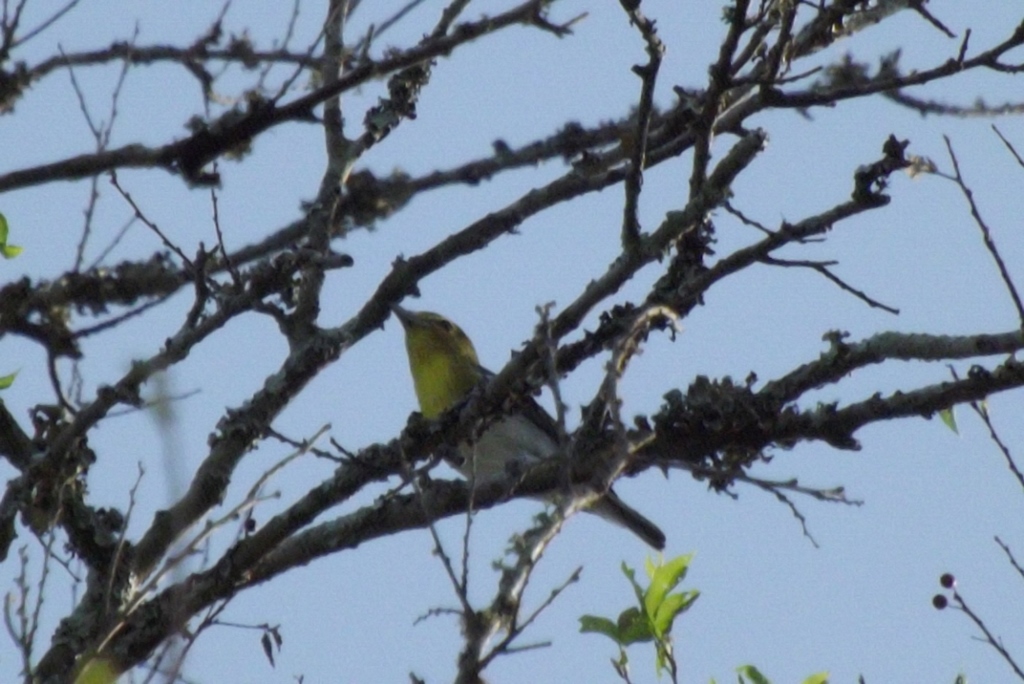
Another of the dead or dying trees around here that I enjoy monitoring for wildlife is a moribund sugarberry.  It happens to be a prop for berry-producing vines, so wildlife can binge on those in addition to the sugarberries that grow on the living side of the tree.  I’ve seen many species of birds feeding on the fruit, including tanagers, orioles, bluebirds, mockingbirds, thrashers, vireos, and woodpeckers.  As you might guess, the tree also attracts lots of insects, so even non-frugivorous bird species—e.g., warblers and gnatcatchers—can find a buffet there.  And woodpeckers really seem to like its dead top branches for drumming and feeding.  Here’s a sampling of some of these birds:
Yellow-throated Vireo inspecting dead branches
American Goldfinch
Baltimore Oriole
Since we're in the thick of bird migration right now, taking another look at snags is well worth the effort!