Showing posts with label Northern Cardinal. Show all posts

Tuesday, June 30, 2026

Northern Cardinal Life Stages

Previously, I discussed the nesting process of Northern Cardinals.  But what happens to the young cardinals after they leave the nest?

At first, not much: Fledglings continue to be fed by their parents for at least a month as they learn how to function as adults.  They’re not that different from human teenagers, when you think about it.

In my long time as a birder, I have had many opportunities to witness “teenager” cardinals as they hang out with their parents.  One year, some of the cardinal parents brought their young to the backyard feeding station, allowing me to see them up close and to study their plumage patterns and behavior.

Juvenile cardinals have dark bills, unlike their parents, which have red or orange-red bills.  The color change is generally complete by winter.  In the photo below, you can see a little bit of orange beginning to come through on the base and margins of the juvenile cardinal’s beak.  Female and male cardinals look very similar in the juvenile stage, but males can have a hint of red on their flanks.  It can be hard to tell, though, and the photo doesn’t provide a lot of strong clues in either direction. 
Juvenile cardinal
This next photo shows a different bird—an immature male.  This cardinal probably came from an earlier brood than the last bird, and its molt into adult plumage has progressed much farther.  Look at the red blotches on the head, back, and flanks. 
Immature male cardinal
The first of the two photos below shows the young male bird from another angle, where you can see all of the red feathers that are coming in on the breast.  The bill has also turned almost completely red.  A bird that looks like this has probably been fending for himself for a while, but he won't be ready to compete with scrappy, aggressive, adult males, like the one in the second photo, until the next year.
Immature male cardinal -- not quite there yet
Adult male cardinal
Although both adult female and juvenile cardinals have reddish tails and flight feathers, adult female cardinals have red crests, as you can see in the first of the two photos below.  In about a year, female cardinals are ready to compete for territories and start nests.  Yes, they compete in much the same way that males do; research has shown that, on breeding territories, female cardinals chase away other females, and male cardinals chase other males.  Females also sing, if somewhat less frequently than males.  Juvenile cardinals might sing softer, unstructured versions of adult songs, as they are still learning.  They will consistently give whistled begging calls whenever they want food from their parents, though!  If you find some juvenile cardinals in the wild, watch for their wing-fluttering behavior and listen for those piping calls.
Adult female cardinal -- note the orange beak
Juvenile cardinals with gray beaks
As cardinals—both the adults and the juveniles/immatures—molt from one plumage to the next, sometimes they wind up looking a bit weird.  One of the most common “oddities” is when a cardinal loses most or all of the feathers on its head.  These cardinals can look as though they have a horrible disease, but, in most cases, they are perfectly normal and will have new feathers in due time.  The cardinal in the foreground of the next photo is an adult female with a bald, gray head. 
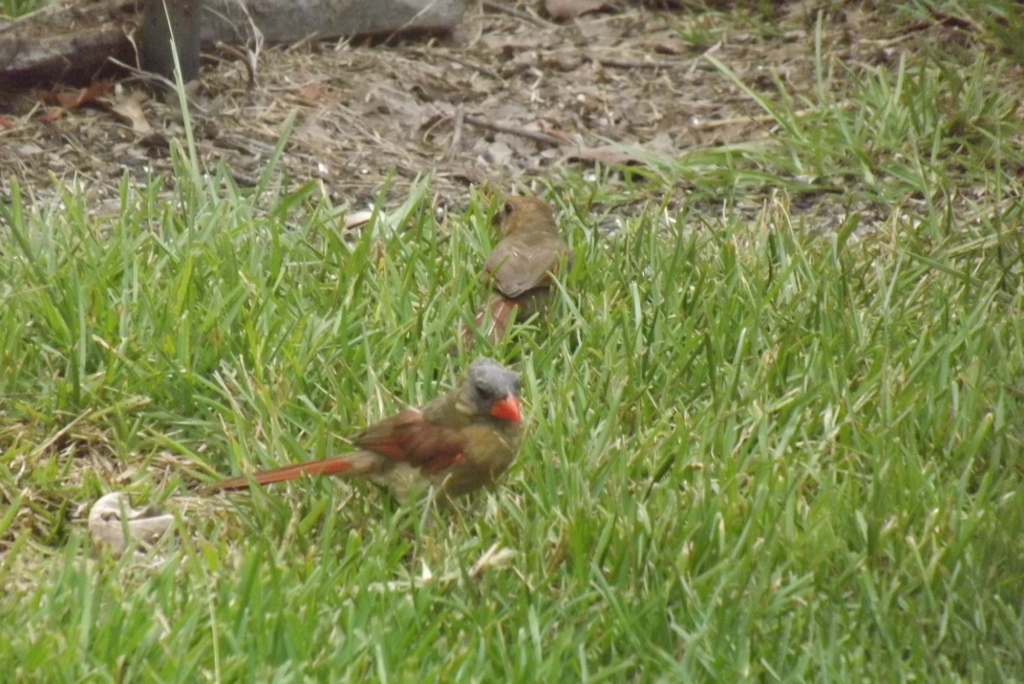
Once, there was a distinctive female cardinal that I routinely watched over a period of many days.  There was a clump of feathers sticking up on her back.  (This bird is actually the female cardinal in the fifth photograph of the post.)  Try as I might, I never could tell whether this was an injury or simply a scraggly patch from a recent molt.  The cardinal seemed to have no difficulty in foraging, flying, and generally moving around, so I didn’t worry about it, but it was certainly interesting to observe.
Ruffled feathers?
As you can probably tell, the wide variety of plumages that Northern Cardinals display during this season of the year makes it fairly easy—at least, for a brief window of time—to determine their age and to track some of them as individuals.  By next spring, some of this year’s juveniles will hold breeding territories of their own, and the cycle will continue.

Source:

Halkin, S. L. and S. U. Linville (2020). Northern Cardinal (Cardinalis cardinalis), version 1.0. In Birds of the World (A. F. Poole and F. B. Gill, Editors). Cornell Lab of Ornithology, Ithaca, NY, USA. https://doi.org/10.2173/bow.norcar.01


Sunday, May 31, 2026

Nesting Northern Cardinals


Female Northern Cardinal in Arkansas, November 5, 2013.

Male -- also November 5, 2013, in Arkansas.

If you live in eastern or central North America and spend any time outside, chances are good that you’re familiar with the Northern Cardinal.  Cardinals are so common, in fact, that I confess I tend not to pay them much attention—especially if there are more unusual birds nearby.  But nearly a decade ago, a pair of these birds nested in the thorny elaeagnus shrub near my home, right outside the living room window.  Naturally, I had to pay attention to that!

The cardinals began nesting in the thorny elaeagnus shrub right around the time that the White-eyed Vireos that I wrote about previously were nearly fledged.  I first noticed the female cardinal carrying twigs in her bill to the nest site, which was a few feet higher in the shrub than the vireos’ nest had been.  This was typical behavior.  Female cardinals construct the nests and incubate the eggs, while males bring food to the females during incubation and assist in feeding the young after they hatch.  

As you can see, cardinals build their nests on top of limbs, unlike vireos, which suspend theirs from forks in the branches.  Whenever the female cardinal added new material to the nest, she bent it with her bill and pushed it into a cup shape with her feet.  The outside layers were constructed from twigs, bark, and leaves, while finer materials, such as grasses and pine needles, formed the lining.

June 19, 2016 -- Cardinal building the nest!

Checking early-stage nests too frequently can lead to the parent birds abandoning the site, so I was cautious about getting photos at that point.  By June 28, there were two eggs in the nest, but, since I had been avoiding the nest, I assumed that they had probably been there for two or three days.  Cardinals lay anywhere from one to five eggs, with two to three being more typical.


According to Birds of North America Online, incubation takes 11-13 days.  The eggs were definitely hatched on or before July 7, when I photographed the slightly downy nestlings for the first time.


By July 11, the young birds were much larger and more heavily feathered.  You can see how their bills are starting to turn dark, a characteristic of juvenile cardinals.  Their beak color doesn’t change to red or red-orange until late in the fall.

July 11, 2016

On July 14, the nestlings were nearly ready to fledge.  Although it’s difficult to determine exactly how heavily feathered the average dinosaur might have been, this is what I tend to imagine juvenile dinos looking like.  (On the anatomical level, though, modern birds and the dinosaurs from which they evolved differ very little—so I’d guess that quite a lot of dinosaurs may have had full plumage.)

July 14, 2016

I think that these cardinals fledged on July 15 or 16.  Fledging usually occurs after about nine or ten days, so this estimate seems reasonable.  You can just barely make out one of the nestlings in the center of the photo below.  That photo was from July 15, and the one of the empty nest was taken the next day.  This might have been the second brood of the year from these nonmigratory birds, but I can’t say for certain.

July 15, 2016 -- at least one young cardinal still on the nest

July 16, 2016

Sunday, February 28, 2021

Ice Storms

The ice storm that hit during the third week of February threw everything off-kilter for a while.  The ground was crunchy (and, later, slick) with a layer of ice, the roads were impassable, tree limbs sagged, and being outdoors was tolerable for only a few minutes at a time.  I had taken down the bird feeders in the backyard, mainly because I was concerned about freezing rain coating them and clogging up their openings.  If the ice rendered them unusable for the birds, then there would be no point in keeping them up.  However, my mom and I did put birdseed inside the rotting stump (mainly for the benefit of the tree-dwelling birds) and on the frozen ground (for the shrub- and ground-dwellers).  This turned out to be a reasonable solution, and it meant that I didn’t have to worry about continually scraping ice off the tube feeders.

Obviously, the storm system was highly unusual for this region, so it’s probably fair to say that it caused most of the birds and other wildlife to struggle.  Most of the time, birds don’t actually need the food that we put out for them; we feed birds because of the enjoyment we get from watching their activity.  During extreme weather events, however, feeding can sometimes help.  Seed-eating birds, such as sparrows and finches, may have a hard time finding food after a storm buries ground vegetation under a sheet of ice.  

Insectivorous birds may have it even worse.  Freezing weather kills most of their prey, making it difficult for them to find anything to eat.  I was reminded of this fact just a few days into the freezing weather event, when an Eastern Phoebe turned up dead on our front porch.  The bird seemed to be extremely thin, with its keel—the part of the sternum to which the flight muscles attach—very bony and prominent, which makes me suspect that it starved to death.  An American Robin was found on the driveway a couple of days later, dead for the same reason, I would guess.  I stored these birds in the freezer until I could give them to the Department of Wildlife, Fisheries and Aquaculture at Mississippi State University.  They’re going to be part of the ornithology collection.

The deceased Eastern Phoebe
 
The American Robin specimen -- after I'd bagged it for the freezer
Although some omnivorous and insectivorous birds will come to feeders for mealworms, I didn't have any of those available, and phoebes tend to feed more on flying insects than on crawling ones, anyway.  I doubt that anything I could have done would have prevented the deaths of the phoebe and the robin.  Other birds, however, seemed to benefit from the easy pickings in the backyard.  The cold weather drew out many small groups of birds, including some species that I don't see very frequently in this area.  For example, the makeshift feeding station attracted at least fifteen Fox Sparrows.  On normal days, I'm lucky if I see one or two of these large, rust-colored sparrows in the neighborhood.  Some of the sparrows even serenaded us with snippets of their songs.

Fox Sparrows foraging with White-throated Sparrows

Like this Fox Sparrow, most of the songbirds fluffed their feathers out in order to stay warm!
A couple of Rusty Blackbirds also showed up.  Although I occasionally see larger flocks of this species, it isn't an especially common bird around here, either.

Rusty Blackbirds -- with a Fox Sparrow in the background
In the fields between the creek and the end of the driveway, a few Killdeer scavenged for whatever dead insects they could find in the icy grass.  I see Killdeer flying over the neighborhood on a semi-regular basis, but it's less typical of them to forage in these fields.  I think that the grass is usually too high for them.

Killdeer in the field
 
The other species were more common birds for this area, but they were still enjoyable to watch.  Here are some photos of the avian activity in our yard:
Perhaps surprisingly, Brown Thrashers came to eat the seed.
 
American Goldfinches fed on the ground.

A female Eastern Towhee showed up at one point.

White-throated Sparrows (front) were fairly numerous, but I saw only one Song Sparrow (back).
 
Northern Cardinals always put in appearances, even during foul weather.

"Snowbird" is actually a nickname for the Dark-eyed Junco.

Cardinals and juncos used the stump feeder.
 
And Purple Finches did, too.

Although this event is definitely not one that I was eager to experience, I think it provided some interesting perspective—enabling me to think about ecosystems and bird communities in ways that I hadn't considered before.  I'm sure that the birds appreciate the much warmer temperatures that have followed this historic event, though!

Fox Sparrow seemingly enjoying the sun!