Showing posts with label American ornithology. Show all posts

Thursday, April 30, 2026

Spring Migrants: Solitary and Spotted Sandpipers

The mention of sandpipers often brings stress to inexperienced birders.  After all, sandpipers are those dull, brownish little creatures that skitter over mud and all look alike.  In other words, it can be hard to appreciate them.  But actually, on closer study, sandpipers are unusual and highly fascinating birds.  And, no, they don’t all look alike!  I will focus on two very distinctive, common sandpipers that can be seen in migration now: the Solitary Sandpiper and the Spotted Sandpiper.

Solitary and Spotted Sandpipers

Although they are not closely related, the Solitary Sandpiper (Tringa solitaria) and the Spotted Sandpiper (Actitis macularius) are often seen together feeding in the same ponds and lakes, frequently those with woods or at least low-lying vegetation nearby.  Both can be found migrating in Mississippi from about March to June in the spring, and late July to late October in the fall.  The Spotted Sandpiper is an occasional winter resident in the state, as well, but is more common along the coast than inland.

Both sandpipers forage and migrate singly or in small groups, and both exhibit tail-bobbing behavior.  With the Spotted, the entire body is teetered; the bird is in constant, jittery motion: scampering along the water’s edge, picking up small insects, mollusks, crustaceans, and even tiny fish.  The Solitary Sandpiper has slower, more deliberate movements, and when it pauses, it often bobs its head and tail.  It has longer legs and a longer bill than the Spotted, which enables it to feed in slightly deeper water, where I assume the menu would include bigger fish and frogs!  As an additional feeding adaptation, it often shakes its foot above the water to draw small fish and insects to the surface.

If you come unexpectedly upon either of these sandpipers, they will probably fly up immediately, uttering high-pitched peet-WEET calls (the Solitary’s call is the higher pitched of the two).  Fortunately, their flight styles are very different and distinctive.  The Solitary Sandpiper has graceful, swallow-like wingbeats and displays long, pointed wings and white edges on its tail.  Spotted Sandpipers fly close to the water and give fluttery, shallow beats of their shorter, more-rounded wings, each of which shows a thin, white stripe.

Once the sandpipers land on the bank and begin feeding again, their colors and patterning are apparent.  The Solitary Sandpiper is slightly larger than the Spotted, with a longer neck and body, and it has a wide, white eye-ring that gives it an alert look.  Its head, neck, and breast are finely streaked with brown, its belly is white, and its back is dark brown and shiny, with a dusting of tiny white spots.  The thin, dark bill and dark, greenish-gray legs complete the picture.  The Spotted Sandpiper is relatively small and stocky, with orange legs and bill, brown upperparts, a white eyebrow and slight eye-ring, and in the breeding season a boldly spotted breast and belly.  At least before the birds molt in the fall and replace the spotted front with plain white, you can sometimes tell the sexes apart.  Females have larger spots that extend farther onto the belly than males.

But why would the female bird be more distinctively marked?  The answer lies in the Spotted Sandpiper’s breeding biology.  Along with phalaropes, it is unusual in that the females are polyandrous, mating with more than one male—sometimes up to five!  Each time after mating, the female lays a clutch of up to four brownish eggs, which the male is solely responsible for incubating.  However, the female does help with constructing the nest—a shallow scrape in the ground, lined with grass.  After the eggs hatch, the male alone raises the chicks, which are born precocial like all sandpipers.

While the Solitary Sandpiper is monogamous and doesn’t exhibit such unusual breeding behavior as the Spotted, it is unique among North American shorebirds in that it nests in trees.  A female Solitary Sandpiper will add a little extra nesting material to the abandoned nest of a songbird, such as a Rusty Blackbird, American Robin, or Cedar Waxwing, incubate her four well-camouflaged, brownish eggs, and care for the young with her mate.  Tree-nesting is so unusual among shorebirds (the Green Sandpiper of Eurasia is the only other species known to do it regularly) that, for decades, no one was sure where the Solitary Sandpiper nested until 1903, when the secret was finally discovered.

Spotted Sandpipers are one of the most widespread shorebirds, commonly found over much of North America, although they aren’t known to breed in Mississippi and some other southern states.  Solitary Sandpipers are more restricted in range, occurring in the breeding season mainly in Canada and Alaska.

The numbers of both of these sandpipers appear to be fairly stable, and that’s good news.  With care and protection, generations years into the future will be able to observe the fascinating behaviors of these and other birds that have been living here for eons.  A world without the little brown sandpipers that enliven our fields, woods, and wetlands would be bleak.

Tuesday, September 30, 2025

Species Account: The Northern Flicker

A shrill ki-ki-ki-ki-ki-ki breaks the silence of the forest, and a pair of fairly large brown birds with flashes of yellow in their wings and tails alight upon a decaying stump and begin picking off little flakes of bark.

With its flashy colors and raucous calls, the Northern Flicker is a difficult bird to miss.  It is a permanent resident of the Southeast and can be found in a variety of habitats where deadwood is present.  Flickers often forage on the ground in search of ants and beetle larvae.  In my own yard I can sometimes see as many as six at a time, poking their bills into the dry, dead grass in search of these insects.  Flickers also feed on small fruits and will come to feeders for suet or peanuts.

At twelve and a half inches from the tip of the bill to the tip of the tail, the Northern Flicker is the second-largest woodpecker in Mississippi.  It has black bars on its brown upper parts and spots on the under parts.  A patch of gray extends from the crown to the nape, and the male bird has a black stripe on its face.  Both sexes have bright red bars on the backs of their heads.  The white rump patch and yellow underwings are conspicuous when the birds are in flight.

Northern Flickers have a variety of calls for different situations.  A short peeough is used as a contact call between related flickers.  The ki-ki-ki-ki-ki is a territory advertisement, and the flicka-flicka-flicka-flicka for which the bird was named is used during courtship and aggressive encounters.  These two longer calls can be confused with the calls of the crow-sized Pileated Woodpecker, but, unlike the calls of this huge bird, they do not change in pitch or loudness.  Flickers drum often, sometimes choosing to do so on tin roofs at the crack of dawn, creating a great disturbance to anyone inside the house.

Nesting occurs in spring when a pair of flickers excavate a hole in a tree, a fence post, a utility pole or a nest box.  Flicker boxes should be 16 inches tall with a 7x7-inch floor and a hole two and a half inches in diameter.  The box should be at least four feet above the ground and should preferably be filled with sawdust so that the birds can partially satisfy their desire to excavate a cavity.  Even with all these rules, flickers apparently aren’t picky.  They will use almost any box large enough, including Wood Duck boxes.  The 3-10 white eggs are incubated by the female during the day and the male at night.  They hatch in about 12 days, and the hatchlings are ready to leave the nest in four weeks.

If your yard has the right habitat, put up a flicker box and study their behavior as they fledge their chicks.  If you already have a nesting box, continue to observe these noisy but beautiful birds throughout the year.


Sources:

 “Conservation Trails.”  WildBird.   March, 1994.

The Cornell Lab of Ornithology’s Guide to Birds of North America, Version 3.

Sunday, August 31, 2025

The Field Sparrow

The Field Sparrow (Spizella pusilla) is a small songbird in the family Emberizidae (Order Passeriformes) that occurs throughout most of eastern North America.  It is one of the relatively few sparrows that commonly breed in the Southeast. 

Field Sparrow in summer
Distinguishing characteristics of the Field Sparrow include a short, pink bill; white eye-rings; white outer tail feathers; and a plain, unmarked breast.  The species is found in a variety of old fields, woodland edges, fencerows, and agricultural areas.  It begins courtship and mating in early spring, with males chasing females and defending territory from other males.  Males maintain and defend their territories through physical altercations between males as well as by their song, which is a warbling trill.  In addition to this song, the Field Sparrow has several alarm and flight calls that are used in a variety of contexts. 
Field Sparrow in winter
Nest construction begins in late April and extends through mid-May.  The nest, which is placed at a height of 9-300 centimeters in vegetation, is built solely by the female, and is composed of grasses, roots, hair, and other fine materials woven into a cup shape.  The eggs have a cream or white ground color, are marked with spots in various shades of brown, and have a smooth surface.  There are usually two to five eggs laid in a brood, and the female incubates for approximately twelve days.  The mostly naked, altricial nestlings are fed in the nest by both male and female parents for a period of about seven to eight days. 

The most frequent foods offered to the nestlings include many insects in both the adult and nymph stages, and various species of spiders.  After the young birds fledge, the parents will care for them until they reach independence at about one month of age.  The adult diet consists mainly of seeds, but some insects are taken, too.  

The Field Sparrow is a widespread species, ranging from southeast and northwest Montana, central Minnesota, southern Ontario, southern Maine, and southern New Brunswick; south to northeast Colorado, western Oklahoma and Kansas, central Texas and northern Mexico, and through the Gulf Coast to central Florida.  Some populations of the Field Sparrow are migratory, although most are not.  In the northernmost regions of its range, it is present only during the breeding season, and in the southernmost regions (such as the Gulf Coast and much of Florida), it is present only as a winter resident.  Be on the lookout for Field Sparrows in grassland and forest-edge habitats as the summer wanes and the fall season approaches!


Source:

Best, L. B.  1977.  Nesting biology of the Field Sparrow.  Auk 94(2):308-319.

Thursday, July 31, 2025

The Red-cockaded Woodpecker

If you live in or near pine forest regions of the southeastern United States, you have a decent chance of encountering the Red-cockaded Woodpecker, a specialist of those habitats.  You will likely hear the raspy calls before actually seeing the woodpeckers, which tend to be relatively inconspicuous against the trunks of the pines.  When one of them comes into view, though, it can be distinguished from the far more common Downy and Hairy Woodpeckers by its white cheek patches and completely barred back.  (Downy and Hairy Woodpeckers, in contrast, have striped faces and white backs.)  Males of the species have red feathers—the “cockades”—on the sides of the crown, but, because these are tiny and seldom displayed, they are not a particularly important field mark.

Note the barred back and the white cheeks

These woodpeckers are restricted to open pine forests with sparse understories of palmettos, grasses, shrubs, and other plants.  The open nature of the habitat is a consequence of natural fires, which restrict understory growth and possibly leave younger trees more susceptible to Phellinus pini, or red heart, a fungal disease that damages the heartwood of infected pines.  The softened, diseased wood can then be more easily excavated by Red-cockaded Woodpeckers, which will dig cavities 5-50 feet high in living trees infected with red heart.  Many of these infected trees are well over 40 years in age.  The birds peck into the sapwood above and below the cavities that they create, which results in a flow of sap that deters predators (such as rat snakes) and other animals from accessing the roost or nest holes.

Open pine habitat in early spring

Like most woodpeckers, Red-cockaded woodpeckers make various vocalizations at the nest and during courtship and other encounters.  Drumming on trees—usually pines—is another common means of communication, as are wing-fluttering, open-winged displays, and crest-raising.  The spread-winged display is used to reinforce the pair bond between a male and female.  Eggs are laid from late April to early June in a pre-existing cavity, rather than one that is excavated specifically for a nest.  The eggs are white in color, and become stained with pine resin over the course of the incubation period.  The female of the pair lays one egg per day, with one to six eggs comprising a clutch.  Incubation, which lasts about ten days, is performed by both parents, with the male incubating overnight.  Both parents feed and tend the altricial, pink-skinned, featherless nestlings.  Although the young birds fledge after about 26-29 days, they are at least partially dependent on their parents for up to six months afterward.  The Red-cockaded Woodpecker’s propensity for living in loose colonies or family groups benefits it during the nesting period, as unmated “helper” birds may aid breeding pairs in feeding nestlings and fledglings.  Usually, a pair has only one brood per year.

A foraging Red-cockaded Woodpecker

Interestingly, male and female Red-cockaded Woodpeckers are somewhat segregated according to the types of feeding sites that they use, with males foraging on branches and high on the trunks of pines, and females preferring to forage at lower elevations and only on the trunks.  Both sexes eat mainly insects and other arthropods, including cerambycid beetles, larvae and grubs of various species, ants, and millipedes.  On occasion, they will also consume small fruits and seeds. 

Although the Red-cockaded Woodpecker is a fairly widespread species, it is patchily distributed due to its highly specialized niche.  Habitat loss remains a serious threat to these woodpeckers, so conservation efforts generally focus on preserving tracts of large pines and subjecting them to controlled burning to clear the understory layers.  These measures seem to be working.  Just last year, the U.S. Fish and Wildlife Service downlisted the species from endangered to threatened.  Any birder or naturalist who is fortunate enough to live near one of the managed populations would do well to keep a sharp eye—and ear—out for these fascinating little woodpeckers during this summer and fall.


Sources:

Ligon, J. D.  1970.  Behavior and breeding biology of the Red-cockaded Woodpecker.  Auk        87(2):255-278.

https://www.fws.gov/press-release/2024-10/downlisting-red-cockaded-woodpecker-endangered-threatened

Monday, June 30, 2025

Observing Gallinules

My first sighting of a gallinule was over twenty years ago at Noxubee National Wildlife Refuge.  It was a Purple Gallinule, and utterly unmistakable: violet head, neck, and breast blending to green on the back and wings; long, yellow legs; red-and-yellow bill; ruffled white undertail feathers; and a chicken-like gait and stance.  I later saw Common Gallinules (then called Common Moorhens—they were split from the Old World species in 2011), as well.  I had heard them calling at a heronry in south-central Mississippi before that, but had not seen them.  As it turns out, even though gallinules may be less secretive than their cousins, the rails, they don’t always make themselves obvious.

Perfect gallinule habitat -- and a gallinule in the upper right corner.

However, this time of year—late summer—is one of the best times to look for them.  Both Common and Purple Gallinules can be found on many ponds and lakes in the southeastern United States.  They need lots of aquatic vegetation on which to build their nests and search for food.  In the summer months, they are surprisingly active and vocal, and often have chicks in tow.  

This Common Gallinule swims with its three young.

This Purple Gallinule stays with its chick.

Gallinule clutch sizes are fairly large; eight is a typical number of eggs, although, obviously, not all of the chicks will survive to adulthood.  In the video below, you can see three Common Gallinule young swimming with the adult.

Gallinules consume a variety of foods, including aquatic vegetation and invertebrates.  Their long toes enable them to walk on floating vegetation (generally lily and lotus pads) while foraging.  They sometimes pluck insects and snails from the undersides of leaves, as you can see in the following video of a Purple Gallinule chick:

Because their nesting period is generally in the spring, their young are pretty far along in development by this point.  It also helps that they are born semi-precocial, rather than altricial.  This means that, unlike songbird chicks, they are feathered and have their eyes open.  Unlike precocial Killdeer chicks, though, they still stay in the nest for a day or so and must be fed by their parents for several days.  Once out of the nest, they can climb through vegetation using the tiny claws on their wings.  This is a feature of birds in Rallidae, the rail family.

This Purple Gallinule chick is stretching its wings.

It takes several weeks for gallinule chicks to learn to fly, and it could be argued that they are never truly comfortable with that skill!  On lakes and ponds, gallinules generally fly for only short distances, but some North American populations do migrate from breeding territories to wintering grounds in southern North America or Central America.  The vast majority of Common and Purple Galinules actually occur in South America, where they are permanent residents.

An immature Purple Gallinule -- old enough to be away from its parents, but not old enough for adult plumage.  Note the white undertail coverts, though.  Adult birds have these, too.

Some of my favorite places to see gallinules are Noxubee NWR and Ross Barnett Reservoir.  Of course, there are many other areas to look, and, if you go exploring, you just might discover a new hotspot. 


Sources:

Bannor, B. K. and E. Kiviat (2020). Common Gallinule (Gallinula galeata), version 1.0. In Birds of the World (A. F. Poole and F. B. Gill, Editors). Cornell Lab of Ornithology, Ithaca, NY, USA. https://doi.org/10.2173/bow.comgal1.01.

West, R. L. and G. K. Hess (2020). Purple Gallinule (Porphyrio martinica), version 1.0. In Birds of the World (A. F. Poole and F. B. Gill, Editors). Cornell Lab of Ornithology, Ithaca, NY, USA. https://doi.org/10.2173/bow.purgal2.01.


Wednesday, April 30, 2025

Swainson's Warblers

My first “sighting” of a Swainson’s Warbler wasn’t really a sighting at all.  I was birding one of the local sewage treatment ponds with my then-mentor, and I heard an unusual song coming from the woods behind us.  My birding mentor identified it, but to try to find the singer in the dense, swampy woods would have been futile.  I didn’t encounter another Swainson’s Warbler until the fall of that year, when one showed up in a thicket behind my house, walking around in the leaves less than five feet in front of me.  After this, I was able to hear, and occasionally glimpse, Swainson’s Warblers many times during the spring and summer.  This elusive bird, once practically unknown to me, was present in a surprising number of places.

The Swainson’s Warbler is very local and difficult to see but is not an exceptionally rare bird over much of its breeding range in the southern United States.  It does have the distinction of being elusive enough to escape detection by ornithologists searching for it for decades.  Two of the most famous cases of “lost” avian species, the Ivory-billed Woodpecker and the Bachman’s Warbler, also had a history of being spotted once, then suddenly disappearing, not to be seen again for years.  These species are legendary for their secretiveness, but the Swainson’s Warbler also had a long history of disappearance and then rediscovery, before regular studies confirmed many facts about its once little-known lifestyle. 

The drab appearance of this diminutive creature seems to point to one reason it was overlooked for so long.  At first glance, the Swainson’s Warbler does seem unremarkable, especially when compared with other North American wood-warblers.  A small bird, but large for a warbler, the Swainson’s Warbler measures about five and a half inches from beak tip to the end of its short, slightly notched tail.  The bill, in fact, is different from that of most other warblers in being relatively long and sharply pointed.  The bird’s upperparts are grayish-brown, a dead-leaf color that serves as an effective camouflage.  As counter shading, the underside of the bird is a pale gray or whitish shade, but some individuals show a tinge of yellow in this area.  The crown of the Swainson’s Warbler is a warm shade of brown, making it look nearly chestnut next to the extremely drab upperparts.  The bird also has a faint eye-line on the grayish face, and its head is very flat at the forehead.  The warbler’s long, pink legs provide a clue to its lifestyle; it spends much of its time walking on the ground—an unusual behavior for a warbler—as it forages for invertebrates in thick leaf litter.

These features reveal much about the habitat of the Swainson’s Warbler, and in fact the real difficulty ornithologists had in studying this bird was the impenetrability of this habitat.  The Swainson’s Warbler prefers dense, swampy woodlands with thick undergrowth and a sparse ground cover, leaving the forest floor open to falling leaves and creating the slowly-decaying microhabitat that many species of invertebrates use.  Although it is not absolutely necessary, cane is often a component of this habitat; where stands of cane are present, the warblers build their nests in them near the ground.  Other stiff understory plants such as palmetto are, of course, also used to support nests.  In the northern areas of its range, parts of the Appalachian Mountains, the Swainson’s Warbler retreats into a very different habitat: mountain laurel and rhododendron are the usual understory plants in these ecosystems. 

Regardless of the plants making up the forest undergrowth in Swainson’s Warbler territory, the bird is extremely difficult to locate.  One of the few clues to its presence is its song, a loud, clear Whew whew whew whip-poor-will that falls in pitch, rising again at the last note.  The song is similar to that of the Louisiana Waterthrush, but the waterthrush’s song ends with a jumble of short trills and sharp notes, rather than the clear, ringing notes at the end of the Swainson’s Warbler’s.  The song may be loud for a tiny bird, but the singer is extremely hard to see.  It nearly always chooses a secluded perch somewhere in the upper mid-story level of the woods.  If the bird senses that it has been detected, it flies quickly to a new perch and sits there silently for several minutes until “danger” has passed, often to the chagrin of a birder wishing to see it!  I once tried to creep up on a singing Swainson’s Warbler, and the best view I got was of the bird’s tail end as the bird—having detected me—darted into a cane thicket.  But during migration, even normally shy birds like the Swainson's Warbler can be seen feeding out in the open, far from dense cover, when songbirds of all species engage in atypical behavior in order to exploit more food sources.
Swainson's Warbler -- pen and ink
If the Swainson’s Warbler is easy to overlook now, over a century ago it was barely known to exist.  The habits of the Swainson’s Warbler helped to keep its most basic life functions secret for decades; discovered by Alexander Wilson in 1832 and described by John James Audubon in 1834, it was nearly unknown and wasn’t reported again until William Brewster and Arthur T. Wayne, two pioneering American ornithologists, found it in South Carolina in 1884.  Unfortunately, after this discovery, the species was again unstudied for many years.  Among other things, these naturalists documented its nest for the very first time.  Since the 1930s, however, when birding became popular, we have learned much about this warbler.

One of the crucial details of the bird's life history—its nesting behavior—was first documented by Brewster and Wayne.  The female Swainson’s Warbler constructs the nest, a somewhat messy, bulky cup composed of twigs, leaves, and vine tendrils.  It is lined with a wide variety of materials, including grass, mosses, bark, and hair, and is usually built only a few feet up in the vegetation.  The eggs are an unmarked white—probably an adaptation to the secluded nature of the nest site.  Most birds with well-concealed nests have pale eggs, since the eggs themselves don’t need camouflage.  This is very common in cavity-nesting birds, and the nest of the Swainson’s Warbler is so well hidden that it almost functions as a cavity—it could pass for just a clump of dead leaves if seen by a casual observer.  The female seldom leaves the nest during the incubation period; she alone hatches the eggs, which takes 13 to 15 days.  Both parents tend the helpless, altricial young until they fledge, ten to twelve days after hatching.  Apparently the chicks are fed on the same kinds of insect larvae, spiders, and millipedes that constitute the adults’ diet.  The long, pointed beaks of the warblers enable them to probe the crevices of dead leaves and even the top layer of forest soil for their prey.  As they shuffle around on the forest floor, they will even flip dead leaves over with their bills to inspect the undersides, causing a slight rustling sound similar to that made by other southeastern forest species, such as the Eastern Towhee. 

Although the Swainson’s Warbler is an uncommon and fairly local species in most of its range, exceptionally good breeding habitat can support far more than the usual number of nesting pairs; up to 44 singing males have been reported in some areas.  The Swainson’s Warbler is, unfortunately, facing many of the same problems that are contributing to the decline of other Neotropical birds.  Because it generally prefers dense woodlands with canebrakes, it is losing habitat on both its breeding grounds and its wintering grounds in the Bahamas, Cuba, Jamaica, Mexico, and Belize.  The unique Appalachian population, which some scientists believe to be a distinct subspecies, has declined precipitously.  In areas where its habitat is badly fragmented, the Swainson’s Warbler is also susceptible to brood parasitism by cowbirds.  Due to these factors, the National Audubon Society has placed the Swainson’s Warbler on its WatchList as a species of global conservation concern.

It’s amazing to think of the millions of years that helped shape the unique behaviors and adaptations of this unusual little bird.  Though we now know a great deal about its habits and place in the ecology of the forest, it took well over a century to discover them, and there are still secrets that it has yet to relinquish. The mysteries behind animals such as the Swainson’s Warbler are constant reminders of how much more there is still to learn about the natural world around us.


References:

Audubon WatchList 2007, National Audubon Society.  http://www.audubon.org/news/audubon-watchlist-2007.

A Field Guide to Warblers of North America.  Dunn, John, and Garrett, Kimball.  Houghton Mifflin, Boston and New York 1997.

A Field Guide to the Birds’ Nests.  Harrison, Hal H.  Houghton Mifflin, Boston and New York.  1975.

Birds of Mississippi.  Turcotte, William H., and Watts, David L.  University Press of Mississippi, Jackson.  Mississippi Department of Wildlife, Fisheries and Parks 1999.

The Cornell Lab of Ornithology’s Guide to Birds of North America, version 3.  2001.

Monday, March 31, 2025

The Summer Redbird

While the Northern Cardinal is the most familiar “redbird” in southeastern North America, the region hosts another rosy-plumaged songbird species that is also quite common, if somewhat more secretive: the Summer Tanager.  Catching a glimpse of one of these migratory birds may be difficult at times, but, if you learn to recognize their vocalizations, you may find them in a lot of places that you might not have expected.  The main call of this species is a dry pik-i-tuk-tuk, while the song is a slurred, throaty warble—smoother than the more separated phrases of the American Robin.  Because Summer Tanagers—and most tanager species, in general—tend to forage in the middle and upper branches of trees, seldom venturing close to the ground, the sounds that they make really are the most obvious signs of their presence in a given area.  Mixed forests, particularly pine-oak woods, are the preferred habitats for this species.

If you do manage to spot a Summer Tanager after hearing its song or call, it’s generally pretty easy to tell whether the bird is male or female.  Fully adult males have rose-red feathers all over.  Adult females are more variable, and can be anywhere from a slightly greenish yellow to an orange-yellow with hints of red.  

Adult male Summer Tanager

Female Summer Tanager

Notice that I said it’s generally pretty easy to tell the sexes apart.  Identification becomes slightly more complicated in the fall, when first-year males can have smatterings of red in their plumage or even an overall orangey appearance, just like female tanagers.  However, the young males usually have more red on the undertail coverts than the adult females do, so it’s sometimes possible to tell them apart.  Additionally, although some first-year female Summer Tanagers may look almost identical to some adult females, it’s more typical for them to be a bit drabber in color.  At any rate, studying the variety of tanager plumages during the autumn season can be an interesting project!  And, when spring rolls around and the tanagers return from their wintering grounds in Mexico, Central America, and the northern portion of South America, most of the young males will have plumage in a patchwork of red and yellow, as in the photos below.  It takes another year for their yellow feathers to be completely replaced with red. 

Preening immature male Summer Tanager
 

Immature male Summer Tanager

Summer Tanagers feed mainly on insects and fruit, and this is evident from the shape of their bills, which are stouter than those of exclusively insectivorous species, but slimmer than those of seed-eaters.  Actually, most people should probably be thrilled to have tanagers around, since the birds’ favorite insects to consume are bees, wasps, and hornets!  One of my earliest Summer Tanager sightings was of an adult male casually catching paper wasps high in a sweet gum tree in my backyard, and I’ve witnessed countless other tanager and hymenopteran interactions since then.  If there isn’t too much ambient noise, then you can sometimes even hear the *SNAP* of a tanager’s bill as it closes on the bee or wasp.  The tanager will then sometimes vigorously rub its prey against a tree branch before swallowing it whole and, later, regurgitating the tough, indigestible bits of insect exoskeleton.  Yep, hawks and owls aren’t the only birds to produce pellets; most species do.

I have never seen an active Summer Tanager nest—perhaps surprisingly, considering how interested I am in birds’ nesting habits.  However, monitoring a nest if I found one would probably not be too difficult, since tanagers prefer building on branches over open spaces and gaps in the woods.  There would be minimal vegetation in the way!  The usual number of eggs for the species is three to four, which are laid in a cup-shaped nest of grasses and leaves.  Females do the incubating, but both parents feed the young throughout the nestling stage and for at least a few weeks after the fledging.  Because Summer Tanagers are Neotropical migratory birds, developing survival skills during their first summer and autumn is crucial; after all, they don’t get any do-overs during that first grueling and hazardous journey to the wintering grounds.  If they make it back to the breeding grounds in the spring, then they can start to claim nesting territories for themselves, continuing the cycle.

Although summer is nearly over, there are still plenty of opportunities to see Summer Tanagers in their breeding range before they depart around mid-October.  Listen for the calls, watch for the wasp-catching behavior, observe the varied plumage patterns, and just enjoy the presence of our other “redbird.”

Source:

Robinson, W. D. (2020). Summer Tanager (Piranga rubra), version 1.0. In Birds of the World (A. F. Poole, Editor). Cornell Lab of Ornithology, Ithaca, NY, USA. https://doi.org/10.2173/bow.sumtan.01

Friday, February 28, 2025

The Blue-headed Vireo: A Winter Songbird


In only a short time, the woods will be filled with the color and song of newly-arrived migrants: warblers, gnatcatchers, tanagers, and vireos, among others.  The Yellow-throated Vireo is one of our earliest migrants, and Red-eyed and White-eyed Vireos are some of the most numerous spring and summer forest birds, but even in the late days of winter there is a species of vireo living secretively in woods of the Southeast: the Blue-headed Vireo.

Blue-headed Vireos are hardy winter residents in the southern states.  They can be found in both upland and lowland habitats, in mixed or coniferous forests, where they feed on insects gleaned from bark, and also a few small fruits.  Like most vireos, they have a loud, scolding call, and their song is a series of short, whistled phrases.  Although they are usually silent in the winter, on warm days they can sometimes be heard singing.

The Blue-headed Vireo was originally grouped with two other species, the Plumbeous and Cassin’s Vireos—both of which occur in western North America—as one species, the Solitary Vireo.  It may be not be used anymore, but this name is still descriptive; outside of the breeding season, Blue-headed Vireos are rarely seen with other members of their species, preferring instead to forage with chickadees, titmice, warblers, and kinglets.  In fact, one of the best ways to locate one is to search through these flocks of small, jittery songbirds, until the slower, more deliberate movements of this reclusive bird catch your eye.

Once you find a Blue-headed Vireo, take the time to appreciate the colors of its plumage.  The namesake bluish-gray head contrasts with the bold white “spectacle” marks around the bird’s eyes.  The back is bright olive, and the wings have prominent yellowish wing bars.  The underparts are white, with yellow flanks.  The heavy, slightly hooked bill is very different from the thin, almost straight bills of the warblers and kinglets that the vireo feeds with.

This songbird arrives for the winter in October and departs for more northerly regions in mid-April.  Be sure to get out into the field to spot the colorful Blue-headed Vireo and other wintering songbirds!

Thursday, October 31, 2024

Blackbird Flocks

During the fall and winter, many species of blackbirds travel in flocks, foraging in a variety of places for seeds and insects.  While some of these flocks are composed of only one species—for example, Red-winged Blackbirds—others may be mixed-species flocks.  How do you tell which species comprise a particular mixed-species group that you're observing in the field?

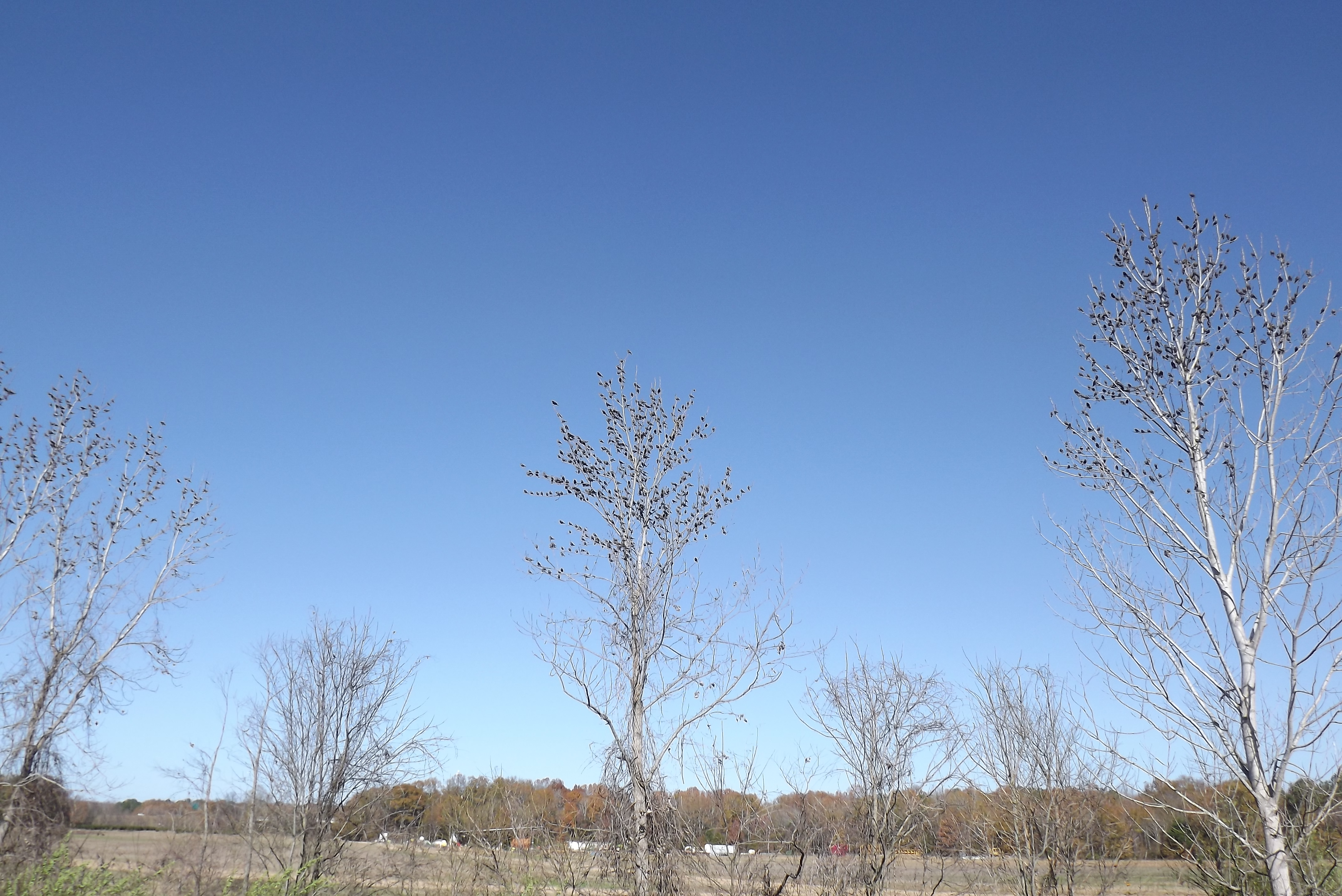
Although it can be overwhelming at first, looking closely at individual birds in large groups of blackbirds will give you the practice you need to identify those species much more quickly.  Here is a flock of blackbirds swarming the upper branches of three tall trees:

When you examine the flock more closely, you can see that it is made up of Brown-headed Cowbirds and Red-winged Blackbirds.  There is an obvious flash of red on the wing of a male Red-winged Blackbird, and the female Red-wings have pale "eyebrows" and are densely streaked with brown.  The Brown-headed Cowbirds—clay-colored females and brown-headed males—are also fairly easy to pick out.

Can you spot the Brown-headed Cowbirds on the wires in the following photo?  A second species is present, as well.

Here is a close-up of the two species: Brown-headed Cowbird and European Starling (the bird on the right).  Starlings are not in the same family as North American blackbirds, although they frequently flock with them.  Studies indicate that mixed-species flocking helps birds to evade predators.

Starlings have longer bills than cowbirds, and their plumage in the winter is speckled with white.

Some blackbirds, like Common Grackles, are easy to identify because of their larger size and proportionally long tails.  These features contrast strongly with those of other, smaller species.  However, even in single-species flocks, grackles' lankiness is distinctive.

Common Grackles seem too big for tube feeders!

The Brewer's Blackbird is another fairly common species in eastern North America, and its shape and proportions make it appear more like a "standard" songbird.  The males, like the one below, have glossy, dark, iridescent plumage and pale eyes, while the females have dark eyes and are browner.  The Brewer's Blackbird tends forage in open areas, such as agricultural fields.

Brewer's Blackbirds shine in the sun.

The Rusty Blackbird is a widespread species that, sadly, has experienced steep population declines—likely as a result of climate change and habitat loss—over the last several decades.  Although it has become scarce, you can still occasionally find larger flocks of these birds during the colder months.  As the name suggests, both males and females have rust-brown coloration in the winter (although males are black in the breeding season).  

Bottomland hardwood forestsor habitats at the borders of these types of woods—are particularly attractive to Rusty Blackbirds during the winter.
Notice the rusty barring and pale eyes.

While several other blackbirds and associated species occur in North America, these are the most common ones over much of the eastern region.  The next time that you're in the field, take a closer look at blackbird flocks—you may be surprised at the diversity of species that you find! 

Tuesday, April 30, 2024

Participate in the North American Migration Count!

For many birders, the hobby of birding is at its best in the springtime.  While you head out into the field, the observer of the changing landscape with all its fresh, different sights, there will be transient birds migrating through, new residents staking out territory, early breeders busy at their nests, and winter visitors moving on north.  This is clearly one of the best times to survey the vast numbers of bird life on this continent and make a useful contribution to science.  This is the idea behind the North American Migration Count—which is held on the second Saturday of May.  Although this date falls later than the peak of spring migration for the Southeast, there should still be plenty of migrating birds moving through.  Migration counts may be conducted by teams of birders or individuals, but each count area must be confined to a single county.  All wild birds within the count area may be included in the tally, and the counting procedure is very simple and straightforward—like that of the Christmas Bird Count.

I was a teenager when I first participated in the North American Migration Count.  The Oktibbeha Audubon Society asked me to survey a route in the southeastern part of the county.  My dad and I headed out on our route at about 9:30 a.m., hitting the Bluff Lake levee first to tally any herons, egrets or songbirds that crossed over into Oktibbeha County.  The morning was warm and muggy but full of birds.  Very quickly we picked up Acadian Flycatcher, Common Yellowthroat, Yellow-throated Warbler, Great Crested Flycatcher, Eastern Kingbird, Prothonotary Warbler, White-eyed Vireo, Indigo Bunting and many other species in the woods, including a Ruby-throated Hummingbird feeding from Trumpet Creeper blossoms.  We heard a Fish Crow and also counted many egrets flying overhead, a couple of Wood Ducks, and one Great Blue Heron, which surprisingly, would turn out to be our only one all day.  Just as we were leaving the area, I glimpsed a group of three large birds flying high overhead—White Ibises.

Prothonotary Warbler

We drove a little down the road, looking and listening for some of the forest species such as Red-eyed and Yellow-throated Vireo, Pileated Woodpecker, Eastern Wood-Pewee and Yellow-billed Cuckoo.  By now our list was around 40 species.  There were good numbers of singing Yellow Warblers, and I could make out two Northern Parulas trilling close by.  As we got out to walk a trail that cut through the woods, there was a harsh chittering overhead, which alerted us to about two dozen Chimney Swifts circling.  These were probably natural-nesting swifts, choosing a hollow tree over a manmade chimney.

The woods were mostly deciduous, with tall pines mixed in here and there.  There were also many deep puddles of muddy water from a recent rainfall.  Pine Warblers, chickadees, titmice, towhees, and vireos noisily proclaimed their territories in the dense woods, seeming almost indignant at us traipsing through their home.  I accidentally flushed a Cooper’s Hawk from its roost.  It flew away, disturbing the singing birds for a few minutes.  I heard White-breasted Nuthatches in the distance and saw a pair of Summer Tanagers in the trees.  Bird songs were not all that we heard:  Gray Treefrogs were also making their presence known in the forest with low-pitched croaks.

Cooper's Hawk

I had just commented to my dad on the odd absence of Kentucky Warblers, when one in a thicket burst emphatically into song.  A Hooded Warbler added its short, eight-syllable whistle to the other sounds of the forest, while wrens and skinks scuttled through the thickets and leaf litter, the wrens putting in a word now and then, unlike the lizards!  There was a creek by this trail where we were likely to find Louisiana Waterthrushes, and in the trees near it, American Redstarts.  Unfortunately, neither species showed up for us, and eventually we moved on, making a mental note to come back to the trail later. 

We went up Oktoc Road for more counting.  The habitat here was mostly thickets, fields and pastures, with scattered trees, which meant a whole new group of species for us.  Bluebirds and kingbirds perched on the wires; grackles and blackbirds foraged in the pastures.  We were able to add Red-headed Woodpeckers and many more Cattle Egrets to the tally.  Eastern Meadowlarks, Orchard Orioles, Barn Swallows and Purple Martins also put in appearances.  Overhead, there were vultures, Red-tailed Hawks and a Green Heron that flew from a small pond.  A little farther down the road, I heard a loud ringing song coming from a thicket—a Swainson’s Warbler.  I listened to the recording on my audio field guide back in the car; no doubt about it:  the song was a Swainson’s Warbler’s.  Since this is a fairly scarce bird, I wrote down the location, including the mailbox number, and we headed on.

We came to a place down the road where mixed forest grew on one side and young trees and shrubs were just coming up on the other.  Almost immediately our ears picked up Northern Bobwhite, Yellow-breasted Chat and one Prairie Warbler.  A few more Kentucky Warblers and Indigo Buntings sang loudly, and I spotted another Summer Tanager pair.  Then I noticed something lower down in an oak tree.  I investigated with binoculars and found myself looking at a beautiful male Scarlet Tanager, just sitting on a limb in a little shaft of sunlight, his jet-black wings and tail contrasting with the bright-red of his body.  What a treat!

Scarlet Tanager

We still had to head through Starkville, so after tallying, we drove on.  While in town, we saw plenty of House Sparrows and European Starlings and two Eurasian Collared Doves.  Our next stop was a sewage lagoon where we supposed to locate a few ducks and shorebirds.  As we began walking around the pond, we flushed bunches of Red-winged Blackbirds and saw Northern Rough-winged Swallows overhead, but the edge of the pond, choked with weeds, just didn’t look promising for sandpipers.  Farther up, however, we noticed the drastic difference in the habitat.  There were obvious mud flats with shorebirds feeding.  Three Solitary and one Spotted Sandpiper dotted the bank with several Killdeer, too.  We saw two Blue-winged Teal, a pair of Canada Geese with four large fuzzy young, and thirteen Wood Ducks—two adults and eleven ducklings. 

The count list was pretty big so far, but I did notice that we were missing a few birds.  We managed to find some Blue Grosbeaks by retracing our route and only counting species that were new to us, not ones we’d counted already.  We managed to hear a flock of Cedar Waxwings this way, and then went to search again for the redstarts and waterthrushes.

The woods were a lot quieter now; it was about 4:00 p.m. and I doubted that we’d see the elusive species we were looking for.  Although we didn’t pick up any new birds while we were there, we did see other wildlife.  Butterflies fed on the flowers, Ichneumon wasps flew up from the grass, and a Southern Leopard Frog was in one of the puddles.  My dad was pleased to observe a Toad Bug that I located near another pool of water.  We watched it as it hopped about, its coloration blending in amazingly well with the gritty mud of its habitat.

Back in the car, we counted up the species we had found during the day:  seventy-six, and hundreds of individuals all over.  It had been a great count.  We were both exhausted but filled with a sense of accomplishment and exciting memories of that spring day. 

Even if your schedule doesn't permit you to count every bird that you see for an entire day, it’s still worthwhile to spend some time marveling at the diversity of species during this fascinating season!

Sunday, December 31, 2023

Waterfowl Identification in the Winter

This is a repeat from several years ago.  Enjoy!

Winter is here.  The landscapes are bare of the lush greenery that cloaks them in summer, and the woodland birds—woodpeckers, waxwings, warblers, and sparrows—are constantly on the search for new sources of food in their altered homes.  Hawks, too, are taking advantage of the dining opportunities that winter brings, choosing a high vantage point as they do so, riding the breezes against a gray sky reflected on the calm water of a pond or lake nearby.

On these ponds and lakes, yet another group of wintering birds can be observed: ducks!  As they float about together, feeding on plants and small aquatic animals, they are much easier to see and identify than all those look-alike warblers and sparrows.

Or are they?

The vast majority of ducks are shy and skittish, and you’re lucky if you can creep up on them without provoking them to fly.  And some of the species that form large flocks on open water, such as scaup and Redheads, are often so far away when you spot them that you’re hard-pressed to locate any distinguishing details even with the aid of a spotting scope.  Ducks circling overhead in flight can also be elusive.  With these points in mind, let’s take a look at the ducks and duck-like birds of the southeastern U.S., and their identifying traits.

The most familiar species in the family Anatidae (which encompasses all of the world’s swans, geese, and ducks) are the dabbling ducks, in the genus Anas.  Species in this group feed directly on the surface of the water or just a few inches below it, tipping themselves forward to reach aquatic vegetation.  The Mallard is one of the most abundant and widespread dabblers, and can be seen in many wetland habitats.  The males are difficult to mistake, with their glossy green heads, rich brown breasts, and yellow bills.  Females are a mottled tawny brown with orange and black bills.  Both sexes have bright purplish-blue speculums (colored patches on the secondary feathers) bordered in white.  In addition, the Mallard is a very large duck, measuring 23 inches from tail to bill.

A similar species that was formerly common but is now in decline is the American Black Duck.  Both male and female Black Ducks look like darker versions of the female Mallard, but the male Black Duck’s bill is yellow, and the female’s is grayish.  Their speculums lack the bold white borders of the Mallards’.  The Gadwall, another duck resembling the female Mallard, is slightly smaller than its relative and has drabber feathers.  Males are mottled grayish-brown, with black tails and dark-gray bills.  Females are browner, and their bills are gray on top and have dull- orange sides.  The most distinctive field mark on this species is a small white patch on the wing, which stands out even at a great distance.

Wintering flocks of Mallards and Gadwalls often contain yet another species: the American Wigeon.  This duck is about 19 inches long and has a rounder build than these other dabbling ducks.  The males and females have brownish flanks, pale gray bills, and green speculums.  The male has green ear patches and a strikingly white forehead and cap.  The female’s head is stippled and has a tinge of olive.  

The Northern Pintail, like the Mallard, is a very large duck.  Slim and long-necked, it has sharp, pointed tail feathers, especially obvious on the male, who also has a dark brown head and a white breast.  His body is mostly light gray.  The female is mottled brown all over.  These ducks have shiny, dark gray bills.

Except for sharing the same genus, the two common species of teal in the eastern U.S. are not closely related.  They are both very small ducks, however, and have green speculums.  In addition to the green speculum, the Blue-winged Teal has periwinkle-blue wing coverts.  Both the male and the female are mostly mottled grayish-brown, but the male has a white crescent in front of the eye.  The Green-winged Teal female can be told from the female Blue-winged Teal by its browner coloration.  The male Green-winged Teal’s head is rich chestnut and green, its back and flanks are gray, and its breast is buff-colored with black speckles.  Blue-winged Teal are very common during migration, but they can be a bit difficult to find in inland areas during the winter.  Green-winged Teal may not be as abundant in the spring and fall, but they winter in these areas more frequently than their counterparts.

Blue-winged Teal
A more unusual dabbling duck is the Northern Shoveler, named for its exceptionally large, spatulate bill.  With these bills, shovelers are able to strain large amounts of mud for small invertebrates.  Sometimes called “spoonbill” or “smiling Mallard”, the male shoveler has a green head, white breast, and chestnut flanks.  Females are mottled brown, but, like the males, they have glossy green speculums.

Diving ducks, genus Aythya, forage mostly below the water’s surface.  They are often seen in huge flocks, or rafts.  They have heavy bodies and relatively short wings, so, unlike dabbling ducks, they must have a running start on the water in order to fly.  If individuals in a distant group of ducks periodically disappear and then pop up again, they are diving ducks.

Some of the most well-known members of this genus, Canvasbacks are large, robust ducks.  They have long black bills and sloping profiles.  The male has a chestnut head, black breast, and white back.  The female has a brown head and neck, and a pale brownish-gray back.  The Redhead is superficially similar to the Canvasback, but it is slightly smaller and has a shorter neck, shorter bill, and lacks the sloping profile of its relative.  Males have chestnut heads, black breasts, and gray backs.  Females are warm brown all over.  The bills of both sexes are tricolored: blue-gray, white, and black.

The white, sloping backs let you know immediately that these are Canvasbacks!  Ring-billed Gulls are in the background.
Probably the most common diving duck is the Ring-necked Duck.  Actually, it might have been better to have named it the Ring-billed Duck, as the thin chestnut ring on its neck is difficult to see, but the white-ringed black bill is obvious.  The male of this species has a dark, glossy head and breast, a black back, and gray sides.  A bright white line separates the black breast from the gray flanks.  The female is brownish overall with pale cheeks and a white eye-ring.

Ring-necked Ducks
There are two species of scaup in North America: the Greater and the Lesser.  If both species are next to each other, it may be possible to see a difference in size between them, but this is not a foolproof field mark.  Better identifying features are the more rounded head shape of Greater Scaup (Lesser Scaup have a slight point at the crown) and the higher amount of white in the Greater Scaups’ wings.  A male scaup of either species will have a dark head and breast, very pale gray flanks, and a gray back.  A female is brown, with a white patch at the base of the bill.  The bill in both sexes is gray.

A group of waterfowl collectively known as Sea Ducks includes scoters, goldeneyes, and buffleheads.  Buffleheads, closely related to goldeneyes, are the only common members of this group where I live.  These tiny ducks, just 13 inches in length, have large, round heads, small bills, and bob about on open lakes.  The male’s black head has a large, white wedge-shaped patch, and his underparts are white.  The female is grayer, with a dark brown head and a white ear patch.  Another small duck that is often seen on large ponds and lakes is the Ruddy Duck, in the group Stiff-tailed Ducks.  This species has a broad bill that on the breeding male is bright blue.  In winter birds, however, the beak is gray.  These ducks have buff-colored underparts, dark brown wings and caps, and the males have white cheeks. 

Mergansers are another set of waterfowl.  The Common Merganser, a very large, mostly pale duck with a dark head and red bill, is actually uncommon to rare in the southeastern U.S. in the winter.  Our most abundant merganser is the Hooded, a medium-sized duck with a thin, serrated bill used in catching fish and crustaceans, and possessing a somewhat bizarre appearance.  The male has rufous sides, a white breast, and a fan-like crest with a large white patch in the center.  His mate is brown with a white wing patch, and a smaller tuft of brown feathers on her head.  This duck occurs in both open and wooded areas, and nests regularly in the Southeast.

The Wood Duck also breeds in the south and is sometimes seen in winter flocks with the Hooded Merganser.  Most birders are familiar with the colorful plumage of the male Wood Duck, and the subtle brown feathering and white eye-ring of the female.  When a group of Wood Ducks is disturbed, they will often fly off with distinctive oooeeek! calls. 

Swans are rare in our area, but geese are nearly always common.  The ubiquitous Canada Goose is well-known to nearly all birders.  Stocky white Snow Geese are also present, providing opportunities to search for their smaller, rarer cousin, the Ross’s Goose.  And, if you’re on the lookout for waterfowl, you may also spot Greater White-fronted Geese mingling with Canada and Snow Geese, or perhaps foraging on their own.  Their brown necks and orange bills are distinctive.

There are also duck look-alikes, such as grebes and coots, both of which have lobed, not webbed feet.  The little Pied-billed Grebe usually swims alone or in small groups.  It frequently submerges itself in the water, only to pop up again several feet from where it dived.  American Coots are very duck-like in their habits, although they are related to rails and gallinules.  Their stocky gray bodies and chicken-like white bills are noticeable even from a great distance.

When you’re out birding this winter, be sure to witness the fascinating behaviors of the ducks, geese, and other waterbirds that are taking up residence.  With their myriad forms and patterns, they bring striking color and vibrant action to our cloudy, gray landscapes.

Ring-necked Ducks and Green-winged Teal