Showing posts with label Solitary Sandpiper. Show all posts

Thursday, April 30, 2026

Spring Migrants: Solitary and Spotted Sandpipers

The mention of sandpipers often brings stress to inexperienced birders.  After all, sandpipers are those dull, brownish little creatures that skitter over mud and all look alike.  In other words, it can be hard to appreciate them.  But actually, on closer study, sandpipers are unusual and highly fascinating birds.  And, no, they don’t all look alike!  I will focus on two very distinctive, common sandpipers that can be seen in migration now: the Solitary Sandpiper and the Spotted Sandpiper.

Solitary and Spotted Sandpipers

Although they are not closely related, the Solitary Sandpiper (Tringa solitaria) and the Spotted Sandpiper (Actitis macularius) are often seen together feeding in the same ponds and lakes, frequently those with woods or at least low-lying vegetation nearby.  Both can be found migrating in Mississippi from about March to June in the spring, and late July to late October in the fall.  The Spotted Sandpiper is an occasional winter resident in the state, as well, but is more common along the coast than inland.

Both sandpipers forage and migrate singly or in small groups, and both exhibit tail-bobbing behavior.  With the Spotted, the entire body is teetered; the bird is in constant, jittery motion: scampering along the water’s edge, picking up small insects, mollusks, crustaceans, and even tiny fish.  The Solitary Sandpiper has slower, more deliberate movements, and when it pauses, it often bobs its head and tail.  It has longer legs and a longer bill than the Spotted, which enables it to feed in slightly deeper water, where I assume the menu would include bigger fish and frogs!  As an additional feeding adaptation, it often shakes its foot above the water to draw small fish and insects to the surface.

If you come unexpectedly upon either of these sandpipers, they will probably fly up immediately, uttering high-pitched peet-WEET calls (the Solitary’s call is the higher pitched of the two).  Fortunately, their flight styles are very different and distinctive.  The Solitary Sandpiper has graceful, swallow-like wingbeats and displays long, pointed wings and white edges on its tail.  Spotted Sandpipers fly close to the water and give fluttery, shallow beats of their shorter, more-rounded wings, each of which shows a thin, white stripe.

Once the sandpipers land on the bank and begin feeding again, their colors and patterning are apparent.  The Solitary Sandpiper is slightly larger than the Spotted, with a longer neck and body, and it has a wide, white eye-ring that gives it an alert look.  Its head, neck, and breast are finely streaked with brown, its belly is white, and its back is dark brown and shiny, with a dusting of tiny white spots.  The thin, dark bill and dark, greenish-gray legs complete the picture.  The Spotted Sandpiper is relatively small and stocky, with orange legs and bill, brown upperparts, a white eyebrow and slight eye-ring, and in the breeding season a boldly spotted breast and belly.  At least before the birds molt in the fall and replace the spotted front with plain white, you can sometimes tell the sexes apart.  Females have larger spots that extend farther onto the belly than males.

But why would the female bird be more distinctively marked?  The answer lies in the Spotted Sandpiper’s breeding biology.  Along with phalaropes, it is unusual in that the females are polyandrous, mating with more than one male—sometimes up to five!  Each time after mating, the female lays a clutch of up to four brownish eggs, which the male is solely responsible for incubating.  However, the female does help with constructing the nest—a shallow scrape in the ground, lined with grass.  After the eggs hatch, the male alone raises the chicks, which are born precocial like all sandpipers.

While the Solitary Sandpiper is monogamous and doesn’t exhibit such unusual breeding behavior as the Spotted, it is unique among North American shorebirds in that it nests in trees.  A female Solitary Sandpiper will add a little extra nesting material to the abandoned nest of a songbird, such as a Rusty Blackbird, American Robin, or Cedar Waxwing, incubate her four well-camouflaged, brownish eggs, and care for the young with her mate.  Tree-nesting is so unusual among shorebirds (the Green Sandpiper of Eurasia is the only other species known to do it regularly) that, for decades, no one was sure where the Solitary Sandpiper nested until 1903, when the secret was finally discovered.

Spotted Sandpipers are one of the most widespread shorebirds, commonly found over much of North America, although they aren’t known to breed in Mississippi and some other southern states.  Solitary Sandpipers are more restricted in range, occurring in the breeding season mainly in Canada and Alaska.

The numbers of both of these sandpipers appear to be fairly stable, and that’s good news.  With care and protection, generations years into the future will be able to observe the fascinating behaviors of these and other birds that have been living here for eons.  A world without the little brown sandpipers that enliven our fields, woods, and wetlands would be bleak.

Friday, April 30, 2021

Spring Shorebirds

Heavy rains in the springtime often lead to flooding in fields and meadows, which, in turn, attracts migrating shorebirds.  Although I’ve discussed shorebird identification in previous posts, my focus has been primarily coastal species.  However, many other shorebirds pass through inland regions on their way to their nesting grounds (which are also often inland), so you definitely don’t have to be a coastal resident or tourist to see them.  I’ve observed many in northeast-central Mississippi, including in the fields at the Mississippi State University research farms.  In late April, 2020, one of those fields became a stopover for these migrating groups of shorebirds.

To an untrained eye, the field wouldn’t have looked particularly special.  There were ridges of mud and multiple tussocks of grass above the water, and the small, brown birds seemed well camouflaged—at least until they moved!  In this photo, you might be able to make out some of the many shorebirds feeding in the mud.  There were even a few Killdeer—common, familiar birds of pastures and grasslands—at the edges of the puddles.

Killdeer in background, to the right
 One of the easiest species to pick out from the rest was the Long-billed Dowitcher, a rust-colored, comparatively chunky bird with a bill over twice the length of its head.  I described Short-billed Dowitchers in an earlier post, and most of what I said about their appearance applies to the Long-billed species, as well.  The Long-billed Dowitcher’s habits and vocalizations differ drastically from that of its cousin, though: Long-billed Dowitchers are far more likely to be found in freshwater habitats, and their call is high-pitched and sharp. 

Long-billed Dowitcher

Long-billed Dowitcher

 
Another species that stood out from the rest was the Wilson’s Phalarope.  As you can see in the photo below, the strongly contrasting head markings of this species are very distinctive.  Surprisingly, the more colorful of the two phalaropes (the one on the left) was actually a female, while the drabber bird was a male.  Phalaropes exhibit polyandry, which simply means that a female bird will mate with multiple males and lay several clutches of eggs.  The males are responsible for incubating the eggs and, later, raising the young.
 
Wilson's Phalaropes

Solitary Sandpipers lurked at the edges of the field, feeding mainly in the weedier areas.  Although these birds aren’t truly “solitary” much of the time, they do tend to avoid mingling with larger flocks.  Some of their distinctive field marks are white bellies, dark brown backs, finely stippled necks, white eye-rings, greenish legs, and black bills. 
 
Solitary Sandpipers
 
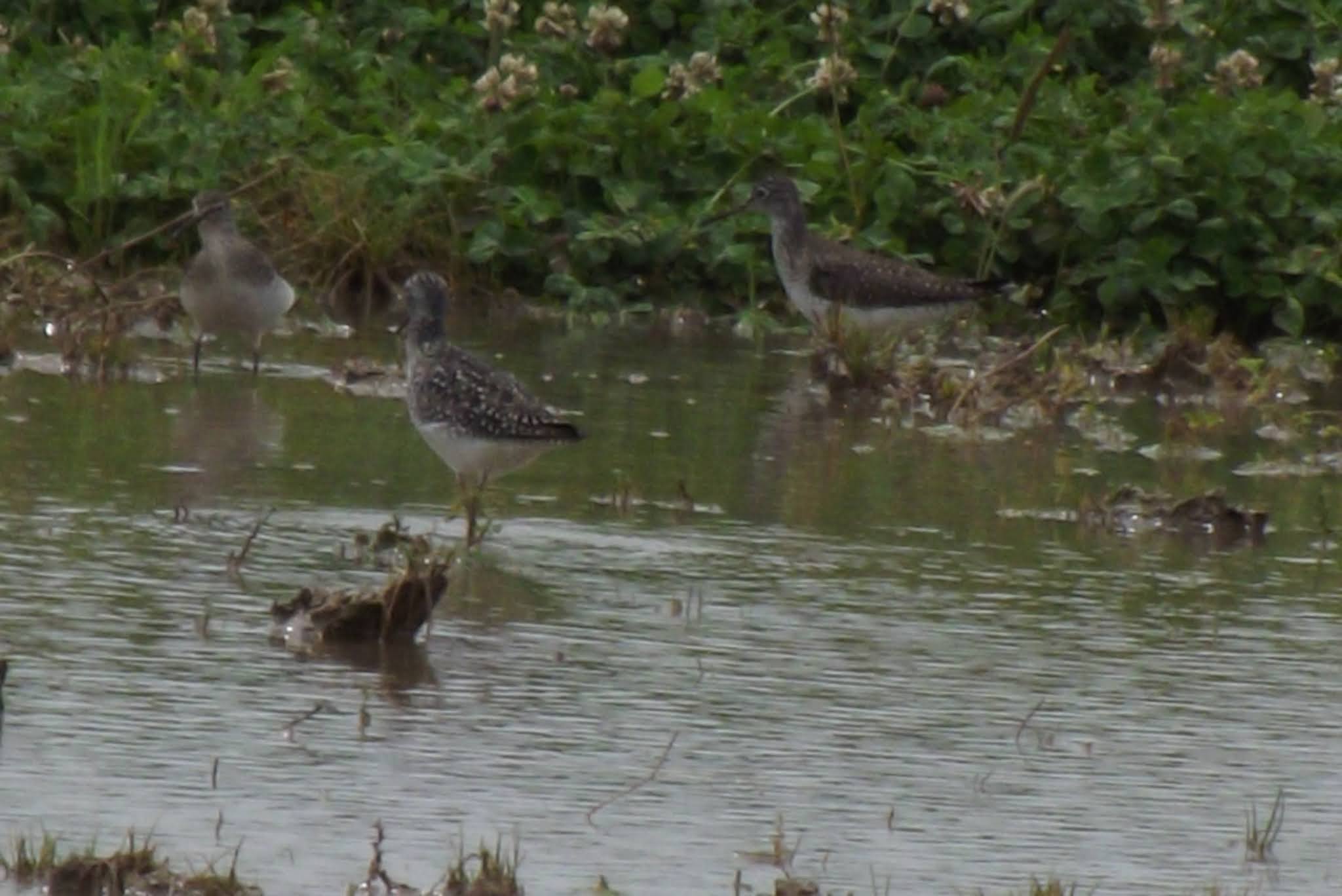
In the next photo, the bird in the middle is a different species from the Solitary Sandpipers standing behind it.  It has far heavier white spotting on its back, and its legs are yellow instead of grayish-green.  The color of the legs actually provides an important clue to the bird’s identification: this was a Lesser Yellowlegs.
 
Lesser Yellowlegs and Solitary Sandpipers
 
As it turned out, there were many Lesser Yellowlegs in the flooded field.  They made long strides while foraging, frequently passing though the groups of Long-billed Dowitchers. 
 
Long-billed Dowitchers and Lesser Yellowlegs
 
Smaller numbers of the Greater Yellowlegs prowled the field, as well.  In addition to the size difference, the heavier barring on the underparts and the proportionally longer bill helped to distinguish the Greater Yellowlegs from the Lesser.
 
Greater Yellowlegs
 
 I enjoyed seeing how the Greater Yellowlegs dwarfed their relatives. 
 
Lesser and Greater Yellowlegs
 
Last but not least, there were a couple of Dunlin in the flooded field.  Yes, I often see these on the coast, but I’ve also found them inland on several occasions.  As I’ve mentioned before, their stocky build, relatively short legs, and drooped-tip bills make them distinctive.  They typically occur on the coast in the winter, but, when spring rolls around, they begin to make their way up to the arctic to breed, passing over and through large expanses of inland territory.  Marshes, wetlands, shallow ponds, and flooded fields provide important stopover sites for these migratory birds.
 
Dunlin
 
The last photo shows three species.  Can you identify them? 


Answer:

Long-billed Dowitcher (left), Wilson’s Phalarope (two birds at center), and Lesser Yellowlegs (right).

Tuesday, April 30, 2019

Solitary and Spotted Sandpipers


At the mention of sandpipers, many birders mentally groan.  After all, sandpipers are those dull, brownish little creatures that skitter over mud and all look alike.  In other words, it can be really hard to appreciate them.  But actually, on closer study, sandpipers are unusual and highly fascinating birds.  And, no, they don’t all look alike!  I will focus on two very distinctive, common sandpipers that can be seen in migration now: the Solitary Sandpiper and the Spotted Sandpiper.

Although they are not closely related, the Solitary Sandpiper (Tringa solitaria) and the Spotted Sandpiper (Actitis macularius) are often seen together feeding in the same ponds and lakes, frequently those with woods or at least low-lying vegetation nearby.  Both can be found migrating in Mississippi from about March to June in the spring, and late July to late October in the fall.  The Spotted Sandpiper is an occasional winter resident in the state, as well, but is more common along the coast than inland.

Both sandpipers forage and migrate singly or in small groups, and both exhibit tail-bobbing behavior.  With the Spotted, the entire body is teetered; the bird is in constant, jittery motion: scampering along the water’s edge, picking up small insects, mollusks, crustaceans, and even tiny fish.  The Solitary Sandpiper has slower, more deliberate movements, and when it pauses, it often bobs its head and tail.  It has longer legs and a longer bill than the Spotted, which enables it to feed in slightly deeper water, where I assume the menu would include bigger fish and frogs!  As an additional feeding adaptation, it often shakes its foot above the water to draw small fish and insects to the surface.

If you come unexpectedly upon either of these sandpipers, they will probably fly up immediately, uttering high-pitched peet-WEET calls (the Solitary’s call is the higher pitched of the two).  Fortunately, their flight styles are very different and distinctive.  The Solitary Sandpiper has graceful, swallow-like wingbeats and displays long, pointed wings and white edges on its tail.  Spotted Sandpipers fly close to the water and give fluttery, shallow beats of their shorter, more-rounded wings, each of which shows a thin, white stripe.

Once the sandpipers land on the bank and begin feeding again, their colors and patterning are apparent.  The Solitary Sandpiper is slightly larger than the Spotted, with a longer neck and body, and it has a wide, white eye-ring that gives it an alert look.  Its head, neck, and breast are finely streaked with brown, its belly is white, and its back is dark brown and shiny, with a dusting of tiny white spots.  The thin, dark bill and dark, greenish-gray legs complete the picture.  The Spotted Sandpiper is relatively small and stocky, with orange legs and bill, brown upperparts, a white eyebrow and slight eye-ring, and in the breeding season a boldly spotted breast and belly.  At least before the birds molt in the fall and replace the spotted front with plain white, you can sometimes tell the sexes apart.  Females have larger spots that extend farther onto the belly than males.

But why would the female bird be more distinctively marked?  The answer lies in the Spotted Sandpiper’s breeding biology.  Along with phalaropes, it is unusual in that the females are polyandrous, mating with more than one male—sometimes up to five!  Each time after mating, the female lays a clutch of up to four brownish eggs, which the male is solely responsible for incubating.  However, the female does help with constructing the nest—a shallow scrape in the ground, lined with grass.  After the eggs hatch, the male alone raises the chicks, which are born precocial like all sandpipers.

While the Solitary Sandpiper is monogamous and doesn’t exhibit such unusual breeding behavior as the Spotted, it is unique among North American shorebirds in that it nests in trees.  A female Solitary Sandpiper will add a little extra nesting material to the abandoned nest of a songbird, such as a Rusty Blackbird, American Robin, or Cedar Waxwing, incubate her four well-camouflaged, brownish eggs, and care for the young with her mate.  Tree-nesting is so unusual among shorebirds (the Green Sandpiper of Eurasia is the only other species known to do it regularly) that, for decades, no one was sure where the Solitary Sandpiper nested until 1903, when the secret was finally discovered.

Spotted Sandpipers are one of the most widespread shorebirds, commonly found over much of North America, although they aren’t known to breed in Mississippi and some other southern states.  Solitary Sandpipers are more restricted in range, occurring in the breeding season mainly in Canada and Alaska.

The numbers of both of these sandpipers appear to be fairly stable, and that’s good news.  With care and protection, generations years into the future will be able to observe the fascinating behaviors of these and other birds that have been living here for eons.  A world without the little brown sandpipers that enliven our fields, woods, and wetlands would be bleak.