I would guess that most birders start out separating birds in the field primarily by plumage colors and patterns. I know that it was like that for me; the first field guide that I used contained photos that showed birds engaged in a variety of behaviors in their natural habitats, and even went so far as to categorize so-called “perching birds” by color. Any given page spread would show six related (or, in the case of the “perching birds” section, not closely related) species, often in completely different poses and with no real sense of scale.
I want to emphasize that photographic guides aren’t necessarily bad—the problem I experienced was only that I came to subconsciously expect what I saw in the field to match the pictures in the book, and when that didn’t happen, I was sometimes a tad frustrated. I simply lacked the experience at that stage to quickly and accurately discern the differences in shape, size, and usual posture between various species of birds. That skill had to come with time.
Not to discount plumage, of course, but shape, size, posture, and behavior are usually far more diagnostic than intricate feather details, at least for some species. Comparing several related or somewhat similar birds at once also helps immensely, although it’s not always easy to find an opportunity to do so. That’s why I was pleased to be able to compare multiple species of gulls, terns, and shorebirds—of various ages—this year at Dauphin Island, Alabama. This occurred on the 14th and 15th of March, which meant that some of the gulls and terns (and other species) were in alternate (or breeding) plumage, while others were still in basic (or winter) plumage, or in the middle of molting. The first part of my photo essay will focus on gulls and terns, although shorebirds do show up in some of the pictures!
Let’s start by analyzing this small assortment of birds:
All of these are pretty easy to identify. Breeding adult Laughing Gulls, like the one on the left, have black hoods, dark-red bills, slate-gray backs and wings, and mostly black wingtips. The bird in back, an adult Ring-billed Gull, has the conspicuous black ring on a yellow bill, yellow legs, a somewhat lighter gray back, and a little more white on the primary feathers. You can probably tell that the Ring-billed Gull is larger than the Laughing Gull, as well. The two birds in front, shorebirds, are also drastically different from each other: the large, lanky one is a Willet, and the tiny one is a Sanderling.
Lone birds can be slightly trickier, especially if they’re not in full adult plumage. For instance, look at this younger Ring-billed Gull:
The bill lacks an obvious dark ring, being pink with a black tip. The legs are a dull pink, as well, and the plumage looks scruffier and more mottled on this “teenager” bird than on the adult in the first photo. The body shape is basically the same, though.
Now, compare that bird to the Herring Gull in this photo:
Although both the Herring Gull and the Ring-billed Gull have black-tipped pink bills, pink legs, mostly grayish backs, and whitish heads, they’re subtly different in shape. The Herring Gull has a bulkier build and a thicker bill. Also notice that the Ring-billed Gull’s primary feathers extend pretty far past the tail. The Herring Gull’s primaries look much shorter. And, of course, the Herring Gull has a lot more brown feathers in its plumage. (An adult bird would show more white, but this one is a subadult.)
Of course, if the Herring Gull had been standing next to the Ring-billed Gull, another difference would have been obvious: Herring Gulls are giants in comparison to Ring-bills. In the photo below, the Herring Gull is on the left, dwarfing the Laughing Gull (without a black hood) and the Royal Tern (the bird with the orange bill).
 |
| Herring Gull, Royal Tern, and Laughing Gull |
Speaking of Royal Terns, there were dozens of them on the beach, along with over a hundred Black Skimmers. Skimmers are mostly crepuscular (i.e., active at dawn and dusk), so these birds were just roosting together in the late morning on the shore. Their distinctive looks didn’t present any identification challenges, but they did provide a nice basis for comparison with other birds.
In the photo below, you can see how some of the skimmers have their heads resting on their backs, while a few of the birds are alert, with their cartoonishly large, red-and-black beaks visible. Skimmers forage by flying low over the water, their long mandibles slicing through the surface. If they touch fish, they snap them up quickly. Terns, like the Royal Terns in the photo, are more specialized than gulls in their feeding habits, and usually dive for aquatic invertebrates and fish. Their bills are longer and more dagger-like than those of gulls, but much smaller than those of skimmers. Some of the Royal Terns had already completed the molt into breeding plumage, while others still retained the characteristic white foreheads of winter plumage.
 |
| There is also a Ring-billed Gull in the picture. Can you spot it? |
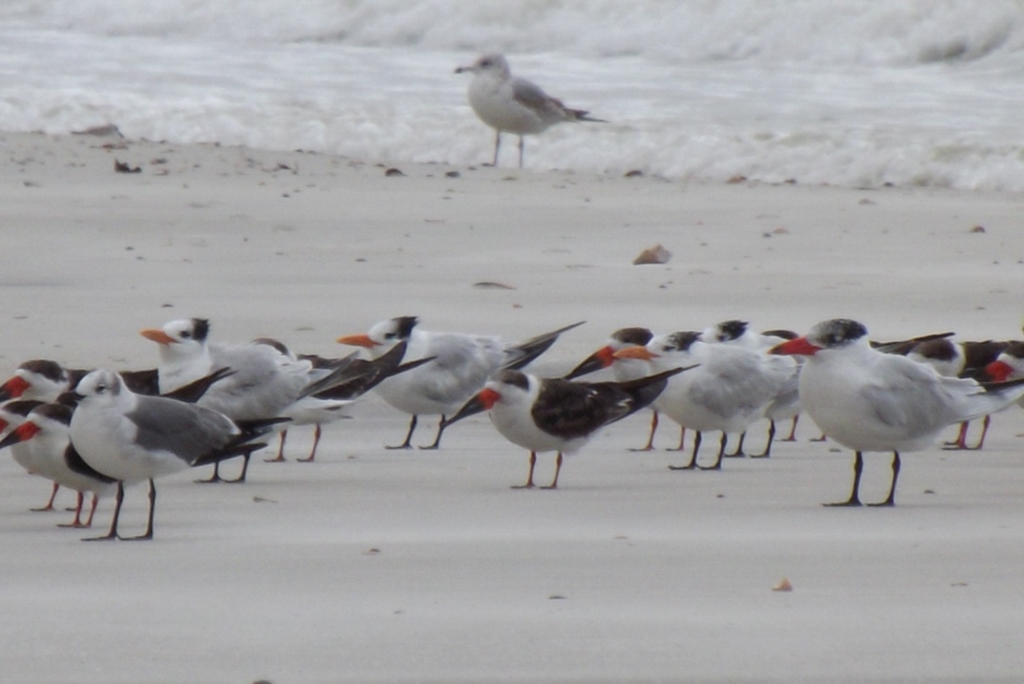
A few Caspian Terns were mixed in with the group. In the next picture, you can see a Caspian Tern on the right. It has a fairly stocky, red bill with a smudge of black at the tip, and its head has a more rounded crest, unlike the long and spiky one of the Royal Tern. The orange-billed Royal Terns in the photo are congregating with Black Skimmers, and do you see the winter-plumaged Laughing Gull on the left, and the Ring-billed Gull in the background?
Here’s another type of tern: the Forster’s Tern. These are considerably smaller than the other two species I mentioned. They have red legs, and, in winter plumage, black bills. Distinguishing them from the similarly small, closely-related Common Terns can be tricky, but they don’t pose an identification challenge when seen with Royal and Caspian Terns.
 |
| Forster's Tern (with Royal Terns and Black Skimmers) |
You might have noticed that the tern at the upper left has a much redder bill than any of the others in that photo. If you were simply relying on bill color for identification, you might be tempted to call this individual a Caspian Tern. However, the bill is relatively slim, like that of a Royal Tern, and lacks the black smudge that you would expect to see on a Caspian Tern. The bird’s crest clinches the ID: it is long and shaggy in the classic Royal Tern shape, rather than short and rounded. Noticeable variation can and does occur within species of birds!
That’s the end of Part I. Stay tuned for Part II, which will focus on the shorebirds.