Showing posts with label Sanderling. Show all posts

Monday, July 31, 2023

Sights of Summer

It has been a hectic and strange summer, as well as a hot one.  I've been getting out whenever I can, and, fortunately, there are always plenty of interesting birds and other wildlife to see.  Here are some sightings from the last few months!

Sanderlings generally depart from their wintering grounds for the Arctic by the end of spring, and that was technically still the season when I saw this bird foraging along the shore.  If you compare the plumage of this bird to Sanderlings in some of my other posts, you’ll see how much richer and redder it is: breeding plumage.

Sanderling

Ruddy Turnstones easily beat it in flashiness, though: caramel brown, black, and white.  A palette like turtle ice cream, maybe, but it stands out against the beige and gray of the sand and mud.

Ruddy Turnstone

A lone Reddish Egret has a fierce appearance, which befits its predatory nature.  Imagine being a fish and that yellow eye being one of the last things you see before going down the egret's gullet!  

Reddish Egret

Although far from rare, the Gull-billed Tern is generally one of the less commonly seen resident tern species around here.  It has a distinctively thick, black bill and narrow, pale wings.  This one went through an entire preening session as I watched it.

Gull-billed Tern


Avian migration seems never to end on the coast, and it could be argued that it truly doesn't.  Even in late June, the middle of summer for the Southeast, it's not uncommon to find migratory shorebirds, such as the boldy patterned American Avocets.  These three individuals appeared to be striking poses against the waves as the sun set that evening.

American Avocets

Of course, beaches attract more than just seashore species.  Eurasian Collared-Doves drop down on occasion to scavenge what they can from the sand and debris.

Eurasian Collared-Doves

Fish Crows are far better adapted to wetland habitats than the Collared-Doves are, so it's less of a surprise to see them walking there.  This individual crow examined the seashore debris closely and methodically before flying back in the direction of the city.

Fish Crow

Away from the shore, in the brackish bayous and marshes, a different species community exists.  This is where I sometimes hear and see secretive Clapper Rails.  This one had temporarily left the dense cover of the marsh grasses to wade in the shallows in a small clearing.

Clapper Rail

The usual wariness of these birds (and many other animals in the area) makes sense when you consider the predators that they need to evade in order to eke out a living in their marshy home.  This means that the alligators, too, have to operate through stealth.  When summer is over and late autumn's cooler weather eventually rolls in (if it ever does), these gators may become dormant, emerging only on warmer days.

American alligator

Regardless of the weather, it's a joy to be out in nature.  Hopefully, the conditions will improve a bit as we transition into August.

Wednesday, May 31, 2023

Reporting from the Coast

How about a nice, long walk?  I find that strolling up and down a stretch of seashore helps me to decompress.  Any time of the year can be good, but springtime is surely one of the most interesting seasons for avian life—especially on the Mississippi coast.

It is late afternoon.  A lone Reddish Egret stalks fish in the cobalt waters.  Its blue-gray body—with touches of white—and rust-colored head and neck echo the tints of the waves.  Found almost exclusively in coastal regions, this species occurs in a white form as well as the more familiar “reddish” morph.  This individual appears almost stately—perhaps it is wary of beach walkers—but Reddish Egrets are frequently very lively foragers, darting back and forth and flicking their wings outward to startle their prey. 

Reddish Egret
The egret isn’t the only wading bird braving the waves: a trio of Marbled Godwits—migratory transients on the Gulf Coast—also feeds in the surf.  They’ll likely have moved on, northward, in a month or two.

Marbled Godwits
The same cannot be said for the ubiquitous Laughing Gulls.  These coastal residents remain here all year long, and are as opportunistic as they are common.  Many people view Laughing Gulls as nothing more than nuisances, but I think this is an unfair assessment of these long-lived and clever birds.  Like crows, raccoons, and black bears, they have figured out how to exploit human resources, and we hate them for it!  I don’t think the gulls are too concerned about this, however.
Laughing Gulls
The Reddish Egret from earlier paces in front of the group of gulls.  Are the pickings better over this way?  Maybe, maybe not.

Reddish Egret and Laughing Gulls
A Snowy Egret shows up to survey the surf for small fish.  As you can probably tell from the photo, this species is considerably smaller than the Reddish Egret.  Like its larger relative, it often displays a particularly active foraging style, with lots of “dancing” in and out of the waves.  The larger wading birds, such as Great Blue Herons and Great Egrets, tend to be more sedate in their hunting behavior.  This Snowy, however, mostly stands still and makes itself compact, probably as protection from the wind.
Snowy Egret and Laughing Gulls
Farther up the beach, a Ruddy Turnstone turns over … not a stone, but a leaf.  What is it finding in the sand?  Tiny insects?  Possibly so—this is a fairly opportunistic hunter.  Like the Marbled Godwit, it’s a species that breeds farther north.  It will probably migrate soon, but, in the meantime, it frequents the beaches with other migratory shorebirds, flashing its stunning black-and-white wing patterns whenever it flies up the shoreline in search of prey.
Ruddy Turnstone
Tire tracks show where someone has driven an ATV up the beach.  Laughing Gulls, Black Skimmers, and a few Sanderlings congregate just past these markings, while Dunlin rest closer to the dunes.  They remind me of cattle, with their (tucked-in) heads all turned in the same direction. 
Beach birds

Laughing Gulls and Sanderling

Dunlin
A close-up of snoozing Dunlin reveals subtle markings, which would help to camouflage these birds in the sand and mud.

Dunlin markings
Other migratory shorebird species on the beach sands are Black-bellied Plovers and Willets.  The plovers are still mostly in drab winter plumage, but they’re showing signs of molting into breeding plumage, in which they will have black bellies.  The Willets are similarly dull and gray, since they haven’t finished molting into their barred-and-mottled breeding plumage.  Willets are common all over the beaches at this time of year.
Black-bellied Plovers and Sanderlings

Black-bellied Plover and Dunlin

Willets and Laughing Gull
Rounding out the beach bird community are Black Skimmers.  It’s still early enough in the day that these crepuscular birds probably haven't made too many trips away from the shore.  They will head out in larger numbers closer to evening, when they fly low over the water and drag their ultra-long, red-and-black bills along the surface to find fish to snap up.  Right now, resting along the beach, they look a bit odd and awkward, propped up on their stumpy legs and with their colossal bills slanting downward.  At evening, however, their unusual adaptations will serve them well, making them highly efficient hunters.
Black Skimmers, Laughing Gulls, and Dunlin
For a diurnal mammal like me, though, it’s about time to turn in for the night.  Since this is spring, coming back to the beach later will likely mean reporting on a slightly different group of birds—a unique mixture of resident species and transients—as migration continues.

Wednesday, June 30, 2021

Fine Dining on the Gulf Coast

When I looked through my photos of Alabama birds from my springtime trip to the Gulf Coast, I thought that there was a pretty obvious theme running through most of them: food!  After all, birds eat a lot, and their efforts to find food provide birders with plenty of entertainment.

The Bald Eagle that I watched on the Ocean Springs beach may have been thwarted in its hunting attempts, but this Osprey that I saw the following day on the Alabama coast clearly hadn’t been.  It devoured its prey, a large fish, while perched in a tall slash pine.  In a way, it was lucky for the Osprey that it found this relatively secure site to enjoy its meal; Bald Eagles are known to chase after Ospreys and steal their catches.  This Osprey did appear slightly wary, but it still clung tightly to the fish that it had caught, as if it wondered if I might try to take it.

Osprey in pine -- warily looking back

Back to lunching
Such a gorgeous and impressive bird! 

Although large species like Ospreys and Eagles are the most obvious predatory birds in marshes and on beaches, some much smaller birds also make a good showing.  Boat-tailed Grackles, the coastal cousins of the abundant and familiar Common Grackles, are extremely opportunistic, feeding by preying on invertebrates and other small animals, scavenging dead creatures along the shore, and nabbing snack food from tourists.  I saw several of these large, glossy grackles strutting along the beach, mainly near the pier.

Female Boat-tailed Grackle

Male Boat-tailed Grackle with food

Male Boat-tailed Grackle
Gulls, obviously, are opportunistic, too, although sometimes this tendency is misdirected.  I spent several minutes observing a small group of gulls loitering in the drier sand, away from the waves.  Take a closer look at the immature Laughing Gull (the one without a dark hood) on the left side of the following photo.  It was attempting to eat a wrapper or some other piece of garbage that it had found on the beach. 

Laughing Gulls on the sand
The Laughing Gull eventually dropped the piece of trash, which was then picked up by a young Ring-billed Gull.  Notice the pattern?  Immature birds tend to be worse at hunting than adult birds.  It’s apparently a skill that they have to gain through experience.

Mine!

All mine.
Like the Laughing Gull, the Ring-billed Gull relinquished its “prey” and moved on. 

Gak!
In the flock of Laughing Gulls was a strange and sad sight: a gull missing part of its foot.  I had seen another disabled Laughing Gull in the same location a few years before, but that bird was missing the opposite foot.  Unfortunately, this is probably the indirect result of humans hunting for food on the beach.  Fishing line can get tangled around birds’ feet and cut off the circulation, and I suspect that this is what had happened to the two gulls.   

Injured Laughing Gull
 
A different injured Laughing Gull in 2018
This particular bird didn’t seem to be too perturbed by its handicap, but I’m sure that foraging was much harder for it as a result of the injury.

Preening with that leg would be difficult, too.

On a lighter note, anyone who has seen my other posts on coastal birds can probably identify the species in the next photo.  The large, brownish, chunky gull on the left is an immature Herring Gull; the small, brownish birds in the center are Sanderlings; the two pale gulls to the right of the Sanderlings are Ring-billed Gulls; and the larger flock of gulls on the right are Laughing Gulls.  Happy birding!

A mix of species on the beach

Herring Gull

Sanderlings

Ring-billed Gulls

Laughing Gulls

Sunday, June 30, 2019

Tricky Birds, Part II

Last month, I discussed how to identify gulls, terns, and related species by analyzing their structural characteristics and behavior.  This time, I’m examining the shorebirds that I saw at Dauphin Island during March of this year.

Shorebirds are a challenging group; most of them are fairly drab in color, and several species are so similar that, at certain times of year, it may be impossible to reliably distinguish them.  That being said, if you know which species are common for the particular area, habitat, and season that you’re birding, then you’re probably already halfway to making an identification.  For example, at Dauphin Island, I was birding on the beach, so I knew that I was unlikely to see any shorebirds that prefer freshwater habitats.  Furthermore, I knew that Sanderlings and Willets are two of the most abundant shorebird species in coastal Alabama, so I could use those as a basis for comparison with other, less familiar species. 

Here’s a photo from the last post.  The larger, brown shorebird is a Willet.  As you’ll see, Willets are much larger and taller than most of the other shorebirds that you are likely to find on the beach.  The small, pale sandpiper is a Sanderling.  It’s considerably smaller than a Willet, but far from the tiniest shorebird seen on the beach, as we’ll see.
Sanderling, Willet, Laughing Gull, and Ring-billed Gull
On the shoreline, there were a few plovers—small, stocky shorebirds.  The one in the photo is a Semipalmated Plover, a name that refers to the partial webbing between its toes.  As you can see, its bill is much shorter than that of the Sanderling (in the lower photo), and its body is stockier and more front-heavy, on the whole.  Semipalmated plovers are smaller than Sanderlings, though, and they tend to forage farther up the beach than Sanderlings, which will skitter around closer to the waves.  The plover family includes the abundant and widespread Killdeer, which usually occurs on inland fields, pastures, and meadows.  Like the Killdeer, the Semipalmated Plover will walk several feet and then pull up sharply, apparently scanning its environment.
Semipalmated Plover
Sanderling
There was another plover species on the beach, the much paler Piping Plover, but I didn’t manage to photograph it.  However, I did get a picture of a Snowy Plover that was wandering on the dunes.  The Snowy Plover is smaller and slimmer than the Semipalmated Plover, and lacks a complete neck-ring.  It has pale, grayish upperparts; a proportionally long, narrow bill; and black legs.  Snowy Plovers are a vulnerable species, and the bird in the photo had been color-banded for population research purposes.
Snowy Plover
In the photo below, you can see a Semipalmated Plover and a Sanderling foraging near the same pool.  The differences between the species are pretty obvious.  What species are the birds in the background?
Sanderling and Semipalmated Plover.  (Ring-billed Gull and Willet in background.)
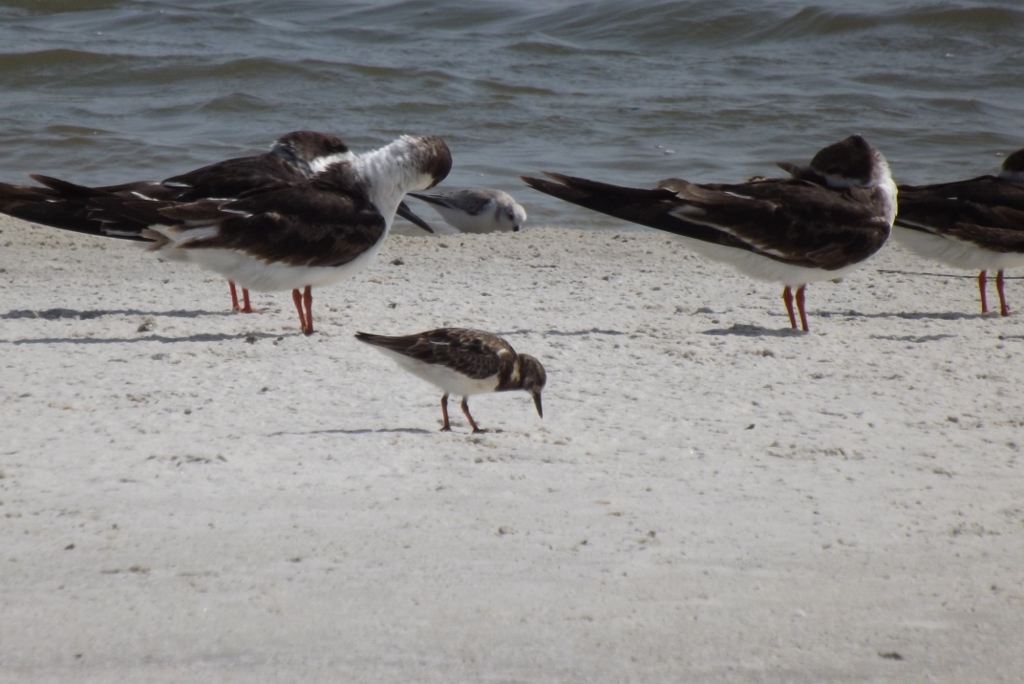
This next photo shows a species that is a bit larger than the Sanderling and the Semipalmated and Snowy Plovers, but much smaller than the Willet.  True to its name, the Ruddy Turnstone actually does turn over rocks and other material to find food underneath, so its foraging behavior can be an important clue to its identity.  It also has bright orange legs and a dark, swirling pattern on the breast.  The white patches on its back, wings, and tail are concealed unless it is in flight.
Ruddy Turnstone with Black Skimmers and Sanderling
Okay, what are the birds in the photo below?  They have small, stocky bodies; short, black legs; drab brown upperparts; and white underparts.  These are Dunlins, which have longer bills than Sanderlings but are otherwise about the same size.  Their longer bills provide a clue to their behavior, as they often feed in deeper water than Sanderlings do. 
Dunlin
In the next photo, a Sanderling forages to the left of two Dunlins.  Notice the difference in color: the warmer brown of the Dunlin versus the pale gray of the Sanderling.
Sanderling and Dunlin
The next pictures show the bill differences a bit more clearly:
Sanderling
Dunlin
Willets are so much larger than any of the shorebirds I’ve previously discussed that they usually don’t provide any identification challenges.  As you can see in the photo below, they’re nearly as large as Laughing Gulls.
Calm Willets, angry Willet, and a Laughing Gull
Here is a Willet by itself.  You can see the long, grayish legs, grayish bill, and overall grayish-brown plumage.  I should mention, though, that Willets are grayer and drabber in the winter and early spring than they are during the summer.  The bird’s face has white feathers in front of the eye and a thin eye-ring, but is otherwise very plain.
Willet
In the next pictures, the two larger birds are Willets, but the smaller bird on the left is a Short-billed Dowitcher.  Notice the warmer tone of the brown plumage, the speckling on the underparts, the pale “eyebrow,” the yellowish-gray legs, and the white rump feathers.  (The very similar Long-billed Dowitchers also occur on the coast in March, but they are less common in saltwater habitats, and their identification is a bit beyond the scope of this piece.)
Short-billed Dowitcher and Willets
Same Short-billed Dowitcher and Willets
In the photo below, dowitchers mingle with Willets and Laughing Gulls.  Size and body structure, plumage characteristics, and posture/behavior can all help you to sort out these birds!
Obviously, identifying tricky-to-ID species is far more difficult when they are alone than when other birds are nearby, and I still struggle with a number of species groups.  However, breaking away from a fixation on minute plumage details and taking a more holistic approach to identification can save you plenty of frustration in the field and teach you more about bird ecology.  Try it out!