Showing posts with label birdwatching. Show all posts

Tuesday, June 30, 2026

Northern Cardinal Life Stages

Previously, I discussed the nesting process of Northern Cardinals.  But what happens to the young cardinals after they leave the nest?

At first, not much: Fledglings continue to be fed by their parents for at least a month as they learn how to function as adults.  They’re not that different from human teenagers, when you think about it.

In my long time as a birder, I have had many opportunities to witness “teenager” cardinals as they hang out with their parents.  One year, some of the cardinal parents brought their young to the backyard feeding station, allowing me to see them up close and to study their plumage patterns and behavior.

Juvenile cardinals have dark bills, unlike their parents, which have red or orange-red bills.  The color change is generally complete by winter.  In the photo below, you can see a little bit of orange beginning to come through on the base and margins of the juvenile cardinal’s beak.  Female and male cardinals look very similar in the juvenile stage, but males can have a hint of red on their flanks.  It can be hard to tell, though, and the photo doesn’t provide a lot of strong clues in either direction. 
Juvenile cardinal
This next photo shows a different bird—an immature male.  This cardinal probably came from an earlier brood than the last bird, and its molt into adult plumage has progressed much farther.  Look at the red blotches on the head, back, and flanks. 
Immature male cardinal
The first of the two photos below shows the young male bird from another angle, where you can see all of the red feathers that are coming in on the breast.  The bill has also turned almost completely red.  A bird that looks like this has probably been fending for himself for a while, but he won't be ready to compete with scrappy, aggressive, adult males, like the one in the second photo, until the next year.
Immature male cardinal -- not quite there yet
Adult male cardinal
Although both adult female and juvenile cardinals have reddish tails and flight feathers, adult female cardinals have red crests, as you can see in the first of the two photos below.  In about a year, female cardinals are ready to compete for territories and start nests.  Yes, they compete in much the same way that males do; research has shown that, on breeding territories, female cardinals chase away other females, and male cardinals chase other males.  Females also sing, if somewhat less frequently than males.  Juvenile cardinals might sing softer, unstructured versions of adult songs, as they are still learning.  They will consistently give whistled begging calls whenever they want food from their parents, though!  If you find some juvenile cardinals in the wild, watch for their wing-fluttering behavior and listen for those piping calls.
Adult female cardinal -- note the orange beak
Juvenile cardinals with gray beaks
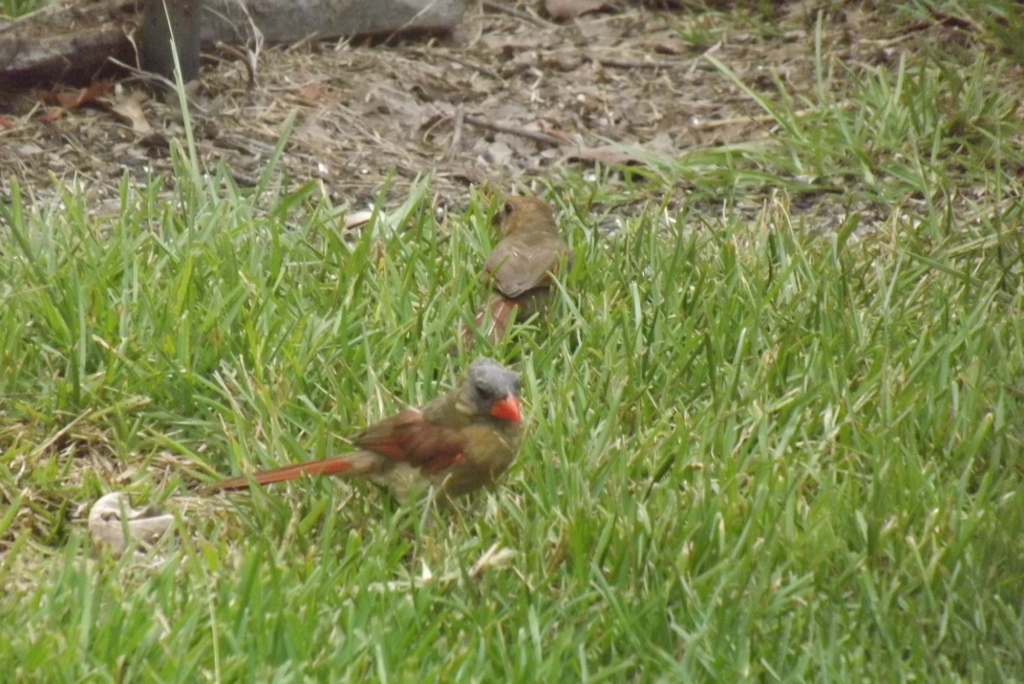
As cardinals—both the adults and the juveniles/immatures—molt from one plumage to the next, sometimes they wind up looking a bit weird.  One of the most common “oddities” is when a cardinal loses most or all of the feathers on its head.  These cardinals can look as though they have a horrible disease, but, in most cases, they are perfectly normal and will have new feathers in due time.  The cardinal in the foreground of the next photo is an adult female with a bald, gray head. 
Once, there was a distinctive female cardinal that I routinely watched over a period of many days.  There was a clump of feathers sticking up on her back.  (This bird is actually the female cardinal in the fifth photograph of the post.)  Try as I might, I never could tell whether this was an injury or simply a scraggly patch from a recent molt.  The cardinal seemed to have no difficulty in foraging, flying, and generally moving around, so I didn’t worry about it, but it was certainly interesting to observe.
Ruffled feathers?
As you can probably tell, the wide variety of plumages that Northern Cardinals display during this season of the year makes it fairly easy—at least, for a brief window of time—to determine their age and to track some of them as individuals.  By next spring, some of this year’s juveniles will hold breeding territories of their own, and the cycle will continue.

Source:

Halkin, S. L. and S. U. Linville (2020). Northern Cardinal (Cardinalis cardinalis), version 1.0. In Birds of the World (A. F. Poole and F. B. Gill, Editors). Cornell Lab of Ornithology, Ithaca, NY, USA. https://doi.org/10.2173/bow.norcar.01


Wednesday, December 31, 2025

The Red-shouldered Hawk


It wouldn’t seem quite like winter without the hawks and falcons hunting along fencerows, darting through the woods, or soaring on the breezes. I have been seeing a number of raptor species over the last few months, including the swift and agile Cooper’s Hawks, the slower but more powerful Red-tailed Hawks, and the wary and fidgety American Kestrels.  Another common species, large and vocal, but sometimes overlooked, is the Red-shouldered Hawk.

Unlike Red-tailed Hawks, Red-shouldered Hawks tend to prefer low-lying, heavily wooded environments. They are commonly found year-round in many hardwood and mixed forests throughout southeastern North America, and, in the fall and winter, this southeastern population is boosted by migrants from the northeastern United States and southeastern Canada. The difference in habitat between Red-shouldered and Red-tailed Hawks means that their dietary preferences are a bit different, as well; like Red-tails, Red-shouldereds eat lots of small mammals, but, because they inhabit denser, swampier woods, they’re also likely to catch frogs, snakes, and lizards. However, even though they’re primarily forest hawks rather than field hawks, they will often hunt from powerlines and prominent snags at the borders of woodlands and fields. Presumably, this makes it easier for them to find and catch their prey, given that they lack the maneuverability of species such as the Cooper’s and Sharp-shinned Hawks.

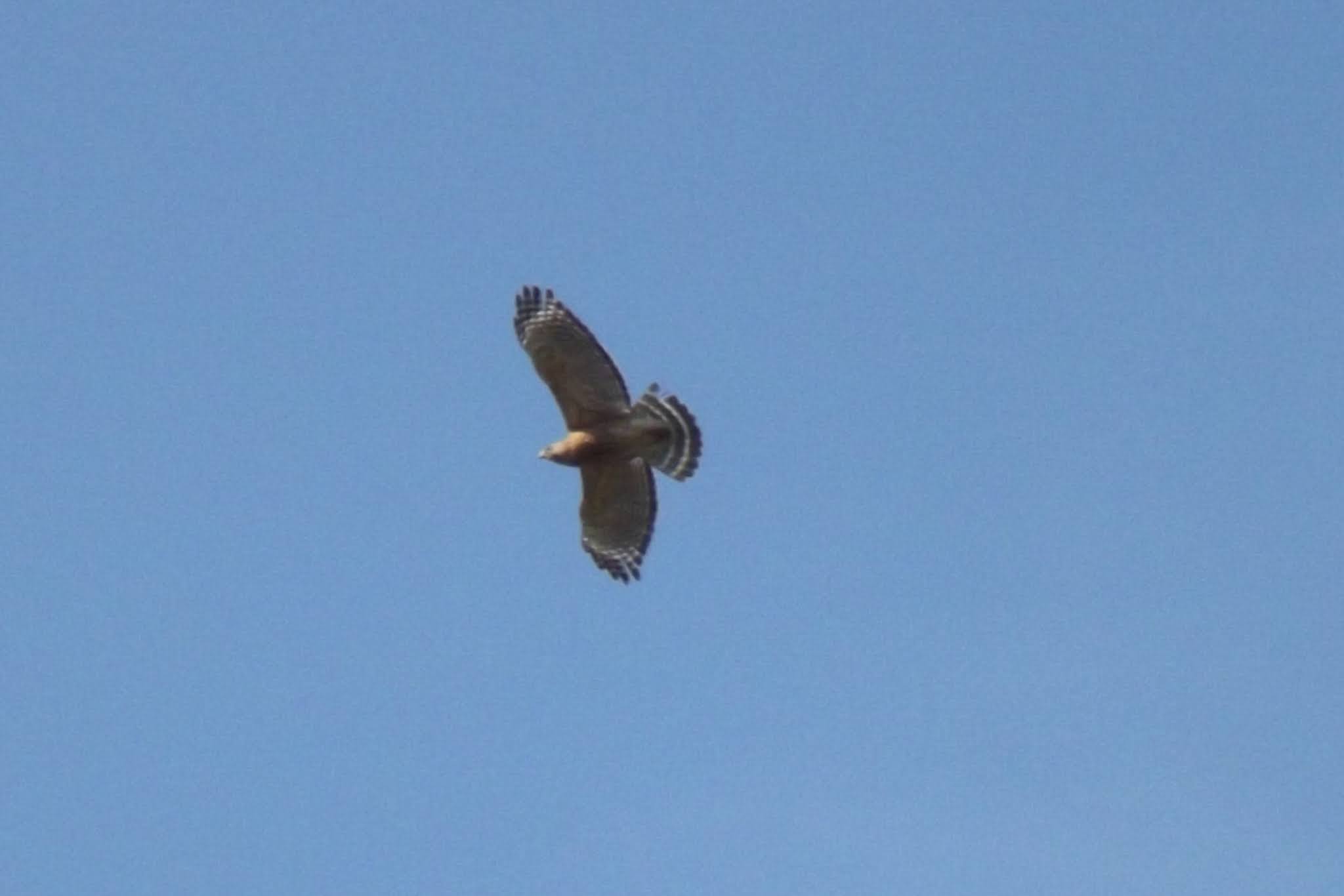
Appearance-wise, Red-shouldered Hawks are a little smaller and slimmer than Red-tailed Hawks, and, of course, they lack the brick-red tails that adult Red-tails have. They DO have reddish-brown “shoulders,” but this usually isn’t the most obvious field mark. The barred, reddish-brown breasts, black-and-white banded tails, and black-and-white wings on the adult hawks are far more noticeable features in the field. As you can see in the first of the two photos below, there are also vertical breast streaks on top of the chestnut-colored horizontal barring. Juvenile Red-shouldered Hawks look fairly similar to the adults, but have drabber, browner feathers and lack reddish barring on their breasts. In flight, both adults and juveniles show “wing windows,” which are essentially just pale crescents near the wingtips. This is a great field mark to look for if a hawk is soaring overhead. 

The rusty breast feathers on this adult hawk are a useful field mark.

Juveniles have browner plumage and streaks on their breasts.

Crescent-shaped wing markings are visible on this soaring adult hawk.

At this time of year, the immature hawks have been independent from their parents for several months, so they’re essentially competing with adult hawks for food and territory. If they survive the winter and later become breeding adults, then they will likely build their nests in large trees in the woods and lay two to five eggs per brood, with only one brood per season. Apparently, little is known about Red-shouldered Hawk nesting habits, so if you happen to spot a breeding pair next year, there is a chance that your observations could be of significant scientific value! In the meantime, enjoy watching Red-shouldered Hawks and other raptors this winter. 

Source:

Dykstra, C. R., J. L. Hays, and S. T. Crocoll (2020). Red-shouldered Hawk (Buteo lineatus), version 1.0. In Birds of the World (A. F. Poole, Editor). Cornell Lab of Ornithology, Ithaca, NY, USA. https://doi.org/10.2173/bow.reshaw.01


Saturday, May 31, 2025

Summer Bird Identification Quiz

Although many North American bird species completed their spring migration months ago, some are just now beginning to set up territories and nest on their breeding grounds.  With that in mind, I present another short identification quiz for the summer months!

1.  This species may be seen migrating late, and some individuals linger in areas outside of the breeding range.

2.  Look for this species in woodlands, especially near water.

3.  The species in this photo is also a bird of woodlands.

4.  In the photo, one of the clues to this bird's identity is hidden.


Answers:

1.  The American White Pelican is widespread across much of North America, and its winter range extends as far south as Central America.  It migrates across wide swaths of North America and breeds in several locations west of the Mississippi River.  Some nonbreeding individuals remain on lakes and other large bodies of water in the eastern portions of the U.S.  Unlike the coastal Brown Pelican, the American White Pelican does not dive for its prey, but instead forages for fish near the surface.  Groups will work together to more efficiently pursue their prey.

2.  Unsurprisingly, a significant clue here is the yellow throat!  Yellow-throated Warblers are far from the only wood warblers with this field mark, however.  For example, there is the widespread Common Yellowthroat, a species of thickets and marshes.  The western Grace's Warbler has even more similar features to the Yellow-throated Warbler: a gray back, white wing bars, black streaks on the sides, and a yellow throat.  The Yellow-throated Warbler's black mask and white eyebrows, though, are distinctive.  

Yellow-throated Warblers will sometimes conceal their nests in the Spanish moss that frequently grows in the wet, wooded habitats that they prefer.

3.  While the widespread and familiar Red-tailed Hawk is commonly found in more open environments, the Red-shouldered Hawk is adapted to woodlands.  The juvenile Red-shouldered Hawk in the photo lacks the rust-colored feathers of its parents, but its moderately slim build (compared to that of the stockier Red-tailed Hawk), banded tail, and streaked breast and belly help clinch the identification.  The Red-shouldered Hawk also lacks the pale "V" marking that can be seen on the back of a perched Red-tail.  

Because they tend to frequent swampy forests, Red-shouldered Hawks feed on a variety of animals, including frogs, snakes, and lizards.

4.  One clue may be hidden, but the white-spotted underside of the tail, the rust-colored wing feathers, and the pale underparts all point to this being a Yellow-billed Cuckoo.  The yellow mandible would be another useful field mark in regions where the Black-billed Cuckoo also occurs.  Cuckoos use their thick bills to catch hairy caterpillars, among other prey items, and tent caterpillar outbreaks may provide excellent conditions for viewing these usually secretive birds.  Unlike the Common Cuckoo, which breeds in Europe and Asia, North American cuckoo species only rarely practice brood parasitism, preferring to build their own nests and raise their own young.  

Tuesday, April 30, 2024

Participate in the North American Migration Count!

For many birders, the hobby of birding is at its best in the springtime.  While you head out into the field, the observer of the changing landscape with all its fresh, different sights, there will be transient birds migrating through, new residents staking out territory, early breeders busy at their nests, and winter visitors moving on north.  This is clearly one of the best times to survey the vast numbers of bird life on this continent and make a useful contribution to science.  This is the idea behind the North American Migration Count—which is held on the second Saturday of May.  Although this date falls later than the peak of spring migration for the Southeast, there should still be plenty of migrating birds moving through.  Migration counts may be conducted by teams of birders or individuals, but each count area must be confined to a single county.  All wild birds within the count area may be included in the tally, and the counting procedure is very simple and straightforward—like that of the Christmas Bird Count.

I was a teenager when I first participated in the North American Migration Count.  The Oktibbeha Audubon Society asked me to survey a route in the southeastern part of the county.  My dad and I headed out on our route at about 9:30 a.m., hitting the Bluff Lake levee first to tally any herons, egrets or songbirds that crossed over into Oktibbeha County.  The morning was warm and muggy but full of birds.  Very quickly we picked up Acadian Flycatcher, Common Yellowthroat, Yellow-throated Warbler, Great Crested Flycatcher, Eastern Kingbird, Prothonotary Warbler, White-eyed Vireo, Indigo Bunting and many other species in the woods, including a Ruby-throated Hummingbird feeding from Trumpet Creeper blossoms.  We heard a Fish Crow and also counted many egrets flying overhead, a couple of Wood Ducks, and one Great Blue Heron, which surprisingly, would turn out to be our only one all day.  Just as we were leaving the area, I glimpsed a group of three large birds flying high overhead—White Ibises.

Prothonotary Warbler

We drove a little down the road, looking and listening for some of the forest species such as Red-eyed and Yellow-throated Vireo, Pileated Woodpecker, Eastern Wood-Pewee and Yellow-billed Cuckoo.  By now our list was around 40 species.  There were good numbers of singing Yellow Warblers, and I could make out two Northern Parulas trilling close by.  As we got out to walk a trail that cut through the woods, there was a harsh chittering overhead, which alerted us to about two dozen Chimney Swifts circling.  These were probably natural-nesting swifts, choosing a hollow tree over a manmade chimney.

The woods were mostly deciduous, with tall pines mixed in here and there.  There were also many deep puddles of muddy water from a recent rainfall.  Pine Warblers, chickadees, titmice, towhees, and vireos noisily proclaimed their territories in the dense woods, seeming almost indignant at us traipsing through their home.  I accidentally flushed a Cooper’s Hawk from its roost.  It flew away, disturbing the singing birds for a few minutes.  I heard White-breasted Nuthatches in the distance and saw a pair of Summer Tanagers in the trees.  Bird songs were not all that we heard:  Gray Treefrogs were also making their presence known in the forest with low-pitched croaks.

Cooper's Hawk

I had just commented to my dad on the odd absence of Kentucky Warblers, when one in a thicket burst emphatically into song.  A Hooded Warbler added its short, eight-syllable whistle to the other sounds of the forest, while wrens and skinks scuttled through the thickets and leaf litter, the wrens putting in a word now and then, unlike the lizards!  There was a creek by this trail where we were likely to find Louisiana Waterthrushes, and in the trees near it, American Redstarts.  Unfortunately, neither species showed up for us, and eventually we moved on, making a mental note to come back to the trail later. 

We went up Oktoc Road for more counting.  The habitat here was mostly thickets, fields and pastures, with scattered trees, which meant a whole new group of species for us.  Bluebirds and kingbirds perched on the wires; grackles and blackbirds foraged in the pastures.  We were able to add Red-headed Woodpeckers and many more Cattle Egrets to the tally.  Eastern Meadowlarks, Orchard Orioles, Barn Swallows and Purple Martins also put in appearances.  Overhead, there were vultures, Red-tailed Hawks and a Green Heron that flew from a small pond.  A little farther down the road, I heard a loud ringing song coming from a thicket—a Swainson’s Warbler.  I listened to the recording on my audio field guide back in the car; no doubt about it:  the song was a Swainson’s Warbler’s.  Since this is a fairly scarce bird, I wrote down the location, including the mailbox number, and we headed on.

We came to a place down the road where mixed forest grew on one side and young trees and shrubs were just coming up on the other.  Almost immediately our ears picked up Northern Bobwhite, Yellow-breasted Chat and one Prairie Warbler.  A few more Kentucky Warblers and Indigo Buntings sang loudly, and I spotted another Summer Tanager pair.  Then I noticed something lower down in an oak tree.  I investigated with binoculars and found myself looking at a beautiful male Scarlet Tanager, just sitting on a limb in a little shaft of sunlight, his jet-black wings and tail contrasting with the bright-red of his body.  What a treat!

Scarlet Tanager

We still had to head through Starkville, so after tallying, we drove on.  While in town, we saw plenty of House Sparrows and European Starlings and two Eurasian Collared Doves.  Our next stop was a sewage lagoon where we supposed to locate a few ducks and shorebirds.  As we began walking around the pond, we flushed bunches of Red-winged Blackbirds and saw Northern Rough-winged Swallows overhead, but the edge of the pond, choked with weeds, just didn’t look promising for sandpipers.  Farther up, however, we noticed the drastic difference in the habitat.  There were obvious mud flats with shorebirds feeding.  Three Solitary and one Spotted Sandpiper dotted the bank with several Killdeer, too.  We saw two Blue-winged Teal, a pair of Canada Geese with four large fuzzy young, and thirteen Wood Ducks—two adults and eleven ducklings. 

The count list was pretty big so far, but I did notice that we were missing a few birds.  We managed to find some Blue Grosbeaks by retracing our route and only counting species that were new to us, not ones we’d counted already.  We managed to hear a flock of Cedar Waxwings this way, and then went to search again for the redstarts and waterthrushes.

The woods were a lot quieter now; it was about 4:00 p.m. and I doubted that we’d see the elusive species we were looking for.  Although we didn’t pick up any new birds while we were there, we did see other wildlife.  Butterflies fed on the flowers, Ichneumon wasps flew up from the grass, and a Southern Leopard Frog was in one of the puddles.  My dad was pleased to observe a Toad Bug that I located near another pool of water.  We watched it as it hopped about, its coloration blending in amazingly well with the gritty mud of its habitat.

Back in the car, we counted up the species we had found during the day:  seventy-six, and hundreds of individuals all over.  It had been a great count.  We were both exhausted but filled with a sense of accomplishment and exciting memories of that spring day. 

Even if your schedule doesn't permit you to count every bird that you see for an entire day, it’s still worthwhile to spend some time marveling at the diversity of species during this fascinating season!