Showing posts with label caterpillars. Show all posts

Saturday, November 30, 2024

Invasive Trees, Shrubs, and Vines

This is a consolidation of two of my earlier posts about invasive plants in the southeastern United States.  Invasives are simply nonnative species that cause significant harm to ecosystems.  Not all nonnative plants are invasive, but the invasives are very likely to be the ones that you notice on a daily basis!  Because the list of exotic plant species present in Mississippi alone (from this site: https://www.se-eppc.org/mississippi/) is lengthy and still increasing, I thought it made sense to focus on the invasive trees, shrubs, and vines that I commonly see in my part of the state.

Let’s start with trees.  A couple of quick definitions: although there are some exceptions, the general rule is that trees have a single woody stem or trunk, while shrubs have multiple woody stems/trunks.  Most of the trees that I regularly observe are native to my area, but, every so often, I will come across an invasive species or two—especially near urban settings.  Some commonly-seen cultivated plants, such as the ginkgo (an ancient, living fossil species that was wiped out across much of its range during the Pleistocene Ice Age) are basically innocuous, but others, such as the Bradford pear, can cause extensive damage to native ecosystems.  The Bradford pear is actually a cultivar of the species Pyrus calleryana, the Callery pear, which the United States Department of Agriculture introduced from Asia to the United States in 1916 to combat blight in the common pear, Pyrus communis.  (Obviously, common pears, along with other species that are used for food, largely benefit humans, so no one is suggesting that they should not be grown.)  Bradford pears are incapable of reproducing with other Bradford pears, but (as any fan of Jurassic Park would likely guess) this doesn’t stop them from proliferating; they just do it by cross pollinating with other calleryana cultivars, spreading this invasive species far and wide.  

One of several Callery/Bradford pears in the neighborhood.  Actually, this looks like it might be a "colony" instead of just one tree.

Chinese tallowtree, or popcorntree, is another common invasive.  Introduced to the U.S. in the 1700s, it is known for the waxy compounds found in its seeds, which have been used for candle- and soap-making Because the plants are toxic, few animals will eat them, so there is next to no biological control of their populations.  The USDA states that eradication is “virtually impossible,“ that the trees may begin reproducing at the age of only three years, and that they can continue breeding for 100 years– all of which make this species a particularly bad choice for North American naturescaping.  Don't grow it here!

The tallowtree tends to have a nice shape, which explains why it's so frequently planted.

Tallowtrees have heart-shaped leaves.  The seeds, which aren't in this summer photo, resemble popcorn.

In one sense, shrubs may be the stumpy cousins of trees, but their lushness more than compensates for that.  Along with tree saplings, shrubs comprise the understory layers in forest ecosystems.  However, invasive species, such as privet, don't always need to grow within wooded areas; they frequently thrive wherever their seeds have been dropped.  While several introduced privet species range across North America, the most common in the mid-southeastern region is Chinese privet.  There seems to be some conflicting information regarding when, exactly, Chinese privet was introduced to the United States—some sources say 1852, while others, including the previous link, say 1952.  The latter date might have been a typo, since the 1852 date shows up in sources such as the websites for the USDA, the University of Florida’s Center for Aquatic and Invasive Plants, and the Texas Invasive Species Institute.   

Chinese privet in the summer.

Privet leaves and unripe fruits.

At any rate, Chinese privet has become well established outside of its native range—so much that United States and regional noxious plant legislation isn’t even concerned with it and other privet species.  Eradicating privet from the U.S. is basically a lost cause.  Its fruits are eagerly consumed and widely spread by birds and other animals; it possesses tough, hardy, evergreen foliage; it forms extremely dense thickets; and, if cut, it regenerates quickly from its extensive underground root systems.  Several privet hedges in the neighborhood where I live have been cut before, but that didn't stop them from coming back with a vengeance.
  
A mockingbird and privet, photographed in Arkansas in 2013.  Birds are attracted to privet berries.

I have written about two bird nests—White-eyed Vireo and Northern Cardinal—that I observed in a thorny olive (or thorny elaeagnus) near the house.  The upper branches of thorny olives grow long and snake-like for the purpose of clinging to whatever is directly above them.  While this species—introduced in 1830 from Asia—lags behind privet in terms of invasiveness, it’s still a problem in many areas, forming spiky, impenetrable barriers.  There are a number of methods used to control thorny olives, but most of them are not particularly effective.  Essentially, even though the thorny olive does provide a certain amount of seclusion and protection for birds during the nesting season, there are much better options that don’t choke out all other vegetation in the ecosystem!

Long "tendrils" on the thorny olive.

The undersides of the thorny olive's leaves have silvery scales and sparse, tiny brown spots.

Another invasive shrub that can dramatically transform its environment is the multiflora rose (Rosa multiflora), a sometimes vinelike plant that was introduced from Asia to the U.S. in the 1860s.  Like kudzu, it was widely used for erosion control, and it also shares the ability to form impenetrable thickets.  Its thorny stems can attain heights of 10 to 15 feet, and it has attractive flowers that have five white petals with blunt or slightly indented tips.  Herbicides are effective at controlling multiflora rose, but follow-up treatments must be consistently applied to prevent germination of seeds, which can lie dormant, ready to sprout at any time, for up to 20 years in the soil.  

Multiflora rose flowers

We've looked at trees and shrubs, but what about vines?  One of the most out-of-control vines in the southeastern U.S. is so abundant that it has even had festivals created around it.  Kudzu (Pueraria montana) is a leafy, purple-flowered vine in the legume family.  Although it was originally imported to the U.S. (from Japan in 1876) as an ornamental, and was used for erosion control in the early 20th century, it has since become a noxious weed, infamous for covering entire landscapes and choking out native vegetation.  In ideal circumstances, it can grow up to a foot a day.  Controlling kudzu is difficult partly because of the stolons (or runners) that it produces, as well as rhizomes, or underground stems that produce roots and shoots; uprooting the plant so that it's incapable of forming new growth is next to impossible.  Herbicides can work if there is enough product to treat the many acres of ground that kudzu frequently smothers.

Kudzu creates odd, alien-looking landscapes.

Interestingly, one of the natural predators, the kudzu bug, was accidentally introduced into the U.S., with the first individuals recorded in Georgia in 2009.  However, because the kudzu bug tends to cause more damage to soybean crops than it does to kudzu, it can't be relied on as a biological control method.

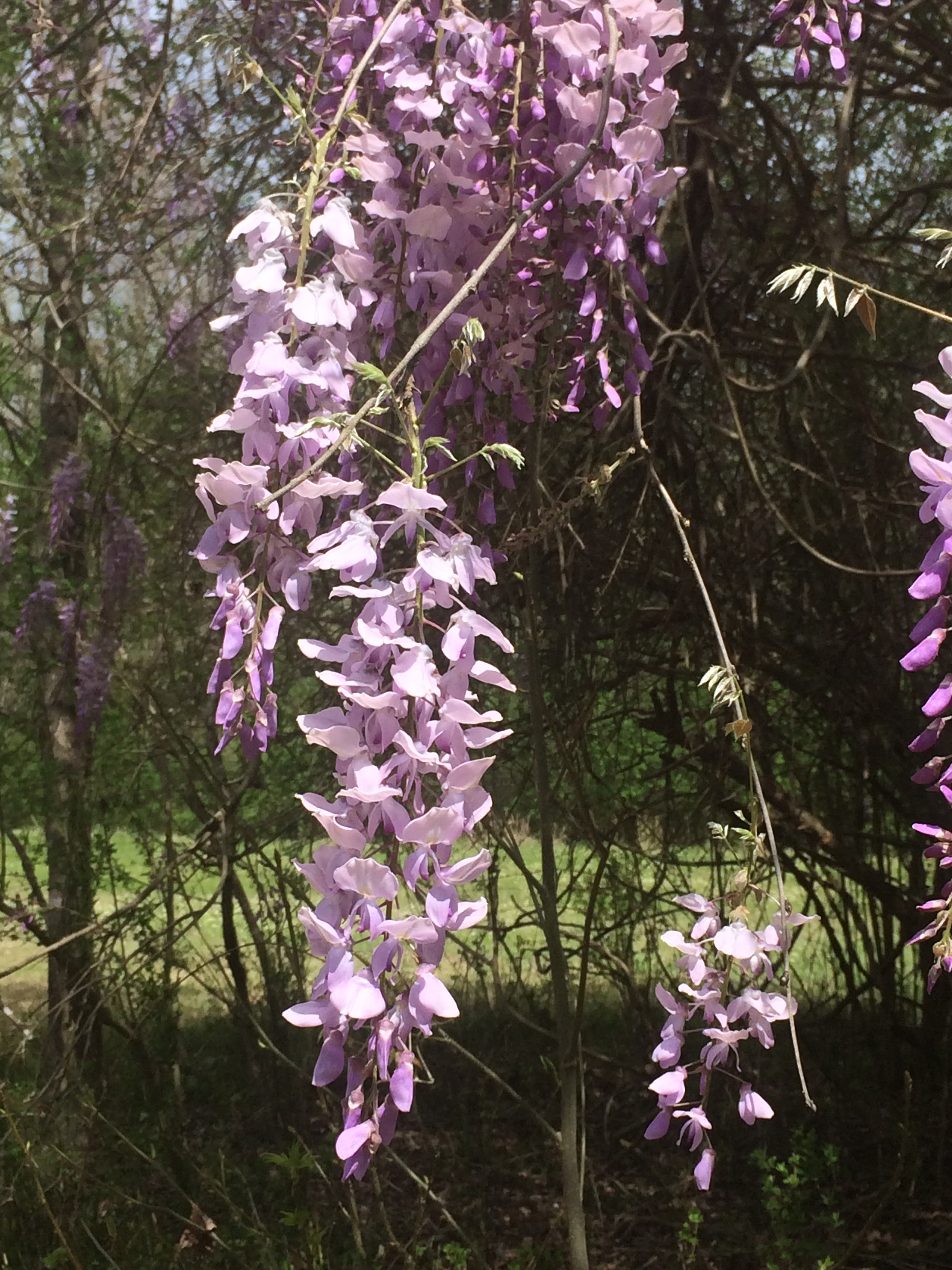
Joining kudzu on the list of invasive vine species are two of the most widespread introduced legumes: Chinese and Japanese wisteria (Wisteria sinensis and W. floribunda, respectively).  Because these species can and do hybridize in the wild (rather like the red and black imported fire ant species), identification is often difficult.  Both species have long, compound leaves and clusters of purple or white flowers.  Given the toxicity of wisteria's fruits, native wildlife species are almost certainly not helping these plants to spread.  Instead, wisteria's quick growth and tendency to strangle and shade out native vegetation provide the explanation for its range expansion after its introduction to the U.S. in the early 19th century (1816 for Chinese wisteria, and about 1830 for the Japanese wisteria).  According to the Mississippi State University Extension Service, wisteria control is extremely difficult.

Wisteria flowers

Wisteria growing over another invasive: privet.

Another fairly horrifying invasive climbing plant is Japanese honeysuckle (Lonicera japonica).  Like all of the plants discussed thus far, Japanese honeysuckle was imported (in 1806) as an ornamental.  It has attractive and fragrant blossoms, and many people have fond childhood memories of sucking the nectar from these blooms.  Like wisteria, however, Japanese honeysuckle's thick, woody stems quickly strangle native vegetationand, as with kudzu, biological control doesn't work.  In fact, there is no available biological control for Japanese honeysuckle.

Japanese honeysuckle flowers

Because of the limited ecological benefits and the difficulty of controlling Japanese honeysuckle, the Mississippi Forestry Commission recommends planting several native vines, insteadincluding crossvine, coral honeysuckle, and Virginia creeper.  That site and others, such as the Mississippi State University Extension Service, are well worth perusing for detailed information about native trees, shrubs, vines, and herbaceous plants.

In general, all of the introduced trees, shrubs, and vines described in this post flourish in their new environments due, in part, to a lack of herbivory by insects.  Native insect species didn't evolve with these plants, so they generally lack the ability to effectively utilize them.  Many studies have shown that insect communities tend to decline in the presence of nonnative plants.  A paper written by Berghardt et al. (2010) and published in the scientific journal Ecosphere (https://esajournals.onlinelibrary.wiley.com/doi/pdf/10.1890/ES10-00032.1) describes how Lepidopteran (that is, butterfly and moth) communities showed both lower population sizes and less species diversity on nonnative plants than on native ones.  Given the fact that many songbird species rely on caterpillars as a food source for their nestlings, the results of this study should definitely ring some alarm bells.  Fewer caterpillars mean less leaf damage, but also impoverished ecosystems.

Wednesday, September 29, 2021

"Fall" in Love with the Refuge

On a warm day in late October, well over a decade ago, my mom and I drove to the Noxubee Refuge to spend some time birding and just winding down from a busy week.  It was a beautiful day, although humid.  Of course, the humidity might have had an effect on us, but it seemed to have very little effect on the wildlife at the Noxubee National Wildlife Refuge--birds, mammals, butterflies.  

Butterflies were everywhere at Morgan Hill, our first stop.  The bright sunlight was drawing them out along the trail leading through the Black Belt prairie.  Most of the butterflies of the fall season are rusty-tinted, and these were no exception.  Gulf Fritillaries, bright orange with nearly three-inch wingspans, were very abundant.  Orange Sulphurs, less intense in color, were also common.  Angle-winged Question Marks and Commas showed up, also, along with a few Painted Ladys, Monarchs and one Red Admiral, dark brown with red-orange bars on its wings.  Cloudless Sulphurs brought touches of yellow to the scene.  They were not confined to the prairie, though; they had flitted in front of our vehicle as we had made our way down the road earlier.

Grasshoppers scattered as we walked, some of them unfurling delicate wings as colorful as some of the butterflies.  On the gravel-covered path, Buckeyes, little butterflies sporting peacock-like eyespots and red and white “paint” on their brown wings, were surprisingly numerous, and I saw one Variegated Fritillary.  Smaller than the Gulf Fritillary, this species has paler but more intricately patterned wings.  By looking closely at a small passionflower (also known as maypop) plant growing on the trail, I spotted two tiny Gulf Fritillary caterpillars.


Of course, there were birds to be seen in addition to the insects.  The sparrows had arrived in flocks, and Savannah, Swamp, Song, and White-throated Sparrows and Dark-eyed Juncos flew out of the grasses at every step we took.  Eastern Bluebirds eyed us from their perches atop the few small trees dotting the hill.  Zhip!  With a sharp call and a flick of its tail, an Eastern Phoebe joined them. 

When my mom and I arrived back at the parking area, a big Woolly Bear caterpillar lurched its way across the gravel and over to some leaf litter in the nearby thicket where it would be safe.  As we left the prairie, a female American Kestrel gave us a great show as it hovered over the field and then landed in a huge oak tree.  A group of eleven Wild Turkeys was foraging in the same area.

Next we headed to Goose Overlook for more watching.  The water was nice and clear at Bluff Lake, where the observation point is located.  It was a little early for ducks, but there were plenty of Canada Geese wading in the shallows.  Chickadees, titmice, woodpeckers and wrens chattered in the surrounding woods.  A flock of Yellow-rumped Warblers landed in a cypress tree, flicking their wings and scrambling over the branches for insects.  We were amused by these antics but soon decided to walk down Woodpecker Trail, a path cutting through areas of both pine and mixed woods.  There were lots of small birds and several small dusty-brown Carolina Satyr butterflies.  Our shoes and socks soon became spotted with clinging Beggar’s Lice from the many plants growing on the edges of the trail. 

After spending time at Goose Overlook, we headed back to Morgan Hill Prairie.  It didn’t take long for me to spot some species I hadn’t seen on the prairie earlier.  A small butterfly alighted on a twig, and from the orange, brown and white wings and long, beak-like extension of the head, it was evident that this was a Snout Butterfly.  Several birds suddenly flew up in front of us and landed in the small trees and shrubs—bluebirds, Savannah Sparrow, juncos—but there was something else:  a Palm Warbler.  This brown-streaked little bird with the yellow undertail was only a few feet away from us.  A small bright-green caterpillar was clasped in its bill, and at first it seemed that the bird would soon eat it.  But the caterpillar was still very much alive; and as we watched, it reached down and grabbed the branch that the warbler was perched on.  The bird jerked its head up, pulling the caterpillar off the branch, but the insect was not ready to give up.  Suspended from the warbler’s bill, it suddenly curled into a tight ball, and the bird dropped it.  Oops!  The bird was probably pretty upset about losing this meal, and it dived down into the shrub to search for it.  We didn’t hang around long enough to see what finally happened, but I can imagine the caterpillar crawling off with a great battle story to retell all of its short life.

It was time to head out of the refuge, so we left, reflecting that the relaxing yet entertaining day there had definitely been worth the bother of going.

Friday, August 31, 2018

Lepidopterans


As much as I initially resisted the idea, the most appropriate topic for me to choose for this post is insect life.  I know—I wrote about bugs around the same time last year.  But the cyclical patterns in nature have ensured that, once again, late summer has been filled with insects—a boon for the birds, who are presumably filling themselves up in preparation for migration.  Maybe the bird migration will provide material for a few more posts this year.  We’ll see.

I don’t mean to depreciate insects, though.  To be fair, if you’re at all interested in observing birds, chances are that, sooner or later, you will find yourself paying attention to insects.  For example, the presence of tent caterpillars in an area generally prompts me to keep a look out for Yellow-billed Cuckoos, since they are one of the major predators of these rather pestilential and unsightly critters.  (Most other animals can’t deal with all of the hairs on the caterpillars.)
A tent caterpillar shelter
In a more general way, insect ecology is pretty strongly tied to patterns of behavior in birds, to the point that some bird species are declining as a result of many insect species emerging earlier in the season than they used to do.  As it turns out, warmer springtime temperatures caused by human-driven climate change can alter the timing of the life cycles of insects, and quite a number of avian species have a hard time adapting quickly to those changes.  This can be particularly damaging to nesting birds, since many of them rely on new insect broods as a food source for their young.  Fat, juicy, protein-rich caterpillars tend to be especially tempting to nesting birds, and, fortunately, it seems that there are good numbers of them in the neighborhood where I live, along with the adult forms: moths and butterflies, Order Lepidoptera.

Although nonnative plants—which tend to attract very few native insects—dot this landscape, there are still enough native species to appeal to a wide variety of bugs.  Large silkmoths, such as this promethea silkmoth that I found in late July, generally utilize hardwood trees—or, at least, their larval forms do.  Adult silkmoths have only vestigial mouthparts and are unable to feed.  The caterpillars hatch, eat leaves (which, for the promethea silkmoth, may include those of sassafras, tulip-tree, spicebush, or ash) for several months, pupate, emerge as moths sometime in the following summer, breed, and die.  I sometimes find it interesting that I ever manage to see the adult giant silkmoths at all, given how brief their existences are.  Promethea silkmoths are odd in that the males are diurnal, their activity overlapping with that of the nocturnal females only during the early evening.  The moth in my photo was a female, as the pinkish tinge of its wings indicates.  Male promethea silkmoths have very dark wings, apparently in mimicry of the toxic pipevine swallowtail butterfly.
Female promethea silkmoth
As an aside, I actually seldom see pipevine swallowtails in the neighborhood (probably because of a lack of pipevine), but I do frequently find another lepidopteran that mimics them: the red-spotted purple!  Red-spotted purple butterflies are far more closely related to another famous mimic, the viceroy (which resembles the monarch butterfly), than they are to swallowtails.  Apparently, red-spotted purple caterpillars feed mainly on black cherry, willow, and birch, all of which are pretty common in this region.
Red-spotted purple butterfly
Here’s another silkmoth—a male io moth.  The nocturnal io moth, like the promethea moth, is strongly sexually dimorphic.  Female io moths are larger and browner than the canary-colored males.  Although you can’t tell in this photo, the underwings of io moths have enormous owl-eye markings.  This species uses a wide variety of host plants, including cherries, maples, willows, poplars, and elms. 
Male io moth
What about moths other than silkmoths?  Well, one of the most conspicuous species around here is the catalpa sphinx.  The larvae, catalpa worms, feed voraciously on their host plants—no prizes for guessing what THOSE are.  

Catalpa sphinx larvae, or catalpa worms
You might have noticed that catalpa worms look somewhat similar to tomato and tobacco hornworms, with their fleshy, green bodies and spiny “horns.”  They’re all in the same family: tomato and tobacco hornworms turn into five-spotted hawk moths and Carolina sphinx moths, respectively.  The adult catalpa sphinx displays subtler patterning than some other sphinx and hawk moths, but it’s still an attractive animal.

Catalpa sphinx caterpillars strip the trees nearly bare in an astonishingly short amount of time.  This photo was taken on July 27:

Less than a week later, the catalpa tree looked like this:
August 2, 2018
The sphinx larvae clung to the veins of the leaves; they had eaten practically everything else.

The “worms” are gone now, having pupated underground.  It’s possible that they may emerge as adults to lay eggs before the summer is over, but it’s been long enough now that I suspect they will stay dormant until next year, as later broods typically do.  Update: Actually, as it turned out, there was one more brood after the one in August. 
By August 15, the tree was well on the way to recovery -- new leaves were present.
Unlike most species of sphinx moths, bagworm moth larvae remain above the ground to pupate.  You may never have noticed adult bagworm moths, but you’ve probably seen their shaggy cocoons (i.e., their “bags”) hanging from the branches of trees.  Below is a photo of an evergreen bagworm pupa on an eastern red cedar tree.  In my opinion, the life cycle of the bagworm moth is more than a little bit disturbing.  Females pupate but never develop wings, instead remaining in their cocoons as caterpillar-like adults.  They emit pheromones to attract the relatively normal-looking, winged males for mating, and then, after breeding, they die in their cocoons.  The larvae hatch inside the females’ dead bodies and work their way out during the spring and summer. 
Bagworm
Tent caterpillars, so named because they create massive shelters out of their own silk, represent yet another interesting group of lepidopterans: the snout or lappet moths.  As I mentioned earlier, tent caterpillars are frequently viewed as pests.  After all, the larvae form enormous colonies and eat several times a day.  Tree defoliation inevitably occurs, but, to be fair, the caterpillars seldom cause permanent damage.  Given that eastern tent caterpillar moths produce only one brood a year, and that the adults—the moth phase—live for only a short time, I think that we should strive to keep things in perspective.  At any rate, if having tent caterpillars around means that I will see plenty of Yellow-billed Cuckoos, then I can live with that.  As you can see in the pictures below, tent caterpillar colonies have sprung up all over the place this year.
Of course, this is by no means meant to be a comprehensive essay on southeastern lepidopterans!  Far too many species exist for me to even begin to do justice to them, and I mainly just learn about and research them as I encounter them.  If you haven’t given them much attention before, though, maybe you’ll feel inspired to seek some out this year or next.

Tuesday, July 31, 2018

Vegetative Invaders, Part I


In my last post, I mentioned that I had more to say about invasive plants.  Well, I had originally intended to write a more comprehensive piece on the vegetative invaders in the southeastern United States, but after looking at the long, long list of exotic plant species present in Mississippi alone (from this site: https://www.gri.msstate.edu/ipams/MSExotics.php), I decided to focus my attention on the invasive trees, shrubs, and vines that I commonly see in my part of the state.  This first post covers the trees and shrubs, and a later post will tackle the invasive vines.  Be sure to check out some of the links!

Let’s start with trees.  A couple of quick definitions: although there are some exceptions, the general rule is that trees have a single woody stem or trunk, while shrubs have multiple woody stems/trunks.  Most of the trees that I regularly observe are native to my area, but, every so often, I will come across an invasive species or two—especially near urban settings.  Some commonly-seen cultivated plants, such as the ginkgo (an ancient, “living fossil” species that was wiped out across much of its range during the Pleistocene Ice Age) are basically innocuous, but others, such as the Bradford pear, can cause extensive damage to native ecosystems.  The Bradford pear is actually a cultivar of the species Pyrus calleryana, the Callery pear, which the United States Department of Agriculture introduced from Asia to the United States in 1916 (https://www.invasive.org/alien/pubs/midatlantic/pyca.htm) to combat blight in the common pear, Pyrus communis.  (Obviously, common pears, along with other species that are used for food, largely benefit humans, so no one is suggesting that they should not be grown.)  Bradford pears are incapable of reproducing with other Bradford pears, but (as any fan of Jurassic Park would likely guess) this doesn’t stop them from proliferating; they just do it by cross pollinating with other calleryana cultivars, spreading this invasive species far and wide.  
One of several Callery/Bradford pears in the neighborhood.  Actually, this looks like it might be a "colony" instead of just one tree.
Chinese tallowtree, or popcorntree, is another common invasive.  Introduced to the U.S. in 1850 (http://www.gri.msstate.edu/ipams/species.php?SName=Triadica%20sebifera), it is known for the waxy compounds found in its seeds, which have been used for candle- and soap-making (https://plants.usda.gov/plantguide/pdf/pg_trse6.pdf).  Because the plants are toxic, few animals will eat them, so there is next to no biological control of their populations.  The USDA states that eradication is “virtually impossible,“ that the trees may begin reproducing at the age of only three years, and that they can continue breeding for 100 years (https://plants.usda.gov/plantguide/pdf/pg_trse6.pdf)– all of which make this species a particularly bad choice for North American naturescaping.  Don't grow it here!

The tallowtree tends to have a nice shape, which explains why it's so frequently planted.
Tallowtrees have heart-shaped leaves.  The seeds, which aren't in this summer photo, resemble popcorn.
In one sense, shrubs may be the stumpier cousins of trees, but their lushness more than compensates for that.  Along with tree saplings, shrubs comprise the understory layers in forest ecosystems.  However, invasive species, such as privet, don't always need to grow within wooded areas; they frequently thrive wherever their seeds have been dropped.  While several introduced privet species range across North America, the most common in the mid-southeastern region (see http://www.gri.msstate.edu/ipams/species.php?SName=Ligustrum%20sinense) is Chinese privet.  There seems to be some conflicting information regarding when, exactly, Chinese privet was introduced to the United States—some sources say 1852, while others, including the previous link, say 1952.  The latter date might have been a typo, since the 1852 date shows up in sources such as the websites for the USDA (https://plants.usda.gov/plantguide/pdf/pg_lisi.pdf), the University of Florida’s Center for Aquatic and Invasive Plants (https://plants.ifas.ufl.edu/plant-directory/ligustrum-sinense/), and the Texas Invasive Species Institute (http://www.tsusinvasives.org/home/database/ligustrum-sinense).   

Chinese privet in the summer.
Privet leaves and unripe fruits.
At any rate, Chinese privet has become well established outside of its native range—so much that United States and regional noxious plant legislation isn’t even concerned with it and other privet species (http://www.gri.msstate.edu/ipams/species.php?SName=Ligustrum%20sinense).  Eradicating privet from the U.S. is basically a lost cause.  Its fruits are eagerly consumed and widely spread by birds and other animals; it possesses tough, hardy, evergreen foliage; it forms extremely dense thickets; and, if cut, it regenerates quickly from its extensive underground root systems.  Several privet hedges in the neighborhood where I live have been cut before, but that didn't stop them from coming back with a vengeance.  
A mockingbird and privet, photographed in Arkansas in 2013.  Birds are attracted to privet berries.
I have written about two bird nests—White-eyed Vireo and Northern Cardinal—that I observed in a thorny olive (or thorny elaeagnus) near the house.  As I mentioned in the Northern Cardinal post, the upper branches of thorny olives grow long and snake-like for the purpose of clinging to whatever is directly above them.  While this species—introduced in 1830 from Asia (https://www.fs.fed.us/database/feis/plants/shrub/elapun/all.html)—lags behind privet in terms of invasiveness, it’s still a problem in many areas, forming spiky, impenetrable barriers.  The website for the Geosystems Research Institute at Mississippi State University lists a number of methods used to control thorny olives (https://www.gri.msstate.edu/ipams/FactSheets/Thorny_olive.pdf), but describes these as “difficult,” “labor intensive,” “slow,” etc.  Essentially, even though the thorny olive does provide a certain amount of seclusion and protection for birds during the nesting season, there are much better options that don’t choke out all other vegetation in the ecosystem!

Long "tendrils" on the thorny olive.
The undersides of the thorny olive's leaves have silvery scales and sparse, tiny brown spots.
In general, all of these introduced shrubs and trees flourish in their new environments due, in part, to a lack of herbivory by insects.  Native insect species didn't evolve with these plants, so they generally lack the ability to effectively utilize them.  Many studies have shown that insect communities tend to decline in the presence of nonnative plants.  A paper written by Berghardt et al. (2010) and published in the scientific journal Ecosphere (https://esajournals.onlinelibrary.wiley.com/doi/pdf/10.1890/ES10-00032.1) describes how Lepidopteran (that is, butterfly and moth) communities showed both lower population sizes and less species diversity on nonnative plants than on native ones.  Given the fact that many songbird species rely on caterpillars as a food source for their nestlings, the results of this study should definitely ring some alarm bells.  Fewer caterpillars mean less leaf damage, but also impoverished ecosystems.