Showing posts with label Semipalmated Plover. Show all posts

Saturday, January 31, 2026

Sunset

I love walking on the beach near sunset, especially when the weather isn’t too warm.  The sand feels delightfully soft and cool, the clouds stretch across the sky in gorgeous pastel shades, and waves provide a relaxing soundtrack as they steadily lap the shoreline.

The seashore birds’ calls—some raucous, some guttural, and some piping—punctuate the sounds of the water and wind.  Black-bellied Plovers may look fairly drab in their winter plumage, but their plaintive, whistling notes are anything but dull.  These close relatives of the familiar, pasture-loving Killdeer remain on the Gulf Coast through the winter, but migrate north in the spring.  It amuses me that this bird doesn’t have a black belly at all during this time of year.

Black-bellied Plover at the shoreline

Like most egrets and herons, the Snowy Egret has a very unmelodious—even grating—call.  But few people would deny its elegance as it gracefully strides through the tide pools, hunting for small fish and invertebrates.  Although the water is a bit too cold for me, the Snowy Egret appears to pay it no mind.  Black legs ending in bright yellow feet are one of its identifying features.

Snowy Egret striding

While the egret moves off, the small, browinish Dunlin comes forward to prod the mud near the edge of the pool with its pointed beak.  The Dunlin is a common winter visitor and migrant on the Gulf Coast, and, on most beaches, only the grayish but equally small Sanderling outnumbers it.  These species may mingle with each other, but the Dunlin tends to feed in somewhat deeper water, as the slightly greater length of its bill would suggest.

Snowy Egret and Dunlin foraging

As I look up and slightly to the right, I see several more species of shorebirds, including Marbled Godwit, Willet, and Semipalmated Plover.  The larger individuals, such as the godwits and the willets, forage in the deeper water, while the smaller plovers and dunlins stay in the shallower sections.  The names godwit and willet may seem strange, but they were intended as transcriptions of the birds’ calls.  I hear neither of these species calling at the time, but the persistent chirps and whistles of the others more than make up for that.

Shorebirds foraging in the tide pools

The sun starts to drop below the horizon, signaling that it’s time for me to leave.  I will miss the sights, sounds, and sensations of the beach, and I hope that I can re-experience them soon.


Tuesday, November 30, 2021

Beach Sunset

I love walking on the beach near sunset, especially when the weather isn’t too warm.  The sand feels delightfully soft and cool, the clouds stretch across the sky in gorgeous pastel shades, and waves provide a relaxing soundtrack as they steadily lap the shoreline.

The seashore birds’ calls—some raucous, some guttural, and some piping—punctuate the sounds of the water and wind.  Black-bellied Plovers may look fairly drab in their winter plumage, but their plaintive, whistling notes are anything but dull.  These close relatives of the familiar, pasture-loving Killdeer remain on the Gulf Coast through the winter, but migrate north in the spring.  It amuses me that this bird doesn’t have a black belly at all during this time of year.

Black-bellied Plover at the shoreline

Like most egrets and herons, the Snowy Egret has a very unmelodious—even grating—call.  But few people would deny its elegance as it gracefully strides through the tide pools, hunting for small fish and invertebrates.  Although the water is a bit too cold for me, the Snowy Egret appears to pay it no mind.  Black legs ending in bright yellow feet are one of its identifying features.

Snowy Egret striding

While the egret moves off, the small, browinish Dunlin comes forward to prod the mud near the edge of the pool with its pointed beak.  The Dunlin is a common winter visitor and migrant on the Gulf Coast, and, on most beaches, only the grayish but equally small Sanderling outnumbers it.  These species may mingle with each other, but the Dunlin tends to feed in somewhat deeper water, as the slightly greater length of its bill would suggest.

Snowy Egret and Dunlin foraging

As I look up and slightly to the right, I see several more species of shorebirds, including Marbled Godwit, Willet, and Semipalmated Plover.  The larger individuals, such as the godwits and the willets, forage in the deeper water, while the smaller plovers and dunlins stay in the shallower sections.  The names godwit and willet may seem strange, but they were intended as transcriptions of the birds’ calls.  I hear neither of these species calling at the time, but the persistent chirps and whistles of the others more than make up for that.

Shorebirds foraging in the tide pools

The sun starts to drop below the horizon, signaling that it’s time for me to leave.  I will miss the sights, sounds, and sensations of the beach, and I hope that I can re-experience them soon.


Monday, March 30, 2020

Beach Birds

Earlier this month, my family and I spent a few days on Dauphin Island, AL.  Given the current pandemic situation, this is likely to be our last coastal trip in quite a while, so I thought it would be interesting to discuss yet more “tricky birds” that I observed (for more of that series, see here and here) and show some of the other avian life that can be found on the Gulf Coast.

This year’s visit was slightly earlier in the season than the one that we made last year—but only slightly.  Even so, the assortment of gulls, terns, and shorebirds on the public beach was fairly different from last time.  I saw only one Black Skimmer, and no Forster’s Terns at all.  But plovers, particularly Semipalmated and Piping, were abundant.  Small, brown sandpipers were also everywhere.  In the photo below, three species are depicted.  What are they?
The ten or so birds in the foreground (plus the one farthest to the left in the back) are chunky with drab, brownish upperparts, white bellies, grayish legs, and semi-long bills that droop at the tips.  If you remember the previous identification post, you may recall that these are Dunlins.  They spend the winter on the coast before migrating to Alaska and northern Canada for the breeding season.
Resting Dunlin
The remaining seven birds are all plovers, but you’ve probably noticed that two of them have very pale plumage compared to the rest.  The five darker plovers are Semipalmated Plovers, and the two paler ones are Piping Plovers.  You can tell that the Semipalmated Plovers have dark bands of feathers that completely encircle their breasts, while the Piping Plovers have incomplete breast-bands.  Both species have orange legs, unlike the Snowy Plover, which has grayish legs.  Like the Dunlin (but unlike the Snowy Plover), the Semipalmated and Piping Plovers do not remain on the Gulf Coast to breed.
Piping Plover
Even more species of shorebirds were to be found at the tide pools.  While I was walking beside one of these pools, I noticed this group of tiny sandpipers.  The two birds in front were obviously not Dunlins or Sanderlings, since they were much smaller in size and had brighter and more mottled plumage.  
The next photo, showing the beak and legs, makes everything perfectly clear: these birds are Least Sandpipers.  Their moderately short, slightly decurved bills; short, yellow legs; and warm-brown upperparts help to distinguish them from other shorebirds.  As you might guess, they migrate northward at this time of year, as well.
Least Sandpiper
As I’ve mentioned before, even though it can be overwhelming to stumble upon large groups of similar-looking bird species, being patient with yourself and going through a mental checklist of field marks for each bird will enable you to identify most or all of them without too much difficulty.  Don’t give up!

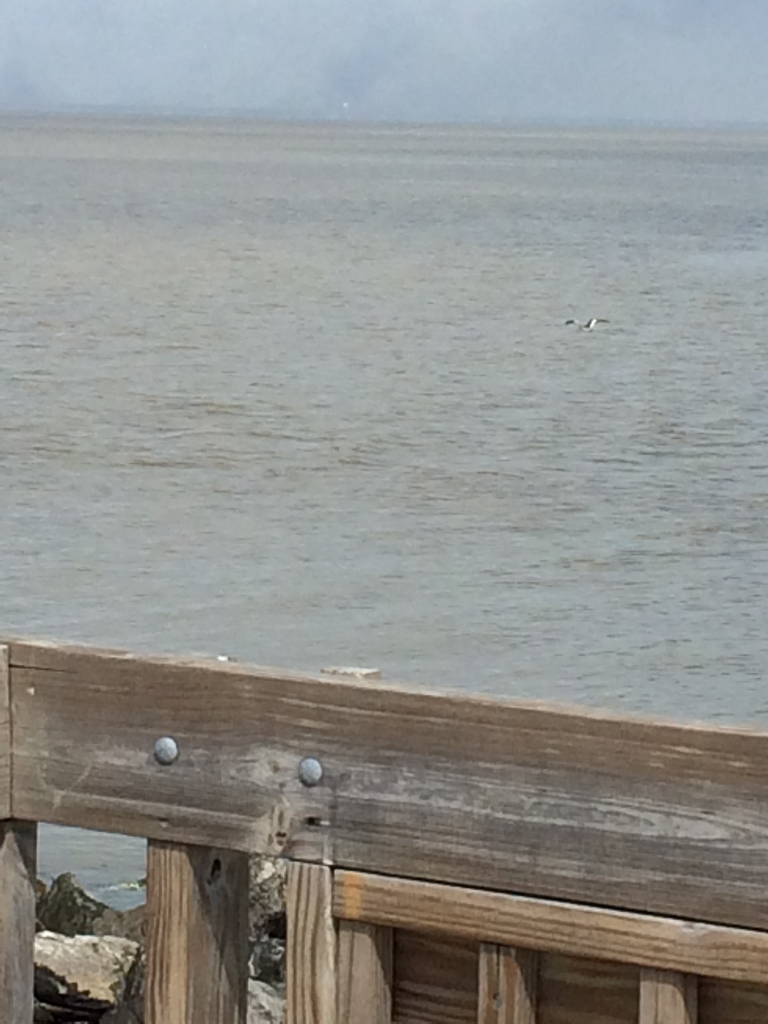
Of course, many of the birds that I saw on this vacation were the farthest thing from “tricky,” at least where identification was concerned.  This American Oystercatcher that I glimpsed through the railing at the Dauphin Island Sea Lab is a shorebird, but its bold black-and-white-and-brown plumage and almost clownish-looking red bill make it unlikely to be confused with any other species!  This particular individual, though, was “tricky” and wary in its behavior, making it difficult for me to get photographs.  Oystercatchers are year-round residents of the Gulf Coast, and they do indeed eat oysters.
American Oystercatcher watching from rock perch...
...and flying over the waves!  Notice its striking wing pattern.

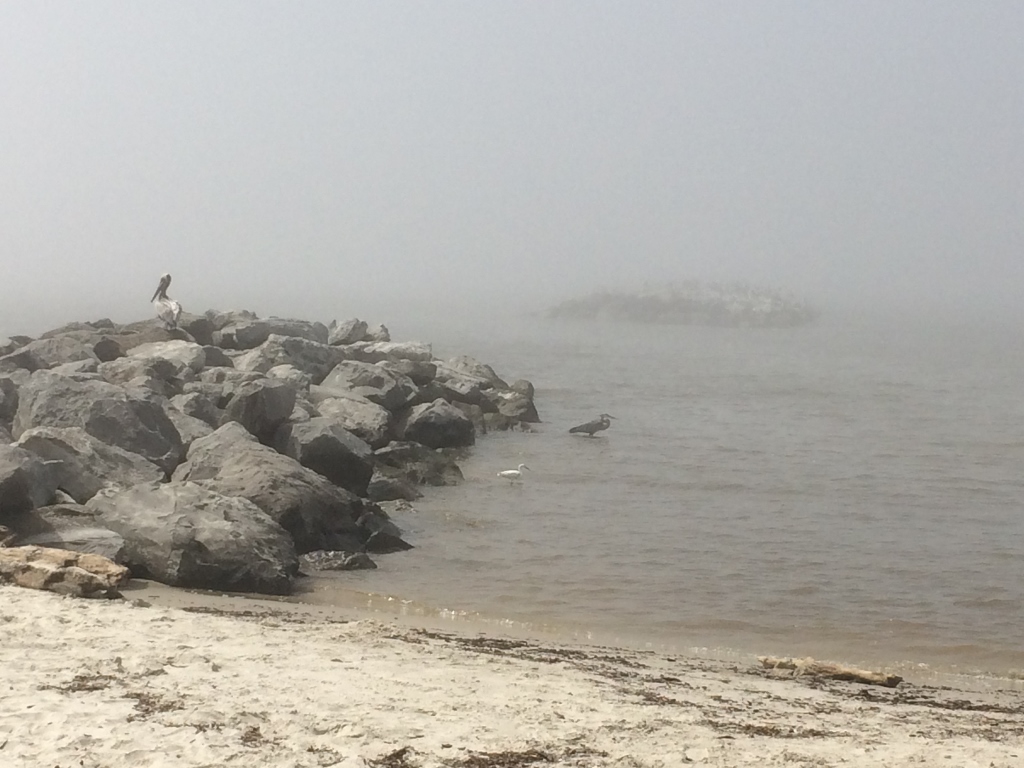
Here are some other interesting but easy-to-ID birds: a Brown Pelican (standing on the rocks on the left), a Snowy Egret, and a Great Blue Heron.  The fog on this day, the 11th, obscured almost everything past the shoreline.  There are probably many cormorants, gulls, terns, and pelicans on the rocks farther out, but it’s almost impossible to tell.  Despite the visibility issues, there was something intriguing about seeing the beach shrouded in mist like this.
I can’t resist ending on this picture of a slightly miffed-looking Laughing Gull.  If you can, keep watching your local wildlife, and please continue to check for updates to the blog as we all move forward in this weird and stressful time. 

Sunday, June 30, 2019

Tricky Birds, Part II

Last month, I discussed how to identify gulls, terns, and related species by analyzing their structural characteristics and behavior.  This time, I’m examining the shorebirds that I saw at Dauphin Island during March of this year.

Shorebirds are a challenging group; most of them are fairly drab in color, and several species are so similar that, at certain times of year, it may be impossible to reliably distinguish them.  That being said, if you know which species are common for the particular area, habitat, and season that you’re birding, then you’re probably already halfway to making an identification.  For example, at Dauphin Island, I was birding on the beach, so I knew that I was unlikely to see any shorebirds that prefer freshwater habitats.  Furthermore, I knew that Sanderlings and Willets are two of the most abundant shorebird species in coastal Alabama, so I could use those as a basis for comparison with other, less familiar species. 

Here’s a photo from the last post.  The larger, brown shorebird is a Willet.  As you’ll see, Willets are much larger and taller than most of the other shorebirds that you are likely to find on the beach.  The small, pale sandpiper is a Sanderling.  It’s considerably smaller than a Willet, but far from the tiniest shorebird seen on the beach, as we’ll see.
Sanderling, Willet, Laughing Gull, and Ring-billed Gull
On the shoreline, there were a few plovers—small, stocky shorebirds.  The one in the photo is a Semipalmated Plover, a name that refers to the partial webbing between its toes.  As you can see, its bill is much shorter than that of the Sanderling (in the lower photo), and its body is stockier and more front-heavy, on the whole.  Semipalmated plovers are smaller than Sanderlings, though, and they tend to forage farther up the beach than Sanderlings, which will skitter around closer to the waves.  The plover family includes the abundant and widespread Killdeer, which usually occurs on inland fields, pastures, and meadows.  Like the Killdeer, the Semipalmated Plover will walk several feet and then pull up sharply, apparently scanning its environment.
Semipalmated Plover
Sanderling
There was another plover species on the beach, the much paler Piping Plover, but I didn’t manage to photograph it.  However, I did get a picture of a Snowy Plover that was wandering on the dunes.  The Snowy Plover is smaller and slimmer than the Semipalmated Plover, and lacks a complete neck-ring.  It has pale, grayish upperparts; a proportionally long, narrow bill; and black legs.  Snowy Plovers are a vulnerable species, and the bird in the photo had been color-banded for population research purposes.
Snowy Plover
In the photo below, you can see a Semipalmated Plover and a Sanderling foraging near the same pool.  The differences between the species are pretty obvious.  What species are the birds in the background?
Sanderling and Semipalmated Plover.  (Ring-billed Gull and Willet in background.)
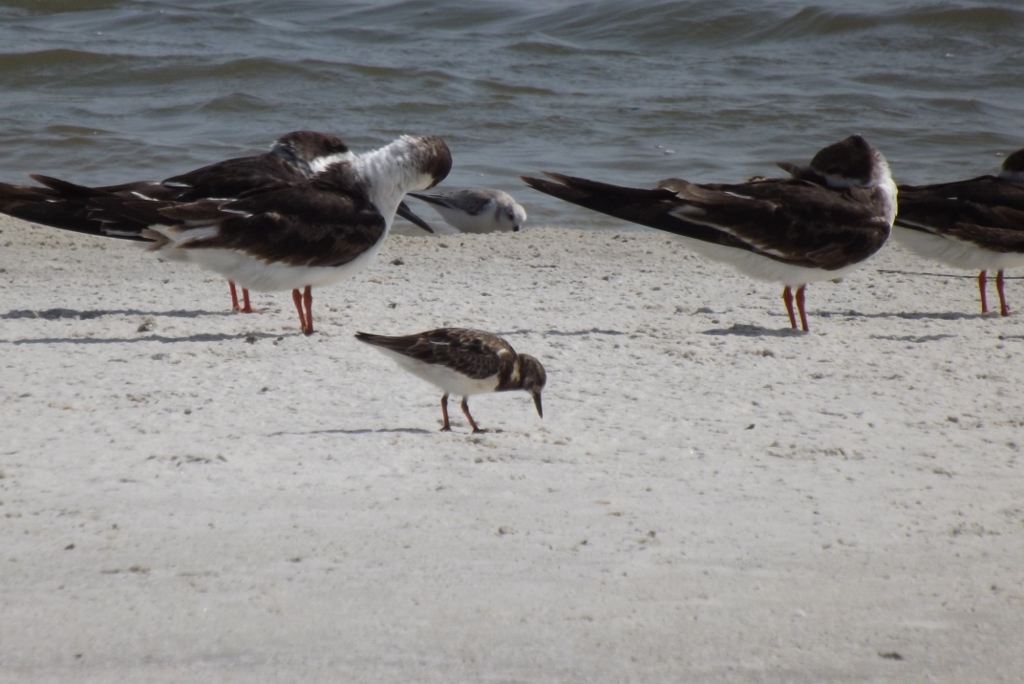
This next photo shows a species that is a bit larger than the Sanderling and the Semipalmated and Snowy Plovers, but much smaller than the Willet.  True to its name, the Ruddy Turnstone actually does turn over rocks and other material to find food underneath, so its foraging behavior can be an important clue to its identity.  It also has bright orange legs and a dark, swirling pattern on the breast.  The white patches on its back, wings, and tail are concealed unless it is in flight.
Ruddy Turnstone with Black Skimmers and Sanderling
Okay, what are the birds in the photo below?  They have small, stocky bodies; short, black legs; drab brown upperparts; and white underparts.  These are Dunlins, which have longer bills than Sanderlings but are otherwise about the same size.  Their longer bills provide a clue to their behavior, as they often feed in deeper water than Sanderlings do. 
Dunlin
In the next photo, a Sanderling forages to the left of two Dunlins.  Notice the difference in color: the warmer brown of the Dunlin versus the pale gray of the Sanderling.
Sanderling and Dunlin
The next pictures show the bill differences a bit more clearly:
Sanderling
Dunlin
Willets are so much larger than any of the shorebirds I’ve previously discussed that they usually don’t provide any identification challenges.  As you can see in the photo below, they’re nearly as large as Laughing Gulls.
Calm Willets, angry Willet, and a Laughing Gull
Here is a Willet by itself.  You can see the long, grayish legs, grayish bill, and overall grayish-brown plumage.  I should mention, though, that Willets are grayer and drabber in the winter and early spring than they are during the summer.  The bird’s face has white feathers in front of the eye and a thin eye-ring, but is otherwise very plain.
Willet
In the next pictures, the two larger birds are Willets, but the smaller bird on the left is a Short-billed Dowitcher.  Notice the warmer tone of the brown plumage, the speckling on the underparts, the pale “eyebrow,” the yellowish-gray legs, and the white rump feathers.  (The very similar Long-billed Dowitchers also occur on the coast in March, but they are less common in saltwater habitats, and their identification is a bit beyond the scope of this piece.)
Short-billed Dowitcher and Willets
Same Short-billed Dowitcher and Willets
In the photo below, dowitchers mingle with Willets and Laughing Gulls.  Size and body structure, plumage characteristics, and posture/behavior can all help you to sort out these birds!
Obviously, identifying tricky-to-ID species is far more difficult when they are alone than when other birds are nearby, and I still struggle with a number of species groups.  However, breaking away from a fixation on minute plumage details and taking a more holistic approach to identification can save you plenty of frustration in the field and teach you more about bird ecology.  Try it out!