Showing posts with label American Kestrel. Show all posts

Saturday, December 31, 2022

My Christmas Bird Count Highlights

This winter’s Christmas Bird Count will end on January 5, 2023, but I suspect that most birding groups have already completed their counts.  I participated in the Noxubee National Wildlife Refuge CBC—a bird survey that I’ve helped with many times over the years—on December 17, which is fairly early in the count period.  The weather started out fairly cold (for this area, at least), but it warmed up a bit over the course of the day, and the woods that make up most of my birding territory provided a surprising amount of protection from the wind.  I started out at Dorman Lake, where I usually pick up on a few Red-cockaded Woodpecker calls as those birds begin to stir in the early morning.  Unfortunately, there were none to be heard in the woods near that lake.

Overall, I would say that bird activity was low.  There were relatively few larger groups of sparrows, warblers, and other small species in the forests and thickets, and I saw no ducks at all—not even at Dorman Lake, where I usually find flocks of Ring-necked Ducks.  However, even though I didn’t see as many species as I am accustomed to finding, there were both expected and unexpected delights.  One of the unexpected ones was an American Kestrel in an area outside of my territory.  For at least a minute or two, the male kestrel darted, swooped, and hovered over the fields and the catalpa trees near the road.  Because birds tend not to stay in one place for very long, this kestrel went undetected by the birders who were covering this territory, so I was able to add it to the count list!  In this same area, I spotted two Vesper Sparrows, which are quite uncommon in this region of the country.  Vesper Sparrows usually inhabit fields and pastures, and their pale bills, white eye-rings, wing-bars, and white outer tail feathers help to distinguish them from other sparrows.  These Vesper Sparrows perched in a tree along the side of the road, allowing me to take some photographs.


Other species that I saw in various locations included White-throated, Song, Swamp, and Savannah Sparrows; White-breasted and Brown-headed Nuthatches; Golden-crowned and Ruby-crowned Kinglets; Yellow-throated and Pine Warblers; Red-headed, Red-bellied, Downy, Hairy, and Pileated Woodpeckers; Yellow-bellied Sapsuckers; Northern Flickers; Eastern Phoebes; Winter and Carolina Wrens; and a good number of others.  All of these were expected, but that didn't make them any less interesting to me.  No, there weren’t as many individuals and species as last year, but I had a great time in the field, regardless!  There is no substitute for time spent enjoying the outdoors, and the CBC is a rewarding way to do just that.

Saturday, December 30, 2017

Considering the Christmas Bird Count


American Coots (Lake Fayetteville, Arkansas, November 27, 2014)
The 101st Christmas Bird Count, back in December 2000, was my introduction to both my local Audubon Society chapter and the wider world of birdwatching.  Prior to that experience, I had birded mostly around my own yard in rural Mississippi, and certainly didn’t know anyone else who shared my avid interest in birds.  But all of that changed.  The count leader assigned my mother (who did the driving) and me to an area that included a portion of the local reservoir and dam, as well as the neighborhoods adjacent to it.  I remember standing at our first stop on the route, shivering in my heavy coat and thick gloves as I observed Bufflehead ducks and American Coots bobbing in the waves near the spillway.  Fortunately, the temperature increased considerably as the day progressed, as did the numbers on my bird checklist and my appreciation for this challenging but enjoyable form of citizen science.  What had originally been only a hobby for me was now a way to make a real contribution to ornithology.

The Christmas Bird Count is one of the longest-running wildlife censuses.  The period of December 14, 2017 through January 5, 2018 marks the 118th time that the count has been conducted.  Like many birdwatchers, I’ve already participated in my local CBC this year.  Some hardworking people will even be involved with more than one count.  The count circles, of which there are several per state or province, measure 15 miles in diameter, and each count compiler assigns portions of the count area to the various groups or individuals to cover.  The rules for counting are fairly simple: all observed, identified wild birds should be included in the tally, and the same area cannot be surveyed more than once.
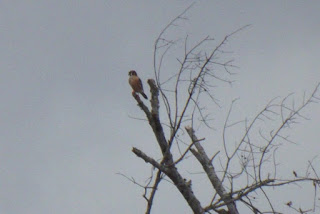
American Kestrel seen on Noxubee NWR CBC, December 17, 2016
In addition to being a fun time in the field, the Christmas Bird Count is a great way to touch base with other birders and hone one’s birding skills.  While I normally do make an effort to keep accurate tallies of birds that I observe, the CBC forces me to pay even closer attention to what I’m seeing and hearing—to locate and identify every individual bird that I possibly can.  A lot of CBC work involves intensely focusing on details: listening carefully to detect all of the brief contact and alarm calls from sparrows, kinglets, warblers, chickadees, titmice, wrens, nuthatches, and creepers in the dense woods; scanning distant rafts of waterfowl for subtle differences in plumage between species; trying to get a reasonable estimate of the number of individuals in an enormous flock of blackbirds, robins, or waxwings; and so forth.

One of the most common songbirds seen in the winter months in North America: the White-throated Sparrow.  (Fayetteville, Arkansas)
The Christmas Bird Count began in 1900 as a response to the then-common “side hunts” that involved teams of hunters competing to see who could shoot the most animals—birds included—on Christmas Day.  The count’s founder, Frank M. Chapman, was a prominent ornithologist and conservationist who (quite understandably) found the tradition of “side hunts” to be irresponsible and repulsive, so he recruited a number of colleagues from all around the country to count all of the birds that they could find on Christmas.  Although the CBC has expanded considerably since its conception, its basic formula hasn’t changed much.  The fairly simple, straightforward rules make it just as fun for beginners as it is for those who have done it for years.

Considering how simple the CBC really is, how valuable could its results be to ornithology?  In some cases, more valuable than one might think.  For example, Niven et al. (2004) used CBC data to examine population changes in the bird species that breed in the boreal forests of Canada and Alaska and winter farther south.  Some of these boreal species, such as Merlins and Palm Warblers, showed population increases.  Populations of several other species were relatively stable, while some species, including Harris’s Sparrows, Rusty Blackbirds, and Northern Shrikes, had declined significantly.  The researchers noticed that the CBC winter population trends paralleled those in the data from the Breeding Bird Survey, another long-running bird census.
Merlin at Choctaw Lake, MS, December 31, 2015.
Like the authors of the boreal species study, Link et al. (2006) found that CBC data matched data from other surveys very well.  In this instance, American Black Ducks showed similar population changes on both the CBC and the Midwinter Waterfowl Inventory—an indication of the general accuracy of CBC data!  The data can also be useful for examining the impact of disease on bird populations; in 2003, C. Caffrey and C. C. Peterson looked at CBC results over a multi-year period for several common species in the northeastern U. S., and came to the conclusion that West Nile Virus had likely not significantly affected the populations in that region.  And these studies are merely the tip of the iceberg; CBC data can be a treasure trove of information for a patient researcher.  This is something worth celebrating about the CBC as the 118th count continues over the next week and as we move into a new year.
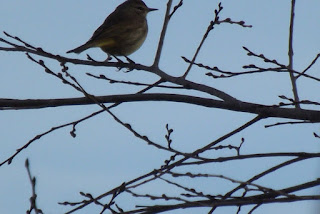
A rare (for the region) Palm Warbler seen on Noxubee NWR CBC, December 16, 2017.

References:

Caffrey, C. and Peterson, C. C.  2003.  Christmas Bird Count data suggest West Nile Virus may not be a conservation issue in the northeastern United States.  American Birds 57:14-21.

Link, W. A., Sauer, J. R., and Niven, D. K.  2006.  A hierarchical model for regional analysis of population change using Christmas Bird Count data, with application to the American Black Duck.  The Condor 108:13-24.

National Audubon Society, Christmas Bird Count Compiler Resources.  Retrieved December 30, 2017, from http://www.audubon.org/christmas-bird-count-compiler-resources.

Niven, D. K., Sauer, J. R., Butcher, G. S., and Link, W. A.  2004.  Christmas Bird Count provides     insights into population change in land birds that breed in the boreal forest.  American Birds 58:10-20.

Weidensaul, S.  2007.  Of a Feather.  Harcourt, Inc., Orlando, Florida, USA.

Thursday, November 30, 2017

Noxubee from New Angles

I’ve written before about the fascinating place that is Sam D. Hamilton Noxubee National Wildlife Refuge.  The two afternoons that my family and I spent there this November definitely attest to the refuge’s uniqueness.  Our first excursion this month occurred on the 4th.  The daytime temperature was in the mid-70s, so it was hardly surprising that we saw three alligators almost right off the bat.  Being ectothermic, these reptiles can’t internally regulate their body temperatures, and instead rely on the external environment for heating and cooling.  The first two gators of our day were in the shallows of Bluff Lake, basking in the afternoon sun.
Large alligator
Larger alligator!
This smaller alligator, which was basking in the spillway, looked like a silvery bit of debris or a half-submerged log in the calm, murky water.
I like how the cypress foliage in this photo reflects on the water's surface, adding rusty hues to the muddy green.
A quarter-sized (including the leg span) orb-weaver spider seemed to float in midair as it built its web between a road sign and some nearby vegetation.
Great Blue Herons and a couple of Great Egrets foraged in Bluff Lake.  Hopefully, they were wary of the alligators!
It was nearly dark by the time we arrived at Goose Overlook, an observation platform over part of Bluff Lake, but there was still light enough for us to watch a very large cottonmouth wind its way through the shallow water.  Unlike the nonvenomous water snakes, which swim with their bodies submerged and their heads sticking out of the water, cottonmouths swim with their bodies parallel to the water’s surface.
In addition to the various chirps and chips of forest and marsh songbirds and the barking of the Canada Geese that were settling in for the night, we heard the sonorous Hoo hoo hoo hooooo hoo of two Great Horned Owls.  Visitors are not allowed to be on the refuge trails after dark, so we made the most we could of the waning daylight before packing up and heading out.  Only a few minutes before we left, I attempted a Barred Owl impression (Who cooks for you?  Who cooks for YOU-all?) and was delighted when a real one called from deep in the swampy woods.  Had the owl really responded to my noise, or was it just coincidence?  I suspect the latter, but it was nevertheless a fun incident.  Remember the Barred Owl—it will be significant later on.
Goose Overlook, November 4
Here is a picture of Goose Overlook on a different date: November 22.  Obviously, it was a different time of day, as well, and the forest birds—including Red-bellied Woodpeckers, Northern Cardinals, Carolina Chickadees, and Golden-crowned Kinglets—chattered away much more noisily.
One of my sisters drew my attention to a Wilson’s Snipe feeding in the mud.  This chunky shorebird is commonly found in marshy areas during the winter in Mississippi.
There were other good birding spots on this day at Noxubee, including Cypress Cove, where we saw a Belted Kingfisher.  The rust-red band across the belly marked this one as a female.  The male lacks the reddish band, but, like the female, it has the blue chest band.  True to their name, kingfishers are master hunters, diving into lakes and ponds to catch fish with their spear-like bills.
An American Kestrel darted up to the top of a cypress snag at the Cove.  This was a male kestrel, as you can tell from the slate-blue wings and the prominent dark bar near the end of the tail.  Kestrels tend to bob their tails when perched, and that is exactly what this bird was doing.  I noticed that most of the songbirds in the area became very quiet when this small falcon made its appearance.  Kestrels feed primarily on small birds, rodents, and insects.
We greatly enjoyed our visit.  As we headed out of the refuge at about 4:00 p.m., a Barred Owl flew in front of our van and landed in an oak tree on the side of the road.  Wow!  This was even more interesting than the aural encounter with an owl of the same species during the last visit.  The owl seemed nonchalant about our presence, sitting still and allowing us to take several photographs.  Eventually, we had to leave, but our afternoon could not have ended on a better note.  Of course, days like this are the normal state of things at the fascinating Noxubee NWR.