My family and I spent a few days on the Mississippi coast last month, mainly to enjoy the wildlife and scenery. The cool sand made walking up and down the beach a pleasant experience, although the water was a bit too cold for wading. The birds, including Great Blue Herons, Laughing Gulls, Forster’s Terns, and sandpipers, never minded this, however. Credit this to the retia mirabilia (
https://www.sciencedirect.com/topics/neuroscience/rete-mirabile) in their feet, which are basically heat exchange systems of blood vessels.
 |
| Laughing Gull flying over Great Blue Heron. |
 |
| Laughing Gulls and Forster's Terns (one of which is clearly visible on the right) congregating. |
|
|
Even though the temperature was slightly low, there were plenty of reminders that it was indeed mid-March. Hot-pink azaleas seemed to be one of the most common shrubs (after wax myrtle, yaupon, and privet, I’d say) in both town and rural environments. The color of the blooms really “popped” against the typical backdrops of sandy soil and live oak leaves.
 |
| Azaleas |
But we didn’t spend all of our time at the beach; the
Pascagoula River Audubon Center provided us with great opportunities for
walking and observing coastal plants and animals.
 |
| Spreading leaves of palmettos |
Near one
of the trails, which was flanked by stands of wax myrtle, yaupon, and palmettos,
a fledgling Great Horned Owl peered out from its perch in a tall pine
tree. Like many of the Great Horned Owls
on the Gulf Coast, the pair that had produced this young bird had nested on a
wooden nesting platform that had originally been made for Ospreys. I took several photos of the fledgling.
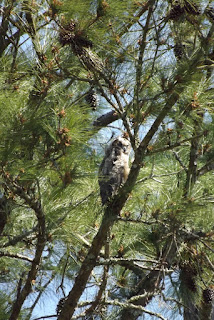 |
| A huge bird, even if not yet fully-grown. |
 |
| "Who?" -- looking indignant, as owls tend to do. |
 |
| Look at the finely-barred adult feathers replacing the downy juvenile ones. |
 |
| Still looks fierce! |
I saw one of the adult owls—probably the female, as I was informed by the staff at the center—in another pine around a hundred feet or so from the nest site. As you can tell from the pictures, adult owls are sleeker—without downy feathers—and have larger ear tufts than the juveniles.
 |
| Mama owl quietly keeping watch. |
 |
| A view of the vegetation and water. |
Even though the Great Horned Owls had taken over the nest
platform for the time being, there were still plenty of potential nesting sites
for the Ospreys in the area. I saw three
of these graceful raptors flying over the river while I was at the Audubon
center. They are quite common in coastal
regions, and their high-pitched, piping calls—which seem somewhat incongruous
in such large birds—carry well and help me to know that they’re nearby even
when I don’t see them.
 |
| Osprey in flight. |
 |
| Circling around! | | |
Ospreys are also sometimes called “sea eagles,” but there are actually Bald Eagles on the coast, as well. I tried to snap pictures of this adult one as it flew over the Audubon building. You can see the white head and tail, at least.
 |
| Bald Eagle flying over. |
Gulf Islands National Seashore was another stopping place. The coastal scrub and marshes provide habitat for numerous species of wildlife. I heard Clapper Rails and saw Red-tailed Hawks, Laughing Gulls, Brown Pelicans, Red-winged Blackbirds, Great Blue Herons, Snowy Egrets, and more. Large alligators prowled close to the shorelines, and cricket frogs called from the marsh grasses.
 |
| Saltmarsh |
 |
| A prowling Great Blue Heron. |
 |
| An American alligator in the marsh. |
The cycle of storms, salt damage, and flooding always leaves its mark on the landscape of the Gulf Coast—it is an essential part of the ecosystem. Sometimes, however, there are particularly obvious signs of recent disturbance, like this damaged boardwalk.
 |
| Flood damage |
The beaches, Pascagoula River Audubon Center, and Gulf Islands National Seashore were some of the places we traveled to during the first full day of vacationing on the coast. The next day involved more trips to the beach, where I watched Brown Pelicans from a public fishing pier.
 |
| Brown Pelicans are commonly seen here. |
Coastal regions tend to host a wide variety of birdlife, and not all of the birds seen near the shore will necessarily be seashore specialists like Laughing Gulls and terns. For example, this Loggerhead Shrike, a species that occurs more generally in fields and other open habitats, had apparently staked out some territory around one of the parking areas near the beach.
 |
| Loggerhead Shrike |
As I mentioned earlier, the Mississippi coast is home to numerous Ospreys. They can be heard and seen practically anywhere that there is water, and they are equally adaptable in their nesting habits. In the photo below, you can see an Osprey nest—with an adult Osprey on it—sitting atop the tower.
 |
| Osprey nest |
Less adaptable are the Mississippi Sandhill Cranes, a local, nonmigratory, federally endangered subspecies of the common and widespread Sandhill Cranes. The Mississippi subspecies is restricted to pine savanna environments in the breeding season, and these habitats have been threatened by human development. Prior to this trip, I had never seen Mississippi Sandhill Cranes, so I tried looking for them at a number of sites. Finally, my family and I spotted a pair of these secretive birds at—of all places—a landfill! They departed with loud, guttural, rattling calls.
 |
| Mississippi Sandhill Cranes--lifting off at the landfill. |
As much as I would have liked to stay longer at the coast, the vacation nevertheless had to come to an end. The Gulf Coast region has such a diversity of wild creatures and habitats, though, that returning again and again never gets old.


