Wednesday, August 30, 2017

Late Summer Birds and Bugs


Ominous clouds at Chadwick Lake, MSU
As the summer winds down, I’m finding myself observing insects nearly as much I observe birds.  For one thing, it’s a buggy time, and the periods of heavy rain we’ve had have seemingly caused population explosions of some of them, especially mosquitoes.  For another, the mad scrambles of birds to find territories and mates and to produce and raise young are basically over for the year; simply holding down those territories, "parenting" fledglings, and preparing for migration are the new priorities, and, at least from our human perspective, these can appear to be slightly more leisurely pursuits than the previous ones—even though they sometimes aren't.

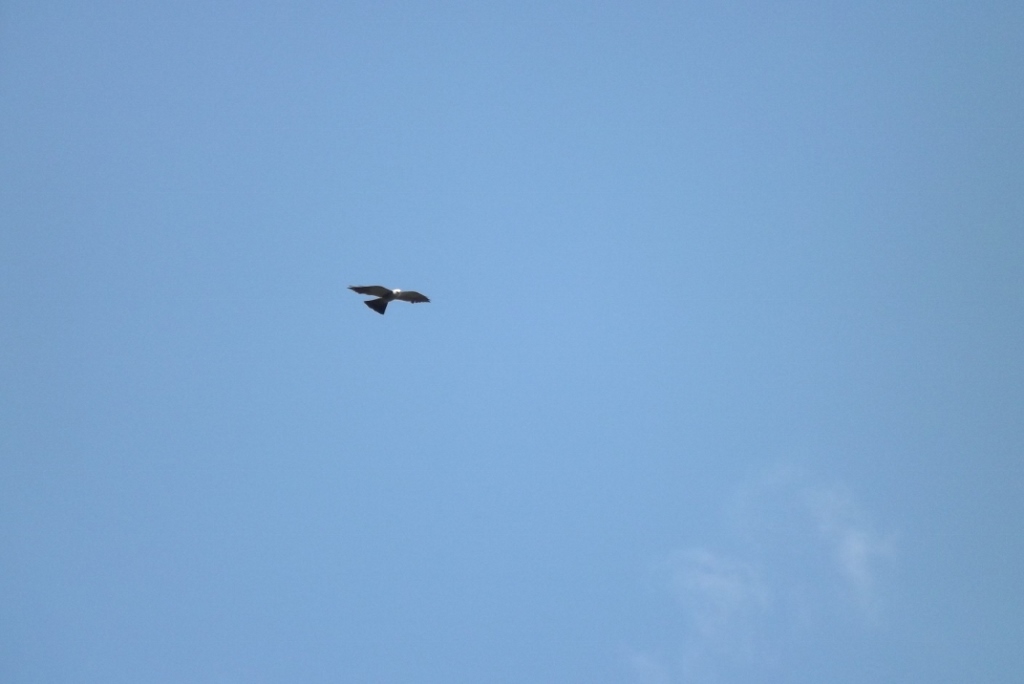
The Mississippi Kites that have been gracing the neighborhood this summer are a migratory species that will leave the area in another month or so.  I’m pretty sure that at least one pair nested nearby earlier in the season, even though I never actually saw a nest.  But three kites—two adults (like the one in the pictures below) and a juvenile—have been hanging around lately, occasionally perching in the snags along the creek or soaring over the open fields.  Their two-syllable, whistled calls alert me to their presence.
Mississippi Kites feed heavily on large insects, such as cicadas, grasshoppers, and praying mantises.  At the moment, the trees are filled with droning choruses of annual cicadas, so it’s no wonder that the kites are spending so much time here. 

As most readers probably already know, cicada nymphs burrow into the ground and emerge to shed their exoskeletons and become adults.  This picture was taken at Jeff Busby Park a little earlier in the year, but it shows a cicada in the process of molting:
 And here’s a picture of a different cast “skin” (really the exoskeleton) in a garage:
This praying mantis that I photographed in the garage at night was enormous—around 4 inches long!  I’m sure that there are many more like it in the area.
July and August have also been great months for viewing butterflies.  Around here, these insects vary in size from the (aptly-named) giant swallowtail (top pictures) to tiny, delicate species like the red-banded hairstreak (bottom pictures), the eastern tailed blue, and the summer azure.
The folded wings of the hairstreak in the photo bulged out slightly on one side, which led me to suspect that the butterfly had only recently emerged from its chrysalis and hadn’t finished drying and stiffening its wings.  This drying process takes a while and can render a butterfly highly vulnerable to predators and the elements.  There's no telling whether or not this little creature survived its ordeal, but, of course, this is an uncertain time of year.

Monday, July 31, 2017

Gulf Coast Observations


As far as I can tell, there is no surefire way to escape the heat and humidity while remaining in my home state, Mississippi, during the dog days of summer.  However, even if we failed to avoid the mugginess, my family and I did manage to find distractions from it—and, really, isn’t that the best that can be expected in July?—by spending a few days in and around Ocean Springs, Mississippi.  We weren’t there for very long, but it turned out to be just what we needed for a refresher.  I saw a good variety of wildlife in the coastal woodlands, brackish marshes, beaches, and tide pools.
You can see Deer Island on the horizon.  It was originally part of the mainland, and isn't a barrier island.
Whether it’s because staring up at the sky or across the water when the sun is out eventually starts to hurt my eyes, or because there are no trees for me to scan for birds, walking on the beach tends to make me focus downward.  That was the case here, and I entertained myself much of the time by watching the vast variety of creatures on the seashore and in the tide pools.  I found a number of crabs, including the ones below:
Disclaimer: this particular crab was found at night, not during the daytime.  Even at night, though, it's a good idea -- for multiple reasons! -- to focus your attention on the ground while walking on the beach.
This is a fiddler crab, and the weirdly oversized claw marks it as a male.
There were also hermit crabs in the tide pools.  Unluckily for would-be photographers, these hermit crabs have an annoying tendency to scrunch themselves tightly down into their appropriated mollusk shells, making it difficult to capture decent pictures!

Occasionally, there will be something that really doesn’t belong on a beach.  No, I don't mean empty cans, fast food containers, or old firework tubes (although, unfortunately, all of those things turned up, too), but a squirrel treefrog.  For some reason, this small frog was shuffling through the salty sand only a few feet from the waves.  I suspected that it had come from the tree-lined area just off the beach, so I carefully relocated it. 
I later learned that squirrel treefrogs can apparently tolerate fairly saline environments (for example, Webb [1965] found that a squirrel treefrog breeding pool on a North Carolina barrier island contained 47% seawater http://amphibiaweb.org/cgi/amphib_query?where-genus=Hyla&where-species=squirella), so perhaps this individual had just been seeking out a rainwater puddle somewhere nearby.  Even so, I feel comfortable with my decision to move it away from the excessive foot traffic.

On most of the beaches of the Gulf Coast, you can expect to see (and hear!) Laughing Gulls, which, during our visit, seemed particularly laid-back—moseying around like tourists.  Occasionally, Royal Terns, sleeker and swifter than the gulls, flew by.  Brown Pelicans and Ospreys were also spotted from the beach during this trip.

Laughing Gulls
Great Blue Heron eying the fishing
Great Blue Herons hung out at the fishing pier, probably taking advantage of the atmosphere created by the people fishing: if they couldn't get handouts, or if they weren’t able to scavenge a few fish from the buckets, at least the bait that was continuously added to the water might attract more fish to the area.

Of course, beaches aren’t the only natural places worth visiting on the coast.  Gulf Islands National Seashore, preserved by the National Park Service, was also on our itinerary.  We walked some of the trails that wound through the coastal scrub forest, enjoying our looks at Spanish moss (actually a bromeliad, not a moss), huge live oaks, marshes, and more.  I heard Clapper Rails and saw Red-winged Blackbirds, Barn Swallows, herons, woodpeckers, and several other bird species.  Coastal wetlands, in particular, can play a major role in reducing storm surge from hurricanes and tropical storms, so conserving them is essential if we want the coastal cities that we enjoy visiting to exist years into the future.
Spanish moss -- an unusual plant for me -- growing on sweetgum, a species that I know extremely well.