Monday, May 31, 2021

An Afternoon at the Beach

As regular readers probably already know, I love spending time on the Gulf Coast.  This spring, I was able to spend a few days enjoying the natural sights in parts of coastal Mississippi and Alabama.  Let’s take a look at some of the avian life that I observed in an afternoon on the Mississippi coast!

It was a pleasant day at the Ocean Springs public beach, and the area was teeming with birds.  Snowy Egrets waded near the shore, darting back and forth in the shallows as they searched for fish and aquatic invertebrates.  They occasionally stopped and flew farther up the beach to find better pickings.

Snowy Egrets
Gulls, terns, cormorants, and pelicans perched on old pilings.  The size difference between the species Laughing Gull and Herring Gull is apparent in the next couple of photos.  Most of the Herring Gulls that I saw had not yet attained adult plumage—probably because it takes the birds four years to reach maturity.  Herring Gulls’ slow maturation goes hand-in-hand with their longevity, though; individuals have been known to live for several decades in the wild.  I imagine that the older ones are the wiliest of beach marauders. 

Herring Gulls, Laughing Gull (foreground), and Double-crested Cormorant (at right)

Herring Gull in middle, Laughing Gulls above and below
In addition to the Herring Gulls, there were dozens of Laughing Gulls milling around on the beach and foraging over the water.  Their raucous calls rang out in the salty air.

Laughing Gull flock
Black Skimmers, which, as their name suggests, hunt for fish by gliding low over the water and skimming the surface with their long bills, formed their own sizeable flocks on the sandbars.  They also sometimes mingled with the Laughing Gulls, but they did not fly out to hunt.  Unlike the more diurnal gulls and terns, skimmers tend to be crepuscular, foraging mainly during dawn and dusk.  I can relate; I don’t always feel so energetic during the heat of midday, either.  Skimmers actually have more rods than cones in their eyes than most birds do, which makes it easier for them to hunt in dim light. 

Gulls and Black Skimmers
A few Ring-billed and Bonaparte’s Gulls were mixed in with the enormous flocks of Laughing Gulls.  Ring-billed Gulls bear distinctive black markings on their bills, and Bonaparte’s Gulls—during winter and spring, at least—have smudgy dark spots on their heads.  Both species are common on the Gulf Coast from fall to spring, although they’re far less numerous than Laughing Gulls.

Ring-billed Gull strolling along

Bonaparte's Gull swimming

At one point, most of the roosting and foraging birds were stirred up by … something.  The flocks of gulls and skimmers simply exploded upward in a flurry of wingbeats.  What was going on? 

Stirred up!
Looking around, I deduced that the source of the consternation was an adult Bald Eagle that was perched in a giant live oak tree.  Wow!  Bald Eagles will certainly catch gulls and other shorebirds if they get the opportunity, but, given that this one had been detected already by its potential prey, I think that its chances of obtaining a poultry meal at this site were slim.

The Bald Eagle

Apparently, even a predator as fierce as a Bald Eagle is a bit less frightening to smaller birds if they can let it know that they can see it.  This is probably why a bunch of the Laughing Gulls dive-bombed the eagle—taunting it prevented it from launching a surprise attack on the flock. 

Gull flying over eagle's head
Overall, it was a great afternoon for birding on the Gulf Coast.  Stay tuned for more in later posts!

Friday, April 30, 2021

Spring Shorebirds

Heavy rains in the springtime often lead to flooding in fields and meadows, which, in turn, attracts migrating shorebirds.  Although I’ve discussed shorebird identification in previous posts, my focus has been primarily coastal species.  However, many other shorebirds pass through inland regions on their way to their nesting grounds (which are also often inland), so you definitely don’t have to be a coastal resident or tourist to see them.  I’ve observed many in northeast-central Mississippi, including in the fields at the Mississippi State University research farms.  In late April, 2020, one of those fields became a stopover for these migrating groups of shorebirds.

To an untrained eye, the field wouldn’t have looked particularly special.  There were ridges of mud and multiple tussocks of grass above the water, and the small, brown birds seemed well camouflaged—at least until they moved!  In this photo, you might be able to make out some of the many shorebirds feeding in the mud.  There were even a few Killdeer—common, familiar birds of pastures and grasslands—at the edges of the puddles.

Killdeer in background, to the right
 One of the easiest species to pick out from the rest was the Long-billed Dowitcher, a rust-colored, comparatively chunky bird with a bill over twice the length of its head.  I described Short-billed Dowitchers in an earlier post, and most of what I said about their appearance applies to the Long-billed species, as well.  The Long-billed Dowitcher’s habits and vocalizations differ drastically from that of its cousin, though: Long-billed Dowitchers are far more likely to be found in freshwater habitats, and their call is high-pitched and sharp. 

Long-billed Dowitcher

Long-billed Dowitcher

 
Another species that stood out from the rest was the Wilson’s Phalarope.  As you can see in the photo below, the strongly contrasting head markings of this species are very distinctive.  Surprisingly, the more colorful of the two phalaropes (the one on the left) was actually a female, while the drabber bird was a male.  Phalaropes exhibit polyandry, which simply means that a female bird will mate with multiple males and lay several clutches of eggs.  The males are responsible for incubating the eggs and, later, raising the young.
 
Wilson's Phalaropes

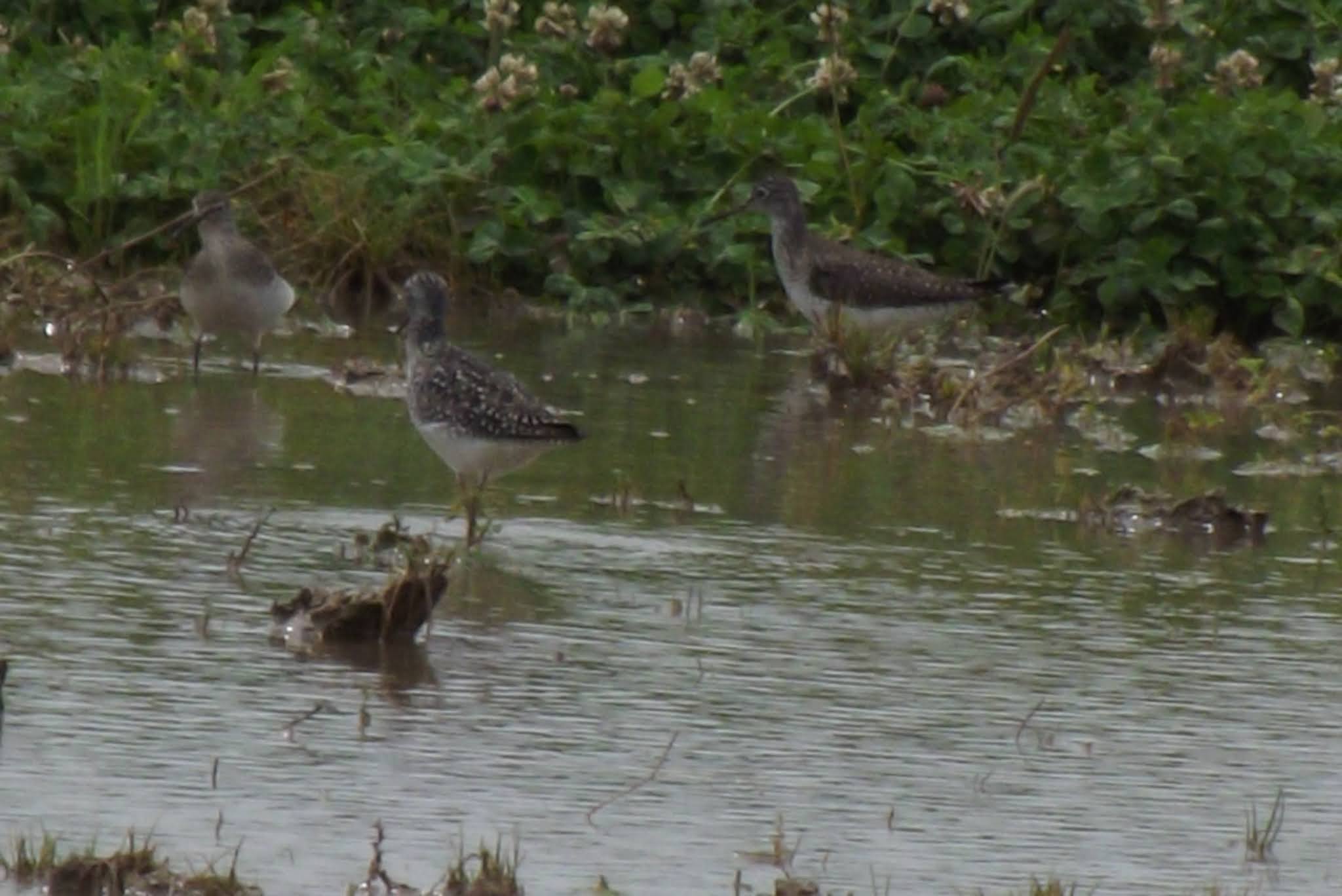
Solitary Sandpipers lurked at the edges of the field, feeding mainly in the weedier areas.  Although these birds aren’t truly “solitary” much of the time, they do tend to avoid mingling with larger flocks.  Some of their distinctive field marks are white bellies, dark brown backs, finely stippled necks, white eye-rings, greenish legs, and black bills. 
 
Solitary Sandpipers
 
In the next photo, the bird in the middle is a different species from the Solitary Sandpipers standing behind it.  It has far heavier white spotting on its back, and its legs are yellow instead of grayish-green.  The color of the legs actually provides an important clue to the bird’s identification: this was a Lesser Yellowlegs.
 
Lesser Yellowlegs and Solitary Sandpipers
 
As it turned out, there were many Lesser Yellowlegs in the flooded field.  They made long strides while foraging, frequently passing though the groups of Long-billed Dowitchers. 
 
Long-billed Dowitchers and Lesser Yellowlegs
 
Smaller numbers of the Greater Yellowlegs prowled the field, as well.  In addition to the size difference, the heavier barring on the underparts and the proportionally longer bill helped to distinguish the Greater Yellowlegs from the Lesser.
 
Greater Yellowlegs
 
 I enjoyed seeing how the Greater Yellowlegs dwarfed their relatives. 
 
Lesser and Greater Yellowlegs
 
Last but not least, there were a couple of Dunlin in the flooded field.  Yes, I often see these on the coast, but I’ve also found them inland on several occasions.  As I’ve mentioned before, their stocky build, relatively short legs, and drooped-tip bills make them distinctive.  They typically occur on the coast in the winter, but, when spring rolls around, they begin to make their way up to the arctic to breed, passing over and through large expanses of inland territory.  Marshes, wetlands, shallow ponds, and flooded fields provide important stopover sites for these migratory birds.
 
Dunlin
 
The last photo shows three species.  Can you identify them? 


Answer:

Long-billed Dowitcher (left), Wilson’s Phalarope (two birds at center), and Lesser Yellowlegs (right).

Wednesday, March 31, 2021

Seasonal Changes at Noxubee National Wildlife Refuge

Although it seemed at first that it might take a while for the Southeast to recover from the ice storms of last February, spring weather has pushed its way into most of these previously frozen areas.  As many readers are already well aware, I frequently visit Sam D. Hamilton Noxubee National Wildlife Refuge to enjoy the natural sights.  I did just that a few days ago.  The woods at Noxubee are beautiful right now, with plenty of blooming trees, such as flowering dogwood.  The cypresses that grow all around the two main lakes have just started unfurling their leaves, and the oaks and redbuds have nearly completed their leafing-out.

Flowering dogwood
The birdlife at Noxubee is in the process of a changeover, with winter residents—such as ducks and most of the sparrow species—leaving the area, and the summer residents—including Purple Martins, Northern Parulas, some types of wading birds, and warblers—settling in.  That is exactly what’s happening right now at Bluff Lake.  In this photo from earlier in the month, you can see an enormous raft of American Coots: 

However, near the end of the month, the coots are nearly all gone from the refuge:

Instead, what can be seen from Bluff Lake right now are the Great Egrets beginning their breeding period.  They roost and nest in the cypress trees over the water.  Cattle Egrets, Little Blue Herons, White Ibises, and several other species also use these trees, but the population of Great Egrets at this location has really exploded in recent years, likely as a result of the trees growing taller.  The smaller Cattle Egrets still nest at the lake, but their numbers are a bit lower than they were a decade or two ago.

Great Egrets at heronry
Little Blue Herons are very common at the refuge, as well, even though they never appear in numbers as high as those of Cattle and Great Egrets.  These Little Blues can be seen foraging in one of the marshy shorelines of Bluff Lake.  Their slate blue coloration is distinctive, and they are unlikely to be confused with other herons in this part of the country.  Unlike the adults, though, juvenile Little Blue Herons are almost entirely white, with touches of gray on their wingtips.  They acquire a patchwork white-and-blue appearance as they gradually molt into adult plumage.

Little Blue Herons foraging in the grass

 
Little Blue Herons

Other spring water birds of note are Blue-winged Teal.  Although these small ducks generally do not overwinter in northern Mississippi in large numbers, flocks of them do pass through regularly during spring and fall migration.  The photo below shows two teal swimming in the shallows of Loakfoma Lake.  The male duck has a prominent white crescent-shaped marking on the face, while the female has buff-colored scallop markings on the wings and flanks. 
Blue-winged Teal
If you spend some time scanning the cypress and pine snags over the water or near the shore, you may spot a Bald Eagle or two.  These huge raptors nest at the refuge every year, and can often be detected by their startlingly chirpy, piping calls.  In the middle part of the 20th century, Bald Eagle populations experienced sharp declines as a result of DDT poisoning, but they have since rebounded, and it now seems that nearly every large body of water in the Southeast may have a pair of eagles nearby.  But Bald Eagles’ commonness doesn’t take anything away from their amazing charisma, in my opinion.  No matter where I am, I love seeing them.
Yes, spring is here.  The temperatures are still fluctuating quite a bit, which is normal, but the heavy rains and strong storms, blossoming and leafing-out plants, and breeding and migrating birds signify the change in seasons. Be sure not to miss it!