![]() |
| The Gallinule is to the right of the American Coot |
![]() |
| Gallinule -- note the white lines on the sides of the body. |
![]() |
| Lots of foraging in the shallows! |
![]() |
| The lake. What you can't see is the biting wind! |
![]() |
| The Gallinule is to the right of the American Coot |
![]() |
| Gallinule -- note the white lines on the sides of the body. |
![]() |
| Lots of foraging in the shallows! |
![]() |
| The lake. What you can't see is the biting wind! |
This winter’s Christmas Bird Count will end on January 5, 2023, but I suspect that most birding groups have already completed their counts. I participated in the Noxubee National Wildlife Refuge CBC—a bird survey that I’ve helped with many times over the years—on December 17, which is fairly early in the count period. The weather started out fairly cold (for this area, at least), but it warmed up a bit over the course of the day, and the woods that make up most of my birding territory provided a surprising amount of protection from the wind. I started out at Dorman Lake, where I usually pick up on a few Red-cockaded Woodpecker calls as those birds begin to stir in the early morning. Unfortunately, there were none to be heard in the woods near that lake.
Overall, I would say that bird activity was low. There were relatively few larger groups of
sparrows, warblers, and other small species in the forests and thickets, and I
saw no ducks at all—not even at Dorman Lake, where I usually find flocks of
Ring-necked Ducks. However, even though
I didn’t see as many species as I am accustomed to finding, there were both
expected and unexpected delights. One of
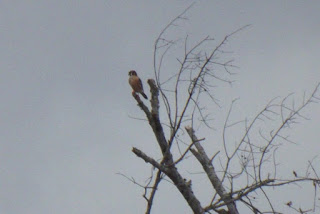
the unexpected ones was an American Kestrel in an area outside of my territory. For at least a minute or two, the male
kestrel darted, swooped, and hovered over the fields and the catalpa trees near
the road. Because birds tend not to stay
in one place for very long, this kestrel went undetected by the birders who were covering this territory, so I was
able to add it to the count list! In
this same area, I spotted two Vesper Sparrows, which are quite uncommon in this
region of the country. Vesper Sparrows
usually inhabit fields and pastures, and their pale bills, white eye-rings,
wing-bars, and white outer tail feathers help to distinguish them from other
sparrows. These Vesper Sparrows perched
in a tree along the side of the road, allowing me to take some photographs.
Other species that I saw in various locations included White-throated, Song, Swamp, and Savannah Sparrows; White-breasted and Brown-headed Nuthatches; Golden-crowned and Ruby-crowned Kinglets; Yellow-throated and Pine Warblers; Red-headed, Red-bellied, Downy, Hairy, and Pileated Woodpeckers; Yellow-bellied Sapsuckers; Northern Flickers; Eastern Phoebes; Winter and Carolina Wrens; and a good number of others. All of these were expected, but that didn't make them any less interesting to me. No, there weren’t as many individuals and species as last year, but I had a great time in the field, regardless! There is no substitute for time spent enjoying the outdoors, and the CBC is a rewarding way to do just that.
The 101st Christmas Bird Count, back in December 2000, was my introduction to both my local Audubon Society chapter and the wider world of birdwatching. Prior to that experience, I had birded mostly around my own yard in rural Mississippi, and certainly didn’t know anyone else who shared my avid interest in birds. But all of that changed. The count leader assigned my mother (who did the driving) and me to an area that included a portion of the local reservoir and dam, as well as the neighborhoods adjacent to it. I remember standing at our first stop on the route, shivering in my heavy coat and thick gloves as I observed Bufflehead ducks and American Coots bobbing in the waves near the spillway. Fortunately, the temperature increased considerably as the day progressed, as did the numbers on my bird checklist and my appreciation for this challenging but enjoyable form of citizen science. What had originally been only a hobby for me was now a way to make a real contribution to ornithology.
The Christmas Bird Count is one of the longest-running wildlife censuses. The period of December 14, 2022 through January 5, 2023 marks the 123rd time that the count has been conducted. The count circles, of which there are several per state or province, measure 15 miles in diameter, and each count compiler assigns portions of the count area to the various groups or individuals to cover. The rules for counting are fairly simple: all observed, identified wild birds should be included in the tally, and the same area cannot be surveyed more than once.![]() |
| American Kestrel seen on Noxubee NWR CBC, December 17, 2016 |
![]() |
| One of the most common songbirds seen in the winter months in North America: the White-throated Sparrow. (Fayetteville, Arkansas) |
![]() |
| Merlin at Choctaw Lake, MS, December 31, 2015. |
![]() |
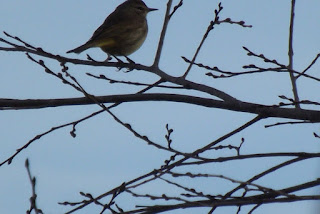
| A rare (for the region) Palm Warbler seen on Noxubee NWR CBC, December 16, 2017. |
Many years ago, on one of our trips to Macon from
Collinsville in late afternoon, I had an encounter with a couple of very
unusual birds.
It was late April, and the month before, I had been fortunate to spot several owls on some of our drives down to Collinsville. The trick had been simply to look for odd-shaped lumps stuck up in the bare branches of trees along the roadside. Now that it was April, it seemed that most of the owls had stopped coming to their nighttime lookouts. Nesting was over, so there was no need to spend so much time hunting prey for the young owls. These impressive night birds had headed back to the forest for a few months.
But wait a minute! There they were: two owls perched in a dead tree about 500 feet from the road. I asked my mom turn around and go back so I could get a better look at them, which she willingly did. When we were parked on the side of the road, I picked up my binoculars and got out of the car, fairly certain that even though I couldn’t make out any “ears” from this distance, the birds were most likely Great Horned Owls. I brought the binoculars to my eyes and focused on the chunky birds, perched side by side on a limb. I expected to see the majestic silhouettes of two owls. Instead, the binoculars revealed a couple of lumpy, hunched-over figures with tiny, wrinkled heads. Well, if these were owls, then they must have crept a little too close to a campfire a long time ago. The two Black Vultures appeared to be settling in for the night; probably they had dined on the road earlier that day.
I got back into the car, and everyone asked me what species the birds were. When I answered, we all laughed over it. What about the birds? Well, as we left, I think I saw them stretch and fluff their feathers.
If you ever happen to be driving down Highway 45, late in the day, definitely keep your eyes open for birds. Maybe you’ll be one of those fortunate birders who can draw a group of naturalists together to tell them about your encounter with the rare Great Horned Vultures…
![]() |
| Black Vultures (January 2017, Pearl River WMA) |
As autumn approaches, I feel like sharpening my bird
identification skills in preparation for the variety of species that I may see:
summer nesters on their way south, year-round resident birds, transients, and even
winter residents arriving from farther north.
Do you feel the same way? If so,
then here is a short identification quiz for the coming months!
1. Let’s start with something easy.
2. This one was foraging in the leaf litter.
3. This species is not uncommon around ponds, lakes, and
swamps.
4. Many individuals of this species can be found perching on wires, especially in the late summer and early fall.
5. This should be another fairly easy one.
6. It wouldn’t be a proper ID quiz without a half-hidden bird!
Answers:
1. The Barn Swallow is a common and colorful summer resident
throughout most of North America. The
blue upperparts, orange throat and forehead, and buffy underparts make the identification
simple. The forked tail is best seen
when the bird is flying.
2. Some warblers molt into drab plumage and are hard to
identify in the fall, but the Pine Warbler tends to look pretty much the same
at any time of year. However, young
birds and adult females with drabber plumage than usual may be confused with
other warbler species. In this
individual, the yellow spectacle-like markings on the face, the white wing
bars, the unstriped back, and the white undertail coverts clinch the
identification. It’s always a bit harder
when there aren’t lots of pine trees around, though!
3. Large, white herons often don’t pose any major identification
challenges, but there are always exceptions to the rule. Immature Little Blue Herons, like this one,
have white plumage (except for the wingtips, which are gray), so they may resemble
immature Snowy Egrets. However, their
two-toned gray-and-black bills are different from the largely black bills of
Snowy Egrets, and the skin around their eyes is blue, unlike the yellow lores
of Snowy Egrets. The legs and feet of
Little Blue Herons are generally a solid greenish-gray, while immature Snowy
Egrets have contrasting yellow feet. Little
Blue Herons commonly nest throughout the southeastern part of North America.
4. With its brown upperparts, dusky underparts, and blunt tail
tip, the Northern Rough-winged Swallow is probably the least flashy of the
North American swallows. Juveniles, like
the one in the photo, can have faint rust-colored bars on their wings. These swallows are extremely widespread in
North America.
5. In some regions (such as the Gulf Coast), Ospreys occur as
permanent residents. In most of the
lower 48 United States, you probably won’t see them unless they’re migrating. Interestingly, the Osprey can be found on
every continent but Antarctica.
6. Even with the branches partly obscuring the bird, the yellow belly, brown head and neck, slate-colored back and uppertail, white wing edges, and overall sleek appearance make it clear that this is a Cedar Waxwing. The pointed crest can barely be seen through the leaves. In Mississippi, where I live, this species is a winter resident, but it occurs all year in many states.
My first sighting of a gallinule was around twenty years ago at Noxubee National Wildlife Refuge. It was a Purple Gallinule, and utterly unmistakable: violet head, neck, and breast blending to green on the back and wings; long, yellow legs; red-and-yellow bill; ruffled white undertail feathers; and a chicken-like gait and stance. I later saw Common Gallinules (then called Common Moorhens—they were split from the Old World species in 2011), as well. I had heard them calling at a heronry in south-central Mississippi before that, but had not seen them. As it turns out, even though gallinules may be less secretive than their cousins, the rails, they don’t always make themselves obvious.
![]() |
| Perfect gallinule habitat -- and a gallinule in the upper right corner. |
However, this time of year—late summer—is one of the best times to look for them. Both Common and Purple Gallinules can be found on many ponds and lakes in the southeastern United States. They need lots of aquatic vegetation on which to build their nests and search for food. In the summer months, they are surprisingly active and vocal, and often have chicks in tow.
![]() |
| This Common Gallinule swims with its three young. |
![]() |
| This Purple Gallinule stays with its chick. |
Gallinule clutch sizes are fairly large; eight is a typical number of eggs, although, obviously, not all of the chicks will survive to adulthood. In the video below, you can see three Common Gallinule young swimming with the adult.
Gallinules consume a variety of foods, including aquatic vegetation and invertebrates. Their long toes enable them to walk on floating vegetation (generally lily and lotus pads) while foraging. They sometimes pluck insects and snails from the undersides of leaves, as you can see in the following video of a Purple Gallinule chick:
Because their nesting period is generally in the spring, their young are pretty far along in development by this point. It also helps that they are born semi-precocial, rather than altricial. This means that, unlike songbird chicks, they are feathered and have their eyes open. Unlike precocial Killdeer chicks, though, they still stay in the nest for a day or so and must be fed by their parents for several days. Once out of the nest, they can climb through vegetation using the tiny claws on their wings. This is a feature of birds in Rallidae, the rail family.
![]() |
| This Purple Gallinule chick is stretching its wings. |
It takes several weeks for gallinule chicks to learn to fly, and it could be argued that they are never truly comfortable with that skill! On lakes and ponds, gallinules generally fly for only short distances, but some North American populations do migrate from breeding territories to wintering grounds in southern North America or Central America. The vast majority of Common and Purple Galinules actually occur in South America, where they are permanent residents.
![]() |
| An immature Purple Gallinule -- old enough to be away from its parents, but not old enough for adult plumage. Note the white undertail coverts, though. Adult birds have these, too. |
Some of my favorite places to see gallinules are Noxubee NWR and Ross Barnett Reservoir. Of course, there are many other areas to look, and, if you go exploring, you just might discover a new hotspot.
Bannor, B. K. and E. Kiviat (2020). Common Gallinule (Gallinula galeata), version 1.0. In Birds of the World (A. F. Poole and F. B. Gill, Editors). Cornell Lab of Ornithology, Ithaca, NY, USA. https://doi.org/10.2173/bow.comgal1.01.
West, R. L. and G. K. Hess (2020). Purple Gallinule (Porphyrio
martinica), version 1.0. In Birds of the World (A. F. Poole and F. B. Gill,
Editors). Cornell Lab of Ornithology, Ithaca, NY, USA. https://doi.org/10.2173/bow.purgal2.01.