Saturday, September 30, 2023

Vegetative Invaders, Part II

A while back, I wrote a piece about some of the common invasive shrubs and trees in my part of the southeastern United States.  The trouble with attempting to write concisely about nonnative plants in any geographic region is that there are so many species to cover.  For example, in North America, many of the plants that we take for granted in our flower beds, gardens, and lawns were not present prior to colonization by Europeans; believe it or not, an unbroken expanse of uniformly green grass is not really natural, and common flowers such as Queen Anne’s lace were imported long ago.  The difference between a more typical naturalized plant species and an invasive is often a matter of degree, but it’s also fair to say that most people understand pretty intuitively which plants have gotten out of hand in their new home ranges.  In many cases, it's impossible to miss these invasives!

One of these out-of-control plants is so abundant in the southeastern U.S. that it has even had festivals created around it.  Kudzu (Pueraria montana) is a leafy, purple-flowered vine in the legume family.  Although it was originally imported to the U.S. (from Japan in 1876) as an ornamental, and was used for erosion control in the early 20th century, it has since become a noxious weed, infamous for covering entire landscapes and choking out native vegetation.  In ideal circumstances, it can grow up to a foot a day.  Controlling kudzu is difficult partly because of the stolons (or runners) that it produces, as well as rhizomes, or underground stems that produce roots and shoots; uprooting the plant so that it's incapable of forming new growth is next to impossible.  Herbicides can work if there is enough product to treat the many acres of ground that kudzu frequently smothers.

Kudzu creates odd, alien-looking landscapes.

Interestingly, one of the natural predators, the kudzu bug, was accidentally introduced into the U.S., with the first individuals recorded in Georgia in 2009.  However, because the kudzu bug tends to cause more damage to soybean crops than it does to kudzu, it can't be relied on as a biological control method.

Another invasive plant that can dramatically transform its environment is the multiflora rose (Rosa multiflora), a sometimes vinelike shrub that was introduced from Asia to the U.S. in the 1860sLike kudzu, it was widely used for erosion control, and it also shares the ability to form impenetrable thickets.  Its thorny stems can attain heights of 10 to 15 feet, and it has attractive flowers that have five white petals with blunt or slightly indented tips.  Herbicides are effective at controlling multiflora rose, but follow-up treatments must be consistently applied to prevent germination of seeds, which can lie dormant, ready to sprout at any time, for up to 20 years in the soil.  

Multiflora rose flowers

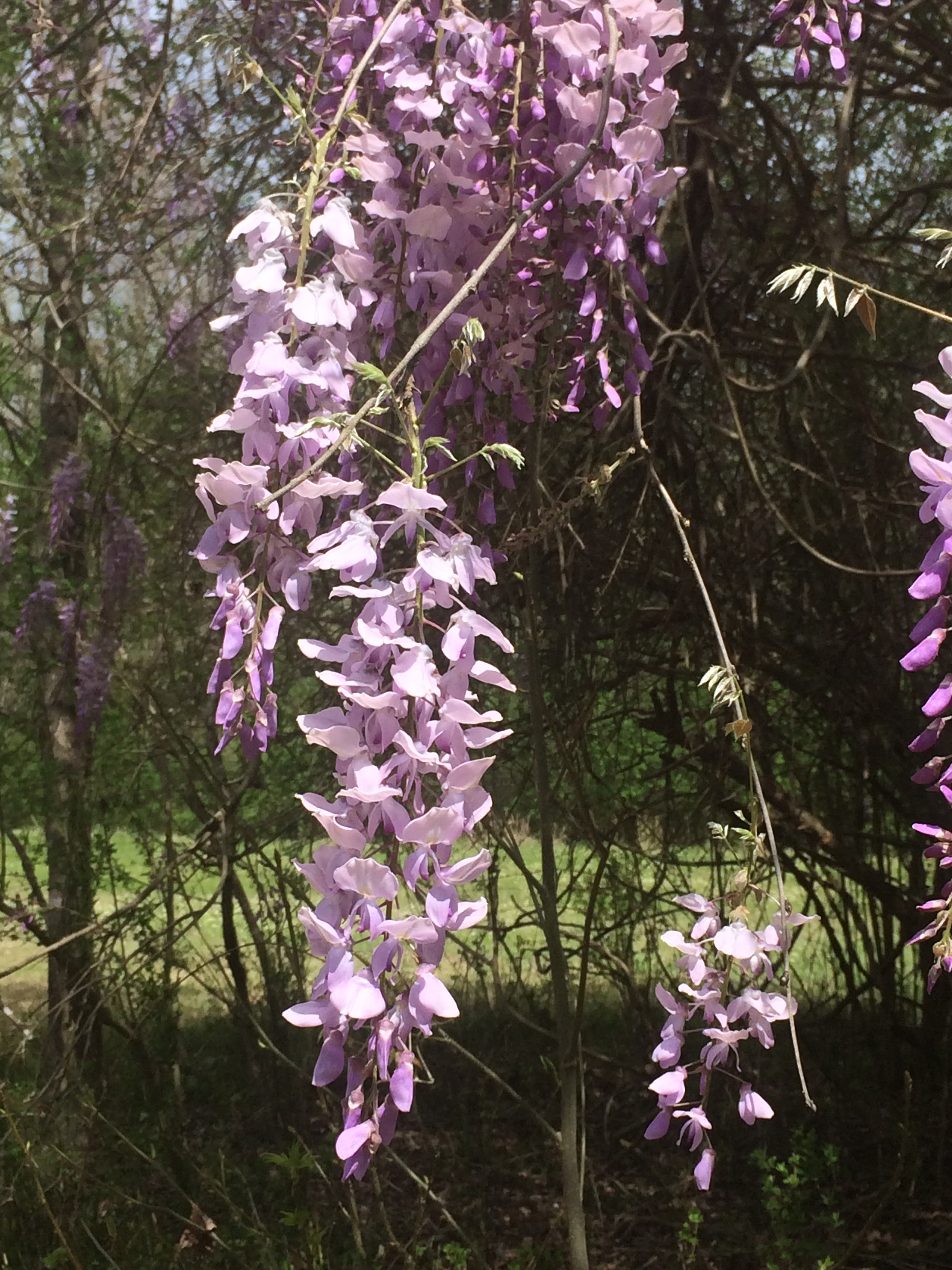
Multiflora rose certainly isn't the only attractive invasive plant that often appears innocuous.  Two of the most widespread introduced legume species in the U.S. are Chinese and Japanese wisteria (Wisteria sinensis and W. floribunda, respectively).  Because these species can and do hybridize in the wild (rather like the red and black imported fire ant species), identification is often difficult.  Both species have long, compound leaves and clusters of purple or white flowers.  Given the toxicity of wisteria's fruits, native wildlife species are almost certainly not helping these plants to spread.  Instead, wisteria's quick growth and tendency to strangle and shade out native vegetation provide the explanation for its range expansion after its introduction to the U.S. in the early 19th century (1816 for Chinese wisteria, and about 1830 for the Japanese wisteria).  According to the Mississippi State University Extension Service, wisteria control is extremely difficult.

Wisteria flowers

Wisteria growing over another invasive: privet.

I put kudzu at the top of this list for a reason, but I also find Japanese honeysuckle (Lonicera japonica) to be a fairly horrifying invasive climbing plant.  Like all of the plants discussed thus far, Japanese honeysuckle was imported (in 1806) as an ornamental.  It has attractive and fragrant blossoms, and many people have fond childhood memories of sucking the nectar from these blooms.  Like wisteria, however, Japanese honeysuckle's thick, woody stems quickly strangle native vegetationand, as with kudzu, biological control doesn't work.  In fact, there is no available biological control for Japanese honeysuckle.

Japanese honeysuckle flowers

Because of the limited ecological benefits and the difficulty of controlling Japanese honeysuckle, the Mississippi Forestry Commission recommends planting several native vines, insteadincluding crossvine, coral honeysuckle, and Virginia creeper.  That site and others, such as the Mississippi State University Extension Service, are well worth perusing for detailed information about native trees, shrubs, vines, and herbaceous plants.  Although complete eradication of kudzu, multiflora rose, wisteria, Japanese honeysuckle, and other long-established invasives is almost certainly a pipe dream at this point, there are still plenty of options for keeping them at bay, and native gardening is one of the many methods.  Natural ecosystems will thank you.

Thursday, August 31, 2023

Fall Bird Identification Quiz, Part III

With September starting and fall bird migration really picking up, it's time for another bird quiz.

1.  This first bird is probably fairly easy to guess: one of the fiercest avian species during the nesting season!

2.  These are usually found near large bodies of water.

3.  Unfortunately for birders, this common migrant's name isn't always very descriptive.

4.  The same is true of this next one!

5.  These birds are more common in open habitats than in woods.

6.  By mid-September, most of these birds will have migrated out of the southeastern United States.


Answers:

1.  A member of the tyrant flycatcher family, the Eastern Kingbird is known for its fierce defense of its territory and nest during the breeding season.  I have seen these birds chase Red-tailed Hawks on numerous occasions, and they seem to have little fear of people, as well.  Their monochromatic color scheme is striking and distinctive, with the dark gray back and wings, black hood, and white-tipped tail.

2.  These large and brightly colored ducks are Black-bellied Whistling-Ducks, which expanded their range to portions of eastern Mississippi in the last decade.  The rest of their range includes western and southern Mississippi, Louisiana, Texas, Central America, and Florida.  They have a high, wheezy whistling call and bright black-and-white wings that stand out in the murky swamps and marshes that they call home.

3.  It's a worm-eating warbler!  Well, a caterpillar-eating warbler, anyway.  It isn't actually a Worm-eating Warbler (and that name refers to caterpillars, too), but a Black-throated Green Warbler.  The trouble with a lot of birds' common names is that they are appropriate only for certain times of year, or for certain sexes or ages.  Breeding adult male Black-throated Green Warblers have the signature solid black throats, but nonbreeding males, adult females, and all immature birds have far fewer black feathers in that area.  The olive-colored back is noticeable even during the fall, though, and the white wing bars, yellow cheek patches, and black streaks on the flanks should make identification fairly straightforward even in the fall.  

Black-throated Green Warblers usually nest in boreal forests, so the farthest south that they will go during the breeding season is the southern Appalachians, where that habitat type exists at high elevations.  In the fall, they are one of the most commonly seen migratory warblers in the Southeast.

4.  While the Black-throated Green Warbler can feel slightly misnamed at times, the Magnolia Warbler's name is downright weird.  Like the Black-throated Green Warbler, the Magnolia Warbler breeds in the boreal forests of Canada and the northeastern United States.  It usually doesn't have much to do with magnolia trees, but because it was discovered in magnolias by the ornithologist Alexander Wilson, the name has stuck.  To be fair to Wilson, this warbler is perhaps one of the least discriminating species during migration, showing up in a wide variety of wooded habitats.  The yellow breast, black streaks, white wing bars, and gray crown are all present in fall plumage, but one of the most obvious field marks is the two-toned tail.  When the tail feathers are spread, as they are in the photo, the white bars can be clearly seen.  When they are closed, the tail appears half white and half black from below.

5.  It may be unfair for me to use this photo, given that there are two species in it!  The birds on the left are male Brown-headed Cowbirds, which look about the same in the fall as they do in the breeding season.  Due to cowbirds' habit of parasitizing other songbirds' nests, most birders aren't particularly thrilled to see them.  Still, this isn't the cowbirds' fault: Human activity has been the driving factor behind their range expansion and population growth.  Cowbirds have a short, pleasant, liquid warble of a song, which can be heard in fields and thickets during the nesting season.

The bird on the right is another frequently reviled species: the European Starling.  Starlings were intentionally released in North America in the late nineteenth century, and they have had no trouble adapting to the environment here!  Depressingly, though, they are not holding on as well in their native range.  During the breeding season, starlings have dark, glossy, iridescent plumage and yellow bills.  In the fall and winter, they become slightly drab, with heavy white speckling and dark bills (as you can see in the photo).  They are known for forming enormous flocks for predator evasion, and for their variety of vocalizations.

6.  Although they nest in hardwood forests along streams and rivers, Mississippi Kites often forage in large flocks over fields and meadows during the late summer and early fall, just before they leave their breeding grounds in the southern and central U.S. for their wintering grounds in South America.  The long, slender wings; slightly forked tail; and overall grayish plumage are distinctive field marks.  This species often gives a two-note, whistled call as it flies.  

Monday, July 31, 2023

Sights of Summer

It has been a hectic and strange summer, as well as a hot one.  I've been getting out whenever I can, and, fortunately, there are always plenty of interesting birds and other wildlife to see.  Here are some sightings from the last few months!

Sanderlings generally depart from their wintering grounds for the Arctic by the end of spring, and that was technically still the season when I saw this bird foraging along the shore.  If you compare the plumage of this bird to Sanderlings in some of my other posts, you’ll see how much richer and redder it is: breeding plumage.

Sanderling

Ruddy Turnstones easily beat it in flashiness, though: caramel brown, black, and white.  A palette like turtle ice cream, maybe, but it stands out against the beige and gray of the sand and mud.

Ruddy Turnstone

A lone Reddish Egret has a fierce appearance, which befits its predatory nature.  Imagine being a fish and that yellow eye being one of the last things you see before going down the egret's gullet!  

Reddish Egret

Although far from rare, the Gull-billed Tern is generally one of the less commonly seen resident tern species around here.  It has a distinctively thick, black bill and narrow, pale wings.  This one went through an entire preening session as I watched it.

Gull-billed Tern


Avian migration seems never to end on the coast, and it could be argued that it truly doesn't.  Even in late June, the middle of summer for the Southeast, it's not uncommon to find migratory shorebirds, such as the boldy patterned American Avocets.  These three individuals appeared to be striking poses against the waves as the sun set that evening.

American Avocets

Of course, beaches attract more than just seashore species.  Eurasian Collared-Doves drop down on occasion to scavenge what they can from the sand and debris.

Eurasian Collared-Doves

Fish Crows are far better adapted to wetland habitats than the Collared-Doves are, so it's less of a surprise to see them walking there.  This individual crow examined the seashore debris closely and methodically before flying back in the direction of the city.

Fish Crow

Away from the shore, in the brackish bayous and marshes, a different species community exists.  This is where I sometimes hear and see secretive Clapper Rails.  This one had temporarily left the dense cover of the marsh grasses to wade in the shallows in a small clearing.

Clapper Rail

The usual wariness of these birds (and many other animals in the area) makes sense when you consider the predators that they need to evade in order to eke out a living in their marshy home.  This means that the alligators, too, have to operate through stealth.  When summer is over and late autumn's cooler weather eventually rolls in (if it ever does), these gators may become dormant, emerging only on warmer days.

American alligator

Regardless of the weather, it's a joy to be out in nature.  Hopefully, the conditions will improve a bit as we transition into August.

Friday, June 30, 2023

Painted Bunting Plumages

Painted Buntings—small, colorful neotropical songbirds—are fairly familiar sights in some portions of the southern United States during the spring and summer.  Although they’re not as abundant in most of these regions as the Indigo Bunting (they outnumber Indigo Buntings in Texas and New Mexico), they still occur in decent numbers.  If you’ve seen Painted Buntings, you are probably most familiar with the adult males, whose vibrant plumage and habit of singing from high perches make them more noticeable than females and immature males.  The typical male Painted Bunting has a blue-violet head, a grass-green back, green wings, and red underparts.

Adult male Painted Bunting

Adult male Painted Bunting -- the head looks purple in the sun.

While adult males may be more obvious, you can also frequently observe females and immature males—if you know what to look for!  Like the males, female Painted Buntings can be attracted to bird feeders, and you can also sometimes see them foraging in vegetation when they’re away from the nest.  They do tend to be more secretive than males, though.  Their plumage is essentially all-over leaf green, which makes them cryptic but also unusual for North American songbirds.

Female Painted Bunting

Adult and immature females look similar, but it might come as a surprise that immature males are also green all over.  Painted Bunting males take two years to achieve their iconic red, green, and blue plumage—a strategy called delayed plumage maturation.  Immature males sometimes manage to breed, but because older males tend to outcompete them for high-quality territories, their breeding success is usually lower.  However, spending this “gap year” to learn how things are done may benefit male Painted Buntings.  In any case, if you see a green Painted Bunting singing, you can be pretty sure that it’s a younger male, probably still learning the ropes.

Singing immature male Painted Bunting

It’s important to note that not all Painted Buntings exhibit textbook plumage patterns.  This male that I saw several years ago in Arkansas had a yellow band across his breast.  He was singing in a stretch of scrubby woods near a river.

Adult male Painted Bunting

The male in the next photo had more of an orange breast than a red one.  It’s possible that he did not consume enough carotenoids during the molting process, although he looks pretty healthy in other ways.  If you’re living somewhere within the Painted Bunting breeding range, be sure to watch for these colorful birds this summer, and make note of any interesting plumages and behaviors that you notice!

Adult male Painted Bunting

Wednesday, May 31, 2023

Reporting from the Coast

How about a nice, long walk?  I find that strolling up and down a stretch of seashore helps me to decompress.  Any time of the year can be good, but springtime is surely one of the most interesting seasons for avian life—especially on the Mississippi coast.

It is late afternoon.  A lone Reddish Egret stalks fish in the cobalt waters.  Its blue-gray body—with touches of white—and rust-colored head and neck echo the tints of the waves.  Found almost exclusively in coastal regions, this species occurs in a white form as well as the more familiar “reddish” morph.  This individual appears almost stately—perhaps it is wary of beach walkers—but Reddish Egrets are frequently very lively foragers, darting back and forth and flicking their wings outward to startle their prey. 

Reddish Egret
The egret isn’t the only wading bird braving the waves: a trio of Marbled Godwits—migratory transients on the Gulf Coast—also feeds in the surf.  They’ll likely have moved on, northward, in a month or two.

Marbled Godwits
The same cannot be said for the ubiquitous Laughing Gulls.  These coastal residents remain here all year long, and are as opportunistic as they are common.  Many people view Laughing Gulls as nothing more than nuisances, but I think this is an unfair assessment of these long-lived and clever birds.  Like crows, raccoons, and black bears, they have figured out how to exploit human resources, and we hate them for it!  I don’t think the gulls are too concerned about this, however.
Laughing Gulls
The Reddish Egret from earlier paces in front of the group of gulls.  Are the pickings better over this way?  Maybe, maybe not.

Reddish Egret and Laughing Gulls
A Snowy Egret shows up to survey the surf for small fish.  As you can probably tell from the photo, this species is considerably smaller than the Reddish Egret.  Like its larger relative, it often displays a particularly active foraging style, with lots of “dancing” in and out of the waves.  The larger wading birds, such as Great Blue Herons and Great Egrets, tend to be more sedate in their hunting behavior.  This Snowy, however, mostly stands still and makes itself compact, probably as protection from the wind.
Snowy Egret and Laughing Gulls
Farther up the beach, a Ruddy Turnstone turns over … not a stone, but a leaf.  What is it finding in the sand?  Tiny insects?  Possibly so—this is a fairly opportunistic hunter.  Like the Marbled Godwit, it’s a species that breeds farther north.  It will probably migrate soon, but, in the meantime, it frequents the beaches with other migratory shorebirds, flashing its stunning black-and-white wing patterns whenever it flies up the shoreline in search of prey.
Ruddy Turnstone
Tire tracks show where someone has driven an ATV up the beach.  Laughing Gulls, Black Skimmers, and a few Sanderlings congregate just past these markings, while Dunlin rest closer to the dunes.  They remind me of cattle, with their (tucked-in) heads all turned in the same direction. 
Beach birds

Laughing Gulls and Sanderling

Dunlin
A close-up of snoozing Dunlin reveals subtle markings, which would help to camouflage these birds in the sand and mud.

Dunlin markings
Other migratory shorebird species on the beach sands are Black-bellied Plovers and Willets.  The plovers are still mostly in drab winter plumage, but they’re showing signs of molting into breeding plumage, in which they will have black bellies.  The Willets are similarly dull and gray, since they haven’t finished molting into their barred-and-mottled breeding plumage.  Willets are common all over the beaches at this time of year.
Black-bellied Plovers and Sanderlings

Black-bellied Plover and Dunlin

Willets and Laughing Gull
Rounding out the beach bird community are Black Skimmers.  It’s still early enough in the day that these crepuscular birds probably haven't made too many trips away from the shore.  They will head out in larger numbers closer to evening, when they fly low over the water and drag their ultra-long, red-and-black bills along the surface to find fish to snap up.  Right now, resting along the beach, they look a bit odd and awkward, propped up on their stumpy legs and with their colossal bills slanting downward.  At evening, however, their unusual adaptations will serve them well, making them highly efficient hunters.
Black Skimmers, Laughing Gulls, and Dunlin
For a diurnal mammal like me, though, it’s about time to turn in for the night.  Since this is spring, coming back to the beach later will likely mean reporting on a slightly different group of birds—a unique mixture of resident species and transients—as migration continues.

Sunday, April 30, 2023

Blue Birds

Henry David Thoreau wrote that the bluebird “carries the sky on his back.”  Although this poetic description referred to the Eastern Bluebird, the meaning could just as easily be applied to two other commonly seen, predominately blue birds that are found throughout the southeast.  The trio of common “blue birds” in Mississippi includes the Indigo Bunting (Passerina cyanea), the Blue Grosbeak (Guiraca caerulea), and, of course, the familiar Eastern Bluebird (Sialia sialis). 

If any of these three birds has a claim to the distinction of carrying the sky in its plumage, it’s the Indigo Bunting—the male of this species can seem to change hues as quickly as the spring sky can fade from clear blue to a duller gray over the course of an afternoon.  Although any blue coloration present in feathers is the result of light reflecting off of the structure of the barbules, the Indigo Bunting’s appearance is especially changeable.  The reason for this is that the feathers are iridescent, catching different amounts of sunlight to appear any shade from blue-black to bright turquoise.  In contrast to the male, the female Indigo Bunting is a much subtler brown, with hints of blue in the wings; this more subdued coloration helps camouflage her at the nest, which is generally placed in a small tree or shrub.  In fact, thickets, woodland edges, and overgrown fields are the favorite environments of this sparrow-sized member of the cardinal family, and, like cardinals, it will come to backyard bird feeders for sunflower seeds and white millet.  Its relatively thick, stout bill aids it in cracking hard seeds, but, like many birds, it also feeds on insects.  During the spring and summer, the excited, up-and-down warbling song of the male bunting cues observers in on its presence—helpful, considering how difficult it can be to catch a glimpse of the vibrant blue bird when it is hidden in vegetation.

Singing male Indigo Bunting in the sunlight.

Male Indigo Bunting on an overcast day.

Female Indigo Bunting

The Indigo Bunting’s larger cousin, the Blue Grosbeak, lacks the eye-catching iridescence of the bunting, but it is also a stunning bird.  The plumage of the male grosbeak is a deep, royal blue with brown bars on the wings and a black “mask.”  For the same reason as the female Indigo Bunting, the female grosbeak is more cryptically colored: brownish gray, with a touch of gray-blue on the wings.  “Grosbeaks” are aptly named—their dark-colored, conical beaks are very stout and large, and point to their relationship with the well-known Northern Cardinal, which also has a large bill.  They can be found in the same habitats as the Indigo Bunting, but usually in much smaller numbers.  However, in spring and summer, it is not uncommon to see these striking birds helping themselves to feeder offerings, bringing delight to observers who realize that their backyard visitors are not simply oversized Indigo Buntings.  Once learned, the song of the Blue Grosbeak is quite different from that of the Indigo Bunting; it is a series of throaty, rolling warbles that befit this larger, less hyperactive bird.  Blue Grosbeaks may be less jumpy than their smaller cousins, but anyone who has seen the males battling for territory in the springtime, chasing each other through the underbrush, knows that they are far from lethargic!

Male Blue Grosbeak

Female Blue Grosbeak carrying nesting material!

Nearly everyone has heard of or seen the bluebird, known to some as the “bird of happiness.”   Unlike the other two “blue birds,” though, the Eastern Bluebird—washed with vibrant blue on the back—has a rust-colored breast fading into a white belly.  Female bluebirds have a similar pattern, but with more subdued coloring.  The contrasting palette of colors makes this species difficult to confuse with anything else, and the song—a short, lilting warble—is a familiar sound in rural areas.  Open woodlots, abandoned fields, and pastures all provide habitat for Eastern Bluebirds, which nest in rotting posts, snags, and the bluebird nest boxes constructed especially for them.  Bluebirds’ diet consists mostly of insects and berries that they find in their natural habitat, although they will also occasionally come to backyard feeders for suet, mealworms, and fruit.  Unlike the Indigo Bunting and Blue Grosbeak, the Eastern Bluebird is a member of the thrush family, which includes such familiar birds as the American Robin and Wood Thrush.  Because bluebirds—like robins—lack spots on their breasts, they do not greatly resemble thrushes at first glance; however, their slim, slightly curved bills, upright posture when perching, and tendency to flutter their wings all point to this relationship.  Interestingly, bluebird young look far more like their thrush relatives.  They have streaked and speckled brown plumage, with blue only in the wings and tail. 

Male Eastern Bluebird

As for seasonal occurrence, the Eastern Bluebird can be found year-round in the state, and the Blue Grosbeak and Indigo Bunting are present during the breeding season.  In a way, we are fortunate that these three “blue birds” are common and widespread across the southeast.  About thirty years ago, Eastern Bluebird populations were declining due to loss of nesting cavities and competition with invasive European Starlings and House Sparrows.  Concern over the bluebird’s plight led many people to construct nest boxes for them, which helped increase the population to a healthy level today.  The Blue Grosbeak is also doing fairly well—it has even expanded its range northward in recent years.  The Indigo Bunting is declining across many areas of its breeding range due to habitat changes, but it seems to be maintaining relatively healthy populations regardless of this fact.  Because it does not use heavily forested habitats, the bunting has fared better than many songbirds, but both it and the grosbeak are at risk from destruction of habitat on their wintering grounds in Central and South America.  Hopefully, measures taken to prevent habitat destruction in both North and South America will ensure that these three species of “blue birds” continue to thrive, bringing welcome touches of sky to the earthly environments that they inhabit.

Friday, March 31, 2023

Hiking

I love the woods.  I am exhilarated to be there in the middle of spring, with the rustle of the trees in the wind and the uneven feel of the ground under my feet.  I walk along paths that twist and turn, while the fresh vegetation brushes against my legs.  I enjoy the warm, loamy soil, the pungent aroma of decaying leaf litter, and the way the sunlight breaks through the canopy and falls in patches on the forest floor.  As I walk, I watch for the tiny, dusty toads that seem to pop out of the soil and the flash of a spring azure butterfly’s lavender wings when I disturb the insect from its spot on the path.  Sometimes I even glimpse a blue-tailed skink’s bright scales as the lizard scuttles into the piles of dead leaves from last winter.

I love the surprise of coming upon a narrow, meandering creek in the middle of the woods.  I watch the sun gleaming on the surface of the water, the revolving bands of whirligig beetles, and the skitter of water striders.  The sounds of the birds in the woods catch my attention, as does the sight of a golden yellow Prothonotary Warbler materializing like a speck of sunshine from the darkness of the trees.  I love hearing the shrill cry of a hawk overhead and the thrill of spotting an owl awake and perched on a branch in the middle of the afternoon.  The owl stares back at me with a wide-eyed gaze and startles away, taking off through the forest with silent beats of its mottled wings.

I love the smell of sap from the pine trees, the feel of the corky bark on the sweet gum twigs, and the rasping calls of the gray treefrogs.  My calf muscles ache and my breaths become a little shorter as I ascend a small slope.  I am in my element.  The rush and frenzy of the rest of the world seems to fall away, replaced by the chatter of birds in the undergrowth along the sides of the path, the squirrels barking from the branches far overhead, and the glimpse of a large saturniid moth that is resting in the shadows.  Sometimes I find ticks clinging to the inside of my socks and mosquito bites that I never noticed earlier.  I relax back into civilization, wishing that I could go outdoors and experience it all over again.

Polyphemus moth