Sunday, December 31, 2023

Waterfowl Identification in the Winter

This is a repeat from several years ago.  Enjoy!

Winter is here.  The landscapes are bare of the lush greenery that cloaks them in summer, and the woodland birds—woodpeckers, waxwings, warblers, and sparrows—are constantly on the search for new sources of food in their altered homes.  Hawks, too, are taking advantage of the dining opportunities that winter brings, choosing a high vantage point as they do so, riding the breezes against a gray sky reflected on the calm water of a pond or lake nearby.

On these ponds and lakes, yet another group of wintering birds can be observed: ducks!  As they float about together, feeding on plants and small aquatic animals, they are much easier to see and identify than all those look-alike warblers and sparrows.

Or are they?

The vast majority of ducks are shy and skittish, and you’re lucky if you can creep up on them without provoking them to fly.  And some of the species that form large flocks on open water, such as scaup and Redheads, are often so far away when you spot them that you’re hard-pressed to locate any distinguishing details even with the aid of a spotting scope.  Ducks circling overhead in flight can also be elusive.  With these points in mind, let’s take a look at the ducks and duck-like birds of the southeastern U.S., and their identifying traits.

The most familiar species in the family Anatidae (which encompasses all of the world’s swans, geese, and ducks) are the dabbling ducks, in the genus Anas.  Species in this group feed directly on the surface of the water or just a few inches below it, tipping themselves forward to reach aquatic vegetation.  The Mallard is one of the most abundant and widespread dabblers, and can be seen in many wetland habitats.  The males are difficult to mistake, with their glossy green heads, rich brown breasts, and yellow bills.  Females are a mottled tawny brown with orange and black bills.  Both sexes have bright purplish-blue speculums (colored patches on the secondary feathers) bordered in white.  In addition, the Mallard is a very large duck, measuring 23 inches from tail to bill.

A similar species that was formerly common but is now in decline is the American Black Duck.  Both male and female Black Ducks look like darker versions of the female Mallard, but the male Black Duck’s bill is yellow, and the female’s is grayish.  Their speculums lack the bold white borders of the Mallards’.  The Gadwall, another duck resembling the female Mallard, is slightly smaller than its relative and has drabber feathers.  Males are mottled grayish-brown, with black tails and dark-gray bills.  Females are browner, and their bills are gray on top and have dull- orange sides.  The most distinctive field mark on this species is a small white patch on the wing, which stands out even at a great distance.

Wintering flocks of Mallards and Gadwalls often contain yet another species: the American Wigeon.  This duck is about 19 inches long and has a rounder build than these other dabbling ducks.  The males and females have brownish flanks, pale gray bills, and green speculums.  The male has green ear patches and a strikingly white forehead and cap.  The female’s head is stippled and has a tinge of olive.  

The Northern Pintail, like the Mallard, is a very large duck.  Slim and long-necked, it has sharp, pointed tail feathers, especially obvious on the male, who also has a dark brown head and a white breast.  His body is mostly light gray.  The female is mottled brown all over.  These ducks have shiny, dark gray bills.

Except for sharing the same genus, the two common species of teal in the eastern U.S. are not closely related.  They are both very small ducks, however, and have green speculums.  In addition to the green speculum, the Blue-winged Teal has periwinkle-blue wing coverts.  Both the male and the female are mostly mottled grayish-brown, but the male has a white crescent in front of the eye.  The Green-winged Teal female can be told from the female Blue-winged Teal by its browner coloration.  The male Green-winged Teal’s head is rich chestnut and green, its back and flanks are gray, and its breast is buff-colored with black speckles.  Blue-winged Teal are very common during migration, but they can be a bit difficult to find in inland areas during the winter.  Green-winged Teal may not be as abundant in the spring and fall, but they winter in these areas more frequently than their counterparts.

Blue-winged Teal
A more unusual dabbling duck is the Northern Shoveler, named for its exceptionally large, spatulate bill.  With these bills, shovelers are able to strain large amounts of mud for small invertebrates.  Sometimes called “spoonbill” or “smiling Mallard”, the male shoveler has a green head, white breast, and chestnut flanks.  Females are mottled brown, but, like the males, they have glossy green speculums.

Diving ducks, genus Aythya, forage mostly below the water’s surface.  They are often seen in huge flocks, or rafts.  They have heavy bodies and relatively short wings, so, unlike dabbling ducks, they must have a running start on the water in order to fly.  If individuals in a distant group of ducks periodically disappear and then pop up again, they are diving ducks.

Some of the most well-known members of this genus, Canvasbacks are large, robust ducks.  They have long black bills and sloping profiles.  The male has a chestnut head, black breast, and white back.  The female has a brown head and neck, and a pale brownish-gray back.  The Redhead is superficially similar to the Canvasback, but it is slightly smaller and has a shorter neck, shorter bill, and lacks the sloping profile of its relative.  Males have chestnut heads, black breasts, and gray backs.  Females are warm brown all over.  The bills of both sexes are tricolored: blue-gray, white, and black.

The white, sloping backs let you know immediately that these are Canvasbacks!  Ring-billed Gulls are in the background.
Probably the most common diving duck is the Ring-necked Duck.  Actually, it might have been better to have named it the Ring-billed Duck, as the thin chestnut ring on its neck is difficult to see, but the white-ringed black bill is obvious.  The male of this species has a dark, glossy head and breast, a black back, and gray sides.  A bright white line separates the black breast from the gray flanks.  The female is brownish overall with pale cheeks and a white eye-ring.

Ring-necked Ducks
There are two species of scaup in North America: the Greater and the Lesser.  If both species are next to each other, it may be possible to see a difference in size between them, but this is not a foolproof field mark.  Better identifying features are the more rounded head shape of Greater Scaup (Lesser Scaup have a slight point at the crown) and the higher amount of white in the Greater Scaups’ wings.  A male scaup of either species will have a dark head and breast, very pale gray flanks, and a gray back.  A female is brown, with a white patch at the base of the bill.  The bill in both sexes is gray.

A group of waterfowl collectively known as Sea Ducks includes scoters, goldeneyes, and buffleheads.  Buffleheads, closely related to goldeneyes, are the only common members of this group where I live.  These tiny ducks, just 13 inches in length, have large, round heads, small bills, and bob about on open lakes.  The male’s black head has a large, white wedge-shaped patch, and his underparts are white.  The female is grayer, with a dark brown head and a white ear patch.  Another small duck that is often seen on large ponds and lakes is the Ruddy Duck, in the group Stiff-tailed Ducks.  This species has a broad bill that on the breeding male is bright blue.  In winter birds, however, the beak is gray.  These ducks have buff-colored underparts, dark brown wings and caps, and the males have white cheeks. 

Mergansers are another set of waterfowl.  The Common Merganser, a very large, mostly pale duck with a dark head and red bill, is actually uncommon to rare in the southeastern U.S. in the winter.  Our most abundant merganser is the Hooded, a medium-sized duck with a thin, serrated bill used in catching fish and crustaceans, and possessing a somewhat bizarre appearance.  The male has rufous sides, a white breast, and a fan-like crest with a large white patch in the center.  His mate is brown with a white wing patch, and a smaller tuft of brown feathers on her head.  This duck occurs in both open and wooded areas, and nests regularly in the Southeast.

The Wood Duck also breeds in the south and is sometimes seen in winter flocks with the Hooded Merganser.  Most birders are familiar with the colorful plumage of the male Wood Duck, and the subtle brown feathering and white eye-ring of the female.  When a group of Wood Ducks is disturbed, they will often fly off with distinctive oooeeek! calls. 

Swans are rare in our area, but geese are nearly always common.  The ubiquitous Canada Goose is well-known to nearly all birders.  Stocky white Snow Geese are also present, providing opportunities to search for their smaller, rarer cousin, the Ross’s Goose.  And, if you’re on the lookout for waterfowl, you may also spot Greater White-fronted Geese mingling with Canada and Snow Geese, or perhaps foraging on their own.  Their brown necks and orange bills are distinctive.

There are also duck look-alikes, such as grebes and coots, both of which have lobed, not webbed feet.  The little Pied-billed Grebe usually swims alone or in small groups.  It frequently submerges itself in the water, only to pop up again several feet from where it dived.  American Coots are very duck-like in their habits, although they are related to rails and gallinules.  Their stocky gray bodies and chicken-like white bills are noticeable even from a great distance.

When you’re out birding this winter, be sure to witness the fascinating behaviors of the ducks, geese, and other waterbirds that are taking up residence.  With their myriad forms and patterns, they bring striking color and vibrant action to our cloudy, gray landscapes.

Ring-necked Ducks and Green-winged Teal

Thursday, November 30, 2023

Unfamiliar Flora

The region where I live boasts such a wide array of plant species that I would never assume I can recognize all of them; knowing the most common ones in a variety of habitats is a goal I’m working toward, though.  Still, it seems that every time I think I have familiarized myself with at least the basics, I’m confronted with something different!  The learning process continues.

Recently, the new-to-me species that is far more abundant than I would have assumed is the Japanese climbing fern.  If I had thought of this species before writing my post on invasive vines, I certainly would have included it, so consider this post an addendum of sorts (of which there may be many more, in the future).  I first noticed this plant while I was taking a walk at a local park; the fern’s small fronds, with their fringed lobes, stretched out from the tree trunk that they clambered over.  I knew that this was a species I didn’t recognize, and I had a strong feeling that it was probably an invasive.  The iNaturalist app confirmed my suspicions.

Japanese climbing fern
It’s an attractive plant, but it tends to grow very rapidly, shading out small trees and recovering quickly after fires.  I doubt that many people are considering planting this one in their gardens, but it’s not worth the ecological risks.

I came upon another aesthetically pleasing invasive plant on a visit to the East Coast area earlier this fall.  The lobed, toothed leaves and small, round fruits initially made me think of a species of grape or muscadine, but the oddly vivid, jellybean colors of the berries didn’t seem quite right.  After a bit of Internet research (with the help of iNaturalist), I identified the plant as a porcelain berry, also known as Amur peppervine.  The species is part of the family Vitaceae, which includes the genus Vitus (grapes), although it’s actually in the genus Ampelopsis.  Fortunately for people in the southeastern parts of the U.S., this plant doesn’t appear to have invaded that region.

Porcelain berry
Muscadine, a native, for comparison’s sake

Not all of my recent plant “discoveries” have been of the invasive variety.  I was pleasantly surprised to find that beach morning glory (Ipomoea imperati), a species I saw for the first time on Dauphin Island, is a native vine in the Gulf Coast region.  Along with sea oats and other native beach plants, it functions as a stabilizer of the sand dunes.  Like other morning glories, it has striking, trumpet-shaped flowers.  Finding these as you’re walking along a natural beach is about as enjoyable an experience as coming upon an unusual shell at the shoreline.
Beach morning glory

As fall transitions into winter, I will continue to watch for interesting, unfamiliar plant species in the areas I regularly visit.  Finding “new” plants and putting them into the context of ecosystems (for good or for bad reasons) is like piecing together a complex puzzle, and there will always be more to learn!

Tuesday, October 31, 2023

Coastal Birds Quiz

Let's have a look at some avian species from the coastal regions!  All of these birds are fairly commonly found on the U.S. Gulf Coast, but, with the exception of one species, they are also pretty common along the East Coast. 

1.  As always, I like to start with something slightly easier.  This species often lurks in marsh grasses during the day.

2.  This bird migrates through the area, but it isn't typically a resident.

3.  Marshes, beaches, and mudflats attract this species.

4.  This tiny bird is typically seen skittering over the beach or along the water's edge.


Answers:

1.  The signature yellow crown of the adult Yellow-crowned Night-Heron is not present in juvenile and immature birds, like this individual.  Young Yellow-crowned Night-Herons strongly resemble immature Black-crowned Night-Herons, but their longer legs, dark bills (unlike the mostly yellow bills of Black-crowneds), finer patterning, and slimmer builds help to distinguish them.  As I mentioned above, they usually skulk -- and roost -- in the marshes in the daytime.  At night, they will often hunt in more open areas for the invertebrates and fish that make up most of their diet.

Yellow-crowned Night-Herons commonly occur all year long in parts of the Gulf Coast, and in coastal areas in Central and South America.  Along the Atlantic seaboard, they are usually found only in the breeding season.

2.  The tail feathers on this immature individual can't compare with the ridiculously long streamers that adult birds have.  Nonetheless, this is a Scissor-tailed Flycatcher!  When it takes off from its perch, the deep fork in the tail is more noticeable, and the yellow-orange feathers (which would be a deeper peach color on an adult) on the belly may catch the light.  The Scissor-tailed Flycatcher is more of a western species, but it can be found on the Gulf Coast (and occasionally the Eastern Coast, as well) during migration.  The open beaches and scrubby coastal vegetation of the region provide excellent substitutes for the fields and pastures that they use during the breeding season in the western-central U.S.

3.  This is one of the most commonly seen shorebirds in the Gulf and Atlantic Coast regions.  It also happens to be one of the larger ones, with long legs that enable it to wade in deeper water than most of its relatives.  In the spring and early summer, the Willet's plumage will be more heavily mottled, but plumage in the fall and winter is mostly gray.  Unlike the thin and lanky Greater Yellowlegs, the Willet has grayish legs and feet, as well as a moderately thick bill.  When it flies, the white stripes on its wings are visible, and it will usually give a shrill, piping call: willet!

4.  Named for the partial webbing between its toes, the Semipalmated Plover might be confusing at first glance, as there are several somewhat similar-looking plover species that inhabit coastal regions.  However, the Semipalmated Plover is darker than the Snowy Plover and the Piping Plover, and, unlike the Snowy Plover, it has a solid breast-band and yellowish legs.  The Wilson's Plover, another fairly common species, has gray legs and a thick, black bill.  Finally, the abundant and familiar Killdeer (also a plover!) has two breast bands and measures much larger than the Semipalmated Plover.  

Semipalmated Plovers breed in the far northern regions of North America and range widely in the winter on the coasts (both eastern and western) of North, Central, and South America.  During migration, they may be seen in a variety of wetland habitats.

Saturday, September 30, 2023

Vegetative Invaders, Part II

A while back, I wrote a piece about some of the common invasive shrubs and trees in my part of the southeastern United States.  The trouble with attempting to write concisely about nonnative plants in any geographic region is that there are so many species to cover.  For example, in North America, many of the plants that we take for granted in our flower beds, gardens, and lawns were not present prior to colonization by Europeans; believe it or not, an unbroken expanse of uniformly green grass is not really natural, and common flowers such as Queen Anne’s lace were imported long ago.  The difference between a more typical naturalized plant species and an invasive is often a matter of degree, but it’s also fair to say that most people understand pretty intuitively which plants have gotten out of hand in their new home ranges.  In many cases, it's impossible to miss these invasives!

One of these out-of-control plants is so abundant in the southeastern U.S. that it has even had festivals created around it.  Kudzu (Pueraria montana) is a leafy, purple-flowered vine in the legume family.  Although it was originally imported to the U.S. (from Japan in 1876) as an ornamental, and was used for erosion control in the early 20th century, it has since become a noxious weed, infamous for covering entire landscapes and choking out native vegetation.  In ideal circumstances, it can grow up to a foot a day.  Controlling kudzu is difficult partly because of the stolons (or runners) that it produces, as well as rhizomes, or underground stems that produce roots and shoots; uprooting the plant so that it's incapable of forming new growth is next to impossible.  Herbicides can work if there is enough product to treat the many acres of ground that kudzu frequently smothers.

Kudzu creates odd, alien-looking landscapes.

Interestingly, one of the natural predators, the kudzu bug, was accidentally introduced into the U.S., with the first individuals recorded in Georgia in 2009.  However, because the kudzu bug tends to cause more damage to soybean crops than it does to kudzu, it can't be relied on as a biological control method.

Another invasive plant that can dramatically transform its environment is the multiflora rose (Rosa multiflora), a sometimes vinelike shrub that was introduced from Asia to the U.S. in the 1860sLike kudzu, it was widely used for erosion control, and it also shares the ability to form impenetrable thickets.  Its thorny stems can attain heights of 10 to 15 feet, and it has attractive flowers that have five white petals with blunt or slightly indented tips.  Herbicides are effective at controlling multiflora rose, but follow-up treatments must be consistently applied to prevent germination of seeds, which can lie dormant, ready to sprout at any time, for up to 20 years in the soil.  

Multiflora rose flowers

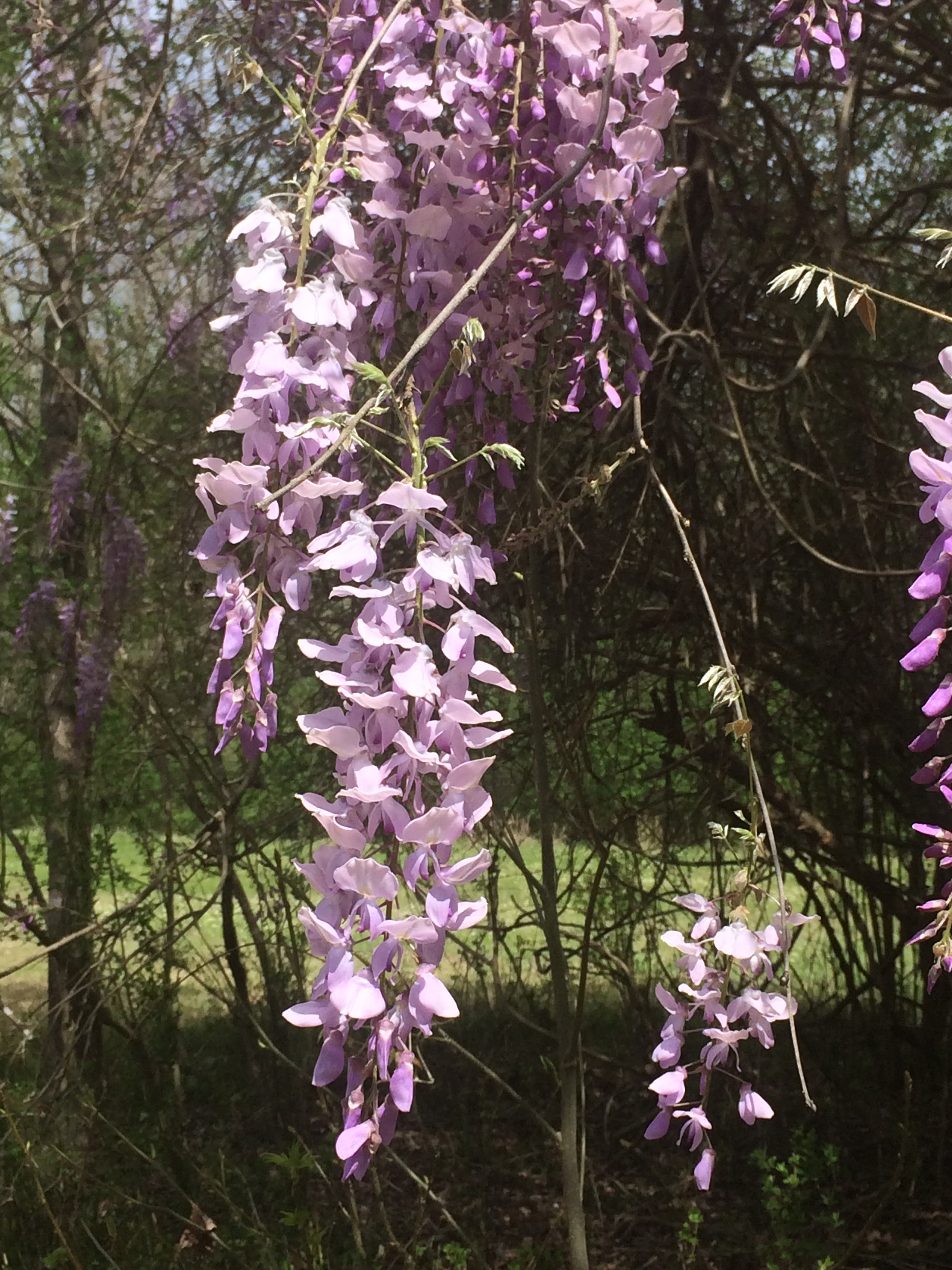
Multiflora rose certainly isn't the only attractive invasive plant that often appears innocuous.  Two of the most widespread introduced legume species in the U.S. are Chinese and Japanese wisteria (Wisteria sinensis and W. floribunda, respectively).  Because these species can and do hybridize in the wild (rather like the red and black imported fire ant species), identification is often difficult.  Both species have long, compound leaves and clusters of purple or white flowers.  Given the toxicity of wisteria's fruits, native wildlife species are almost certainly not helping these plants to spread.  Instead, wisteria's quick growth and tendency to strangle and shade out native vegetation provide the explanation for its range expansion after its introduction to the U.S. in the early 19th century (1816 for Chinese wisteria, and about 1830 for the Japanese wisteria).  According to the Mississippi State University Extension Service, wisteria control is extremely difficult.

Wisteria flowers

Wisteria growing over another invasive: privet.

I put kudzu at the top of this list for a reason, but I also find Japanese honeysuckle (Lonicera japonica) to be a fairly horrifying invasive climbing plant.  Like all of the plants discussed thus far, Japanese honeysuckle was imported (in 1806) as an ornamental.  It has attractive and fragrant blossoms, and many people have fond childhood memories of sucking the nectar from these blooms.  Like wisteria, however, Japanese honeysuckle's thick, woody stems quickly strangle native vegetationand, as with kudzu, biological control doesn't work.  In fact, there is no available biological control for Japanese honeysuckle.

Japanese honeysuckle flowers

Because of the limited ecological benefits and the difficulty of controlling Japanese honeysuckle, the Mississippi Forestry Commission recommends planting several native vines, insteadincluding crossvine, coral honeysuckle, and Virginia creeper.  That site and others, such as the Mississippi State University Extension Service, are well worth perusing for detailed information about native trees, shrubs, vines, and herbaceous plants.  Although complete eradication of kudzu, multiflora rose, wisteria, Japanese honeysuckle, and other long-established invasives is almost certainly a pipe dream at this point, there are still plenty of options for keeping them at bay, and native gardening is one of the many methods.  Natural ecosystems will thank you.

Thursday, August 31, 2023

Fall Bird Identification Quiz, Part III

With September starting and fall bird migration really picking up, it's time for another bird quiz.

1.  This first bird is probably fairly easy to guess: one of the fiercest avian species during the nesting season!

2.  These are usually found near large bodies of water.

3.  Unfortunately for birders, this common migrant's name isn't always very descriptive.

4.  The same is true of this next one!

5.  These birds are more common in open habitats than in woods.

6.  By mid-September, most of these birds will have migrated out of the southeastern United States.


Answers:

1.  A member of the tyrant flycatcher family, the Eastern Kingbird is known for its fierce defense of its territory and nest during the breeding season.  I have seen these birds chase Red-tailed Hawks on numerous occasions, and they seem to have little fear of people, as well.  Their monochromatic color scheme is striking and distinctive, with the dark gray back and wings, black hood, and white-tipped tail.

2.  These large and brightly colored ducks are Black-bellied Whistling-Ducks, which expanded their range to portions of eastern Mississippi in the last decade.  The rest of their range includes western and southern Mississippi, Louisiana, Texas, Central America, and Florida.  They have a high, wheezy whistling call and bright black-and-white wings that stand out in the murky swamps and marshes that they call home.

3.  It's a worm-eating warbler!  Well, a caterpillar-eating warbler, anyway.  It isn't actually a Worm-eating Warbler (and that name refers to caterpillars, too), but a Black-throated Green Warbler.  The trouble with a lot of birds' common names is that they are appropriate only for certain times of year, or for certain sexes or ages.  Breeding adult male Black-throated Green Warblers have the signature solid black throats, but nonbreeding males, adult females, and all immature birds have far fewer black feathers in that area.  The olive-colored back is noticeable even during the fall, though, and the white wing bars, yellow cheek patches, and black streaks on the flanks should make identification fairly straightforward even in the fall.  

Black-throated Green Warblers usually nest in boreal forests, so the farthest south that they will go during the breeding season is the southern Appalachians, where that habitat type exists at high elevations.  In the fall, they are one of the most commonly seen migratory warblers in the Southeast.

4.  While the Black-throated Green Warbler can feel slightly misnamed at times, the Magnolia Warbler's name is downright weird.  Like the Black-throated Green Warbler, the Magnolia Warbler breeds in the boreal forests of Canada and the northeastern United States.  It usually doesn't have much to do with magnolia trees, but because it was discovered in magnolias by the ornithologist Alexander Wilson, the name has stuck.  To be fair to Wilson, this warbler is perhaps one of the least discriminating species during migration, showing up in a wide variety of wooded habitats.  The yellow breast, black streaks, white wing bars, and gray crown are all present in fall plumage, but one of the most obvious field marks is the two-toned tail.  When the tail feathers are spread, as they are in the photo, the white bars can be clearly seen.  When they are closed, the tail appears half white and half black from below.

5.  It may be unfair for me to use this photo, given that there are two species in it!  The birds on the left are male Brown-headed Cowbirds, which look about the same in the fall as they do in the breeding season.  Due to cowbirds' habit of parasitizing other songbirds' nests, most birders aren't particularly thrilled to see them.  Still, this isn't the cowbirds' fault: Human activity has been the driving factor behind their range expansion and population growth.  Cowbirds have a short, pleasant, liquid warble of a song, which can be heard in fields and thickets during the nesting season.

The bird on the right is another frequently reviled species: the European Starling.  Starlings were intentionally released in North America in the late nineteenth century, and they have had no trouble adapting to the environment here!  Depressingly, though, they are not holding on as well in their native range.  During the breeding season, starlings have dark, glossy, iridescent plumage and yellow bills.  In the fall and winter, they become slightly drab, with heavy white speckling and dark bills (as you can see in the photo).  They are known for forming enormous flocks for predator evasion, and for their variety of vocalizations.

6.  Although they nest in hardwood forests along streams and rivers, Mississippi Kites often forage in large flocks over fields and meadows during the late summer and early fall, just before they leave their breeding grounds in the southern and central U.S. for their wintering grounds in South America.  The long, slender wings; slightly forked tail; and overall grayish plumage are distinctive field marks.  This species often gives a two-note, whistled call as it flies.  

Monday, July 31, 2023

Sights of Summer

It has been a hectic and strange summer, as well as a hot one.  I've been getting out whenever I can, and, fortunately, there are always plenty of interesting birds and other wildlife to see.  Here are some sightings from the last few months!

Sanderlings generally depart from their wintering grounds for the Arctic by the end of spring, and that was technically still the season when I saw this bird foraging along the shore.  If you compare the plumage of this bird to Sanderlings in some of my other posts, you’ll see how much richer and redder it is: breeding plumage.

Sanderling

Ruddy Turnstones easily beat it in flashiness, though: caramel brown, black, and white.  A palette like turtle ice cream, maybe, but it stands out against the beige and gray of the sand and mud.

Ruddy Turnstone

A lone Reddish Egret has a fierce appearance, which befits its predatory nature.  Imagine being a fish and that yellow eye being one of the last things you see before going down the egret's gullet!  

Reddish Egret

Although far from rare, the Gull-billed Tern is generally one of the less commonly seen resident tern species around here.  It has a distinctively thick, black bill and narrow, pale wings.  This one went through an entire preening session as I watched it.

Gull-billed Tern


Avian migration seems never to end on the coast, and it could be argued that it truly doesn't.  Even in late June, the middle of summer for the Southeast, it's not uncommon to find migratory shorebirds, such as the boldy patterned American Avocets.  These three individuals appeared to be striking poses against the waves as the sun set that evening.

American Avocets

Of course, beaches attract more than just seashore species.  Eurasian Collared-Doves drop down on occasion to scavenge what they can from the sand and debris.

Eurasian Collared-Doves

Fish Crows are far better adapted to wetland habitats than the Collared-Doves are, so it's less of a surprise to see them walking there.  This individual crow examined the seashore debris closely and methodically before flying back in the direction of the city.

Fish Crow

Away from the shore, in the brackish bayous and marshes, a different species community exists.  This is where I sometimes hear and see secretive Clapper Rails.  This one had temporarily left the dense cover of the marsh grasses to wade in the shallows in a small clearing.

Clapper Rail

The usual wariness of these birds (and many other animals in the area) makes sense when you consider the predators that they need to evade in order to eke out a living in their marshy home.  This means that the alligators, too, have to operate through stealth.  When summer is over and late autumn's cooler weather eventually rolls in (if it ever does), these gators may become dormant, emerging only on warmer days.

American alligator

Regardless of the weather, it's a joy to be out in nature.  Hopefully, the conditions will improve a bit as we transition into August.