Monday, September 30, 2019

The Value of Snags


One of the benefits of leaving large, dead trees standing is that they often become magnets for wildlife.  Their decaying bark and wood attract countless species of insects, which in turn become food for wild animals; they provide space for nesting and roosting; and hawks, owls, and flycatchers, among other species, use them as hunting perches.  I realize that sometimes these snags have to be removed, as they pose a danger to humans or to property, but if a dead tree stands in a place that isn’t inconvenient for people, I would argue that it’s better to leave it alone.  
Half-dead sugarberry tree
My observations of birds in and around snags in the neighborhood where I live bear this out.  Like most residential areas, my neighborhood has severely fragmented forest habitats, which aren’t ideal.  However, within those tiny woodlands, the ages of the trees vary widely, and there are some trees that have died.  Ecologically, this is a good thing!  If you have snags near your home, watch closely to see the variety of birds and other animals that use them.  For example, I often see a Mourning Dove perched atop one particularly large and prominent snag.  I don’t know whether this is always the same Mourning Dove, or whether several different individuals like to use this perch.  Woodpeckers, including the species Red-headed and Red-bellied, hammer on this tree, as well (juvenile Red-headed Woodpecker in the bottom photo).  
Mourning Dove
Red-headed Woodpecker

One rather exciting find for me this fall was a migrating Olive-sided Flycatcher foraging from this snag.  Although it isn’t exactly a rare bird, it is becoming scarcer, probably as a result of global climate change combined with habitat destruction on its wintering grounds in Central and South America.  Disturbingly, surveys show that populations have declined 79% since 1970.  
Olive-sided Flycatcher
The bird’s distinctive feeding style usually involves sitting at the top of a prominent perch and darting out to catch flying insects that pass by.  This neighborhood snag is tall enough to provide an excellent vantage point for flycatchers to survey a wide area, so while I was pleased to see an Olive-sided in it, I wasn’t really surprised.  The Olive-sided’s smaller and paler cousins, Eastern Wood-Pewees, also hunt from the snag—although less habitually.
Olive-sided Flycatcher (left) and Eastern Wood-Pewee (right)

The apex predators of the bird world, hawks and owls, use snags, as well.  Red-shouldered Hawks are the ones that I most commonly see around here, probably because of the creek that harbors the frogs, crayfish, and snakes that these lowland-loving hawks like to eat.  
Red-shouldered Hawk
Mississippi Kites left the neighborhood for their wintering territories in South America well over a month ago, but while they were here, they could be seen on occasion in the tops of the snags bordering the fields.  I sometimes see Red-tailed Hawks here, as well, and I am sure that Barred Owls and Great Horned Owls use these trees at night.
Mississippi Kite
Another of the dead or dying trees around here that I enjoy monitoring for wildlife is a moribund sugarberry.  It happens to be a prop for berry-producing vines, so wildlife can binge on those in addition to the sugarberries that grow on the living side of the tree.  I’ve seen many species of birds feeding on the fruit, including tanagers, orioles, bluebirds, mockingbirds, thrashers, vireos, and woodpeckers.  As you might guess, the tree also attracts lots of insects, so even non-frugivorous bird species—e.g., warblers and gnatcatchers—can find a buffet there.  And woodpeckers really seem to like its dead top branches for drumming and feeding.  Here’s a sampling of some of these birds:
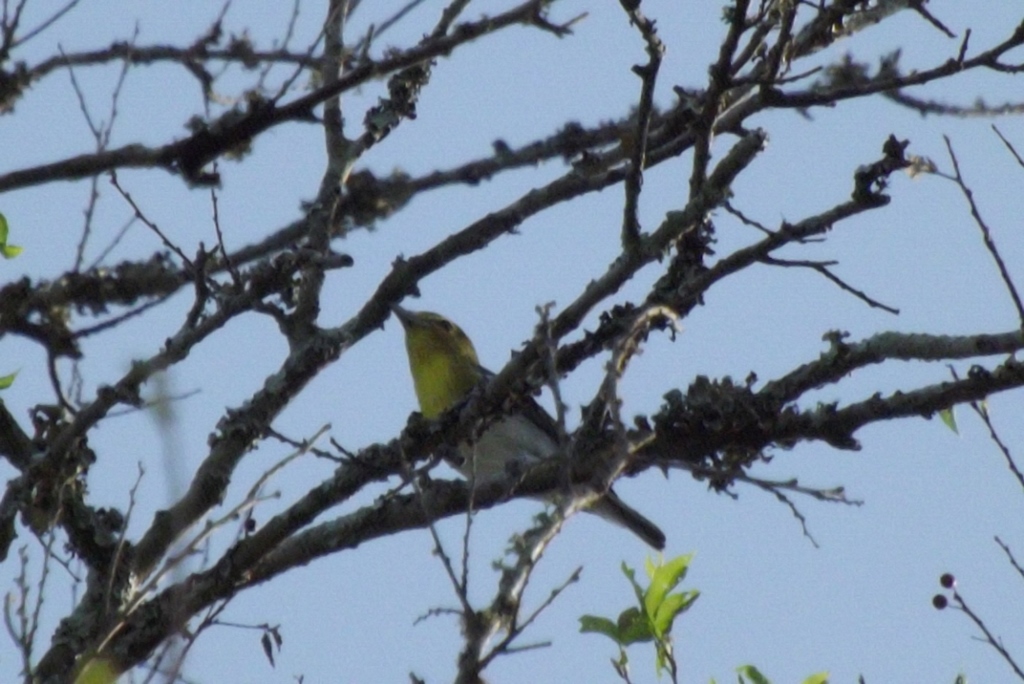
Yellow-throated Vireo inspecting dead branches
American Goldfinch
Baltimore Oriole
Since we're in the thick of bird migration right now, taking another look at snags is well worth the effort!

Friday, August 30, 2019

New Model Hummers


Hummingbirds buzz about, darting out with vicious energy, sparring with each other for possession of a port at the nectar feeders, which are filled to the brims with a hummer-enticing mix of sugar and water.  As is usual this time of year, the youngsters outnumber the adults.  Fresh out of the nests for only about three months, they are just being introduced to the hardships of migration, a task to which their elders have already proven themselves equal.  Not surprisingly, these young birds are persistent in their struggle to obtain energy.  Their being feisty is a survival instinct; their elders aren’t too likely to yield them a space at the feeder if they are not, and that could mean death for them over the coming days, when they begin their annual fall migration.

Ruby-throated Hummingbirds make several stops along their route through North America in preparation for their non-stop flight across the Gulf of Mexico, a seemingly astounding feat for such a diminutive animal.

In fact, one of these nectar-dispensers is already being dominated by an adult male Ruby-throated Hummingbird.  The only birds that have a good chance at this spot are the females, both young and old.  But let a young male hummingbird advance for a sip of nectar, and the adult male dashes out at him, asserting his dominance.  Sometimes, while this is happening, another immature hummingbird can sneak in to feed—but not for long.  Other hummingbirds burst in to claim the feeding port.

With careful observation a surprising number of the birds can be told apart; all of the first-year males have dark striations on their throats, and most of them are also developing iridescent red feathers: a single scarlet feather in the center of the throat, a few scattered ones, or even a whole patch of them around the auricular (ear) area.  I see one bird that fits into this last category; oddly, there is a patch of feathers on only one side of his head.  The female hummingbirds have paler streaking on their throats, and the immature hummingbirds have shorter bills.  One bird has a slight indentation on its throat: missing feathers, or a scar?  The way these creatures batter each other about, I’m inclined to think the latter.

The immature male with the asymmetrical feathering is back, fighting with the dominant male again.  The rest of the birds continue to squabble for food.  They surely must be getting enough to eat, judging by their plumpness.  Watching the first year birds, especially, is interesting.  They will be next year’s breeding birds, if they survive.  Only about twenty per cent of birds make it past their first year; many of them die during migration, and for these hummingbirds, a good store of fat is one of their most important assets.  Before migrating, they consume enough food to double their body weight: flower nectar, sugar water, insects, and sometimes even rotting fruit.  Still, since the weight gain is only around 3 grams or so, these hummers are very fuel-efficient.

Even their inherent toughness doesn’t always protect these young hummingbirds from the hazards of migration.  Although they are capable of a non-stop journey across the Gulf of Mexico (provided that they have good stores of energy), their route over land is a deadly obstacle course.  The lights on buildings and communication towers are a draw for birds migrating at night, and the birds often collide with the structures, killing themselves.  Windows pose a similar threat; birds see the reflections in window glass and fly right into it.  Predatory wild and domestic animals catch many birds during the migration season.  And severe weather—both on land and over the Gulf—also prevents many hummingbirds from reaching their destinations each spring and fall.  The young, inexperienced hummingbirds often fare the worst.  All in all, around 80% of them don’t survive their first migration.

The hummingbirds are still swarming around the sugar-water feeders as I leave my grandmother’s house.  I’ll be watching for them next year.